Strategies & Risk
Best Over Under Settings for Binary Bots (2026)
Use DIGITOVER 2 with a 5-tick duration and Multi Shot's Recovery to find the best over under settings for binary bots on Deriv.

Deploying an even odd strategy deriv bots execution on the Volatility 10 (1s) Index allows you to target 50/50 probability digit payouts with a fast 1-second tick speed. You automate contract entries on DIGITEVEN or DIGITODD contracts using a pre-set parameter stack, taking advantage of predictable execution speeds without needing to manually click tick after tick. If you want high trade density on low-volatility synthetic ticks, this asset-strategy pairing gives you the highest frequency per minute.
The Volatility 10 (1s) Index is a synthetic market created by Deriv that updates its spot price exactly once every second with a low baseline volatility of 10%. It suits automated traders who want high contract frequency on DIGITEVEN and DIGITODD trades without facing violent price swings. Running an even odd strategy deriv bots configuration on this specific index lets you maintain rapid trade cycles while keeping your overall session pace strictly controlled.
Deriv generates the Volatility 10 (1s) Index using a cryptographic random number generator that outputs a fresh tick every second. The "10" in its name represents an annualized volatility of 10%, meaning price fluctuations remain tight compared to high-volatility indices. When you trade digit contracts, the actual price movement direction doesn't dictate your win or loss. What matters is the final decimal place of the tick price.
Every single tick yields a last digit between 0 and 9. Statistically, five of those digits are even (0, 2, 4, 6, 8) and five are odd (1, 3, 5, 7, 9). That gives DIGITEVEN and DIGITODD contracts an identical base mathematical probability of 50% per tick, paying out slightly under 100% net profit due to the broker's built-in house margin.
Crucially, each tick is statistically independent. A string of seven even digits in a row doesn't mean an odd digit is due next. The random engine doesn't remember past ticks. When binary bots execute trades on this market, they connect directly to Deriv over their official API, reading the incoming tick payload as soon as the engine produces it. Understanding this independence keeps you from falling into pattern-chasing traps.
Not all synthetic markets treat digit automation the same way. The rate at which ticks arrive directly affects how your deriv bots calculate stakes, process contract results, and launch the next purchase. Compare how Volatility 10 (1s) stacks up against other popular choices in the platform's feed:
| Market | Tick Interval | Typical Spot Price Movement | Digit Stream Rate | Preferred Contract Duration |
|---|---|---|---|---|
| Volatility 10 (1s) | 1 second | Extremely small (0.001 - 0.05) | 60 digits per minute | 1 tick |
| Volatility 10 (Standard) | 2 seconds | Small (0.01 - 0.10) | 30 digits per minute | 1 tick |
| Volatility 100 (1s) | 1 second | Large (1.00 - 15.00) | 60 digits per minute | 1 tick |
Why choose Volatility 10 (1s) over the others? Standard Volatility 10 updates every two seconds, which cuts your potential trade density in half during short trading sessions. On the other hand, Volatility 100 (1s) delivers 1-second ticks but comes with erratic price swings that cause severe visual noise on your charts. While digit contracts care only about the last digit, extreme price jumping can cause confusion if you track technical indicators alongside your digit statistics. Volatility 10 (1s) hits the sweet spot: fast 1-second contract turns paired with stable, readable price action.
Setting up an even odd strategy deriv bots session requires exact control inputs. You aren't guessing entries; you're matching your contract parameters to the 1-second speed of the market. Here are the precise baseline settings designed for this strategy on the platform:
| Parameter Name | Target Setting | Purpose / Operational Logic |
|---|---|---|
| Market Asset | Volatility 10 (1s) Index | Selects the 1-second low-volatility tick feed |
| Trade Type | DIGITEVEN / DIGITODD | Sets the target contract condition (even or odd last digit) |
| Duration | 1 tick | Closes the contract on the very next incoming spot price |
| Base Stake | $1.00 (or 1% account risk) | Defines starting position size for the initial trade |
| Money Management | Multi Shot's Recovery | Dynamically scales stake after a loss based on exact market payout |
| Target Profit | $10.00 | Automatically stops the bot once profit target is hit |
| Stop Loss | $15.00 | Closes session immediately if drawdown limit is reached |
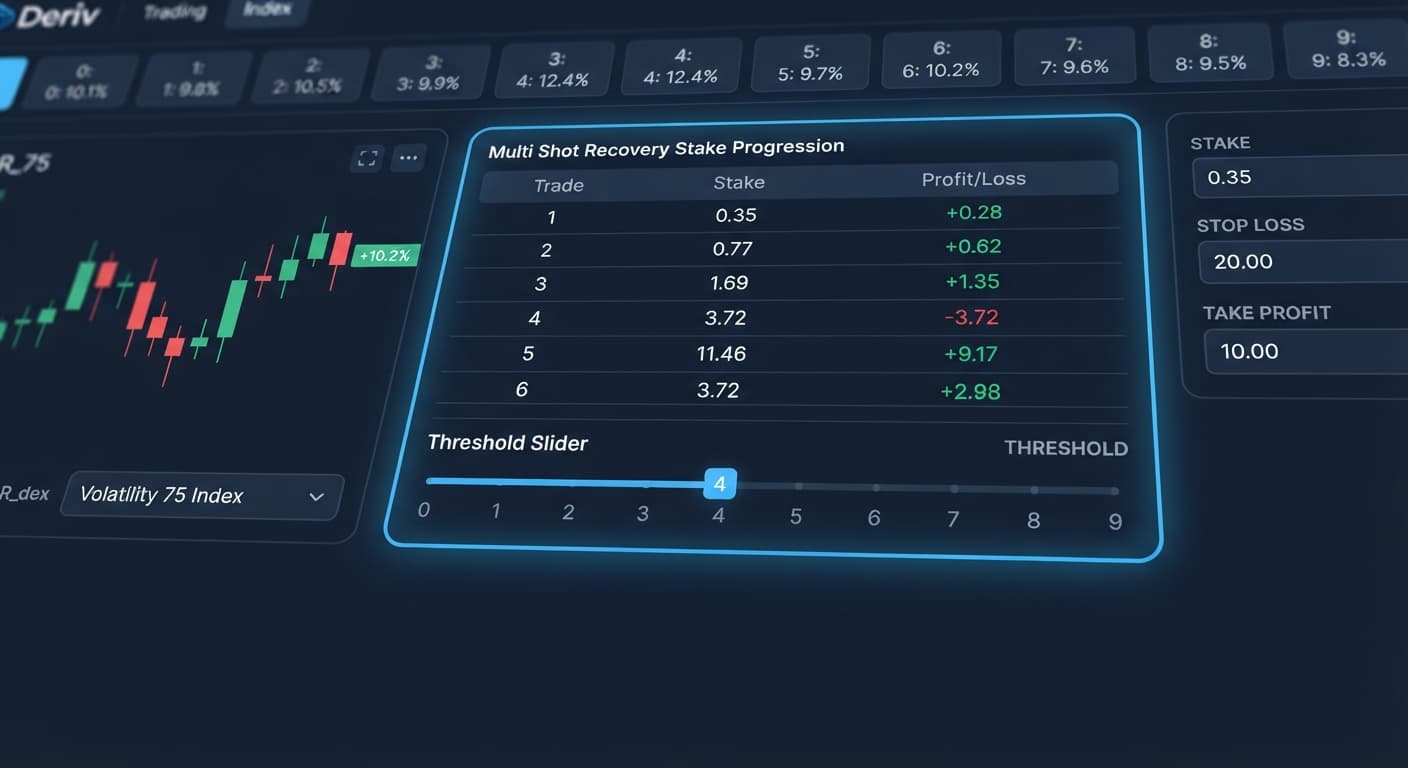
When using Multi Shot's Recovery, each lost market's next stake is sized from its live payout so one win repays it. This avoids the rapid stake escalation seen in traditional doubling methods. You can easily test these settings on the Multi Shot bot or configure custom logic using the Solid Trading Bot. If you want to analyze live digit frequency before launching your setup, open the LDP Analyzer Pro dashboard to monitor real-time statistical distributions.
The most common error traders make when shifting from standard Volatility 10 to the 1-second index is ignoring contract velocity. On a 2-second market, 30 trades take a full minute. On a 1-second market, those 30 trades happen in 30 seconds.
That extra speed changes your session dynamics completely. If your risk controls are set too loose, an unexpected streak of opposite digits will hit your balance twice as fast. A trader who usually manages trades manually gets overwhelmed immediately on 1-second charts. You can't adjust settings on the fly while contracts resolve every second.
To handle this speed safely:
When you prepare properly, binary bots execute your deriv bot trading strategy without emotional interference. You can explore additional automated setups across the free bot library to find configurations that match your trading hours and risk tolerance.
Try it yourself on the free tools using a demo balance first.
If you don't have one yet, create a free Deriv account.
Trading involves risk. Past performance does not guarantee future results.
Related: Best Digit Match Settings for Binary Bots (2026)
How the strategies behind the bots actually work — Digit Differs, Over/Under, Even/Odd, Rise/Fall, and the money management that decides whether they survive a losing streak.
Try 9 Strategies on Solid →It's a synthetic market that updates its spot price once every second with a low baseline volatility of 10%. It uses a cryptographic random number generator to output a fresh tick every second, yielding a last digit between 0 and 9.
The strategy automates contract entries on DIGITEVEN or DIGITODD contracts using a pre-set parameter stack. Since five digits are even and five are odd, these contracts carry a 50% base mathematical probability per tick.
Volatility 10 (1s) delivers 60 digits per minute with a 1-second tick interval, whereas the standard Volatility 10 updates every two seconds and cuts your potential trade density in half. It lets you maintain rapid trade cycles on low-volatility synthetic ticks.
No, each tick is statistically independent because the random engine doesn't remember past ticks. A string of seven even digits in a row doesn't mean an odd digit is due next.
Guides closest to this one.
Use DIGITOVER 2 with a 5-tick duration and Multi Shot's Recovery to find the best over under settings for binary bots on Deriv.
Four exact parameters form the best digit match settings for binary bots: 1% stake, Multi Shot Recovery, Max Ladder Level 3, and 15% to 20% stop loss.
Avoid emotional bias in digit psychology in deriv by setting up a real-time digit analyzer with a 100 tick window, strict risk limits, and API tokens.