Strategies & Risk
Why Your Rise Fall Strategy Is Not Working on Deriv Bots
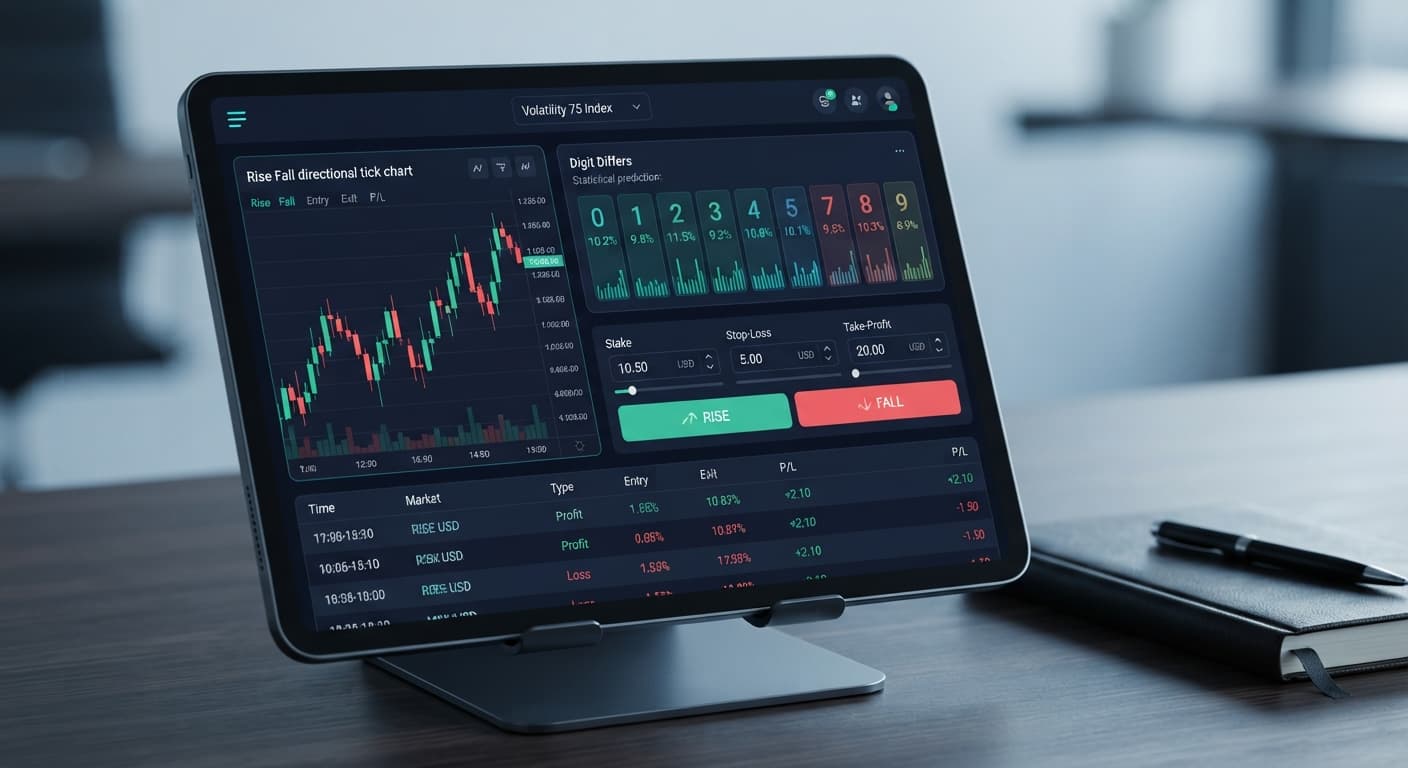
Your rise fall strategy deriv bots fails due to tick duration mismatch and aggressive stake sizing. Fix it with Fixed Stake and longer durations.
How the strategies behind the bots actually work — Digit Differs, Over/Under, Even/Odd, Rise/Fall, and the money management that decides whether they survive a losing streak.
Page 1 of 2
Your rise fall strategy deriv bots fails due to tick duration mismatch and aggressive stake sizing. Fix it with Fixed Stake and longer durations.
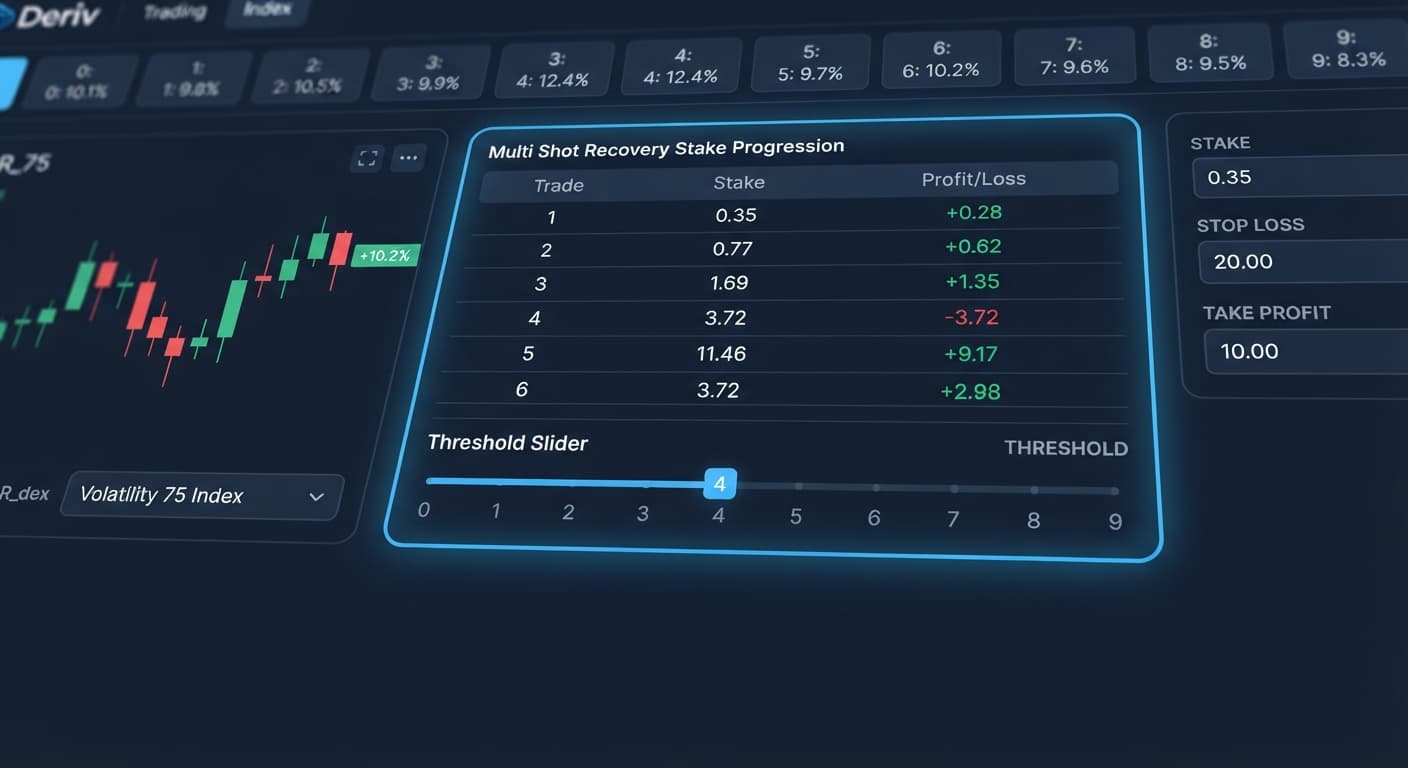
Use DIGITOVER 2 with a 5-tick duration and Multi Shot's Recovery to find the best over under settings for binary bots on Deriv.
Compare rise fall vs digit differs bot strategies: 95% payout on 5-tick direction vs 9.9% yield on 90% probability 1-tick trades.
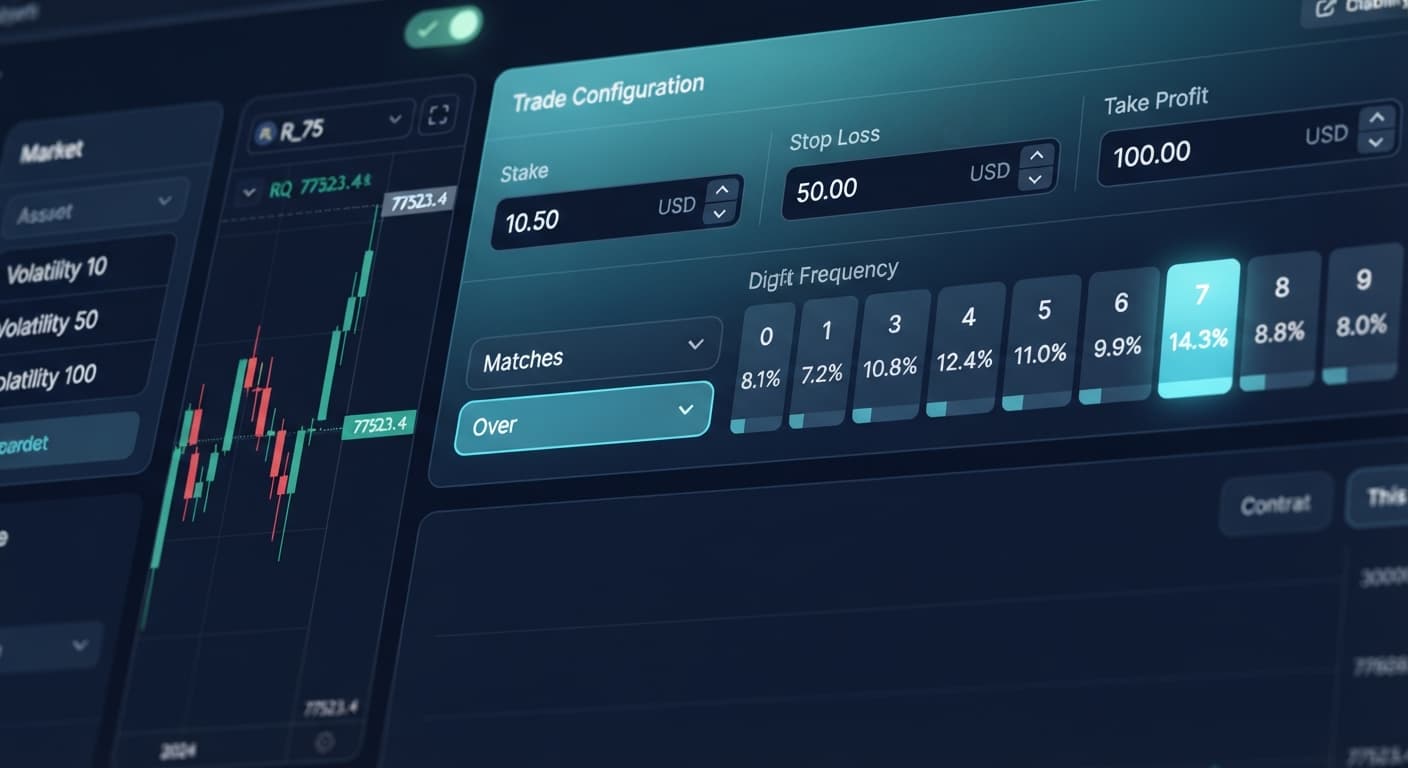
Compare over under vs rise fall strategies on Deriv bots by matching payout probability, tick duration, and risk settings to protect your trading balance.
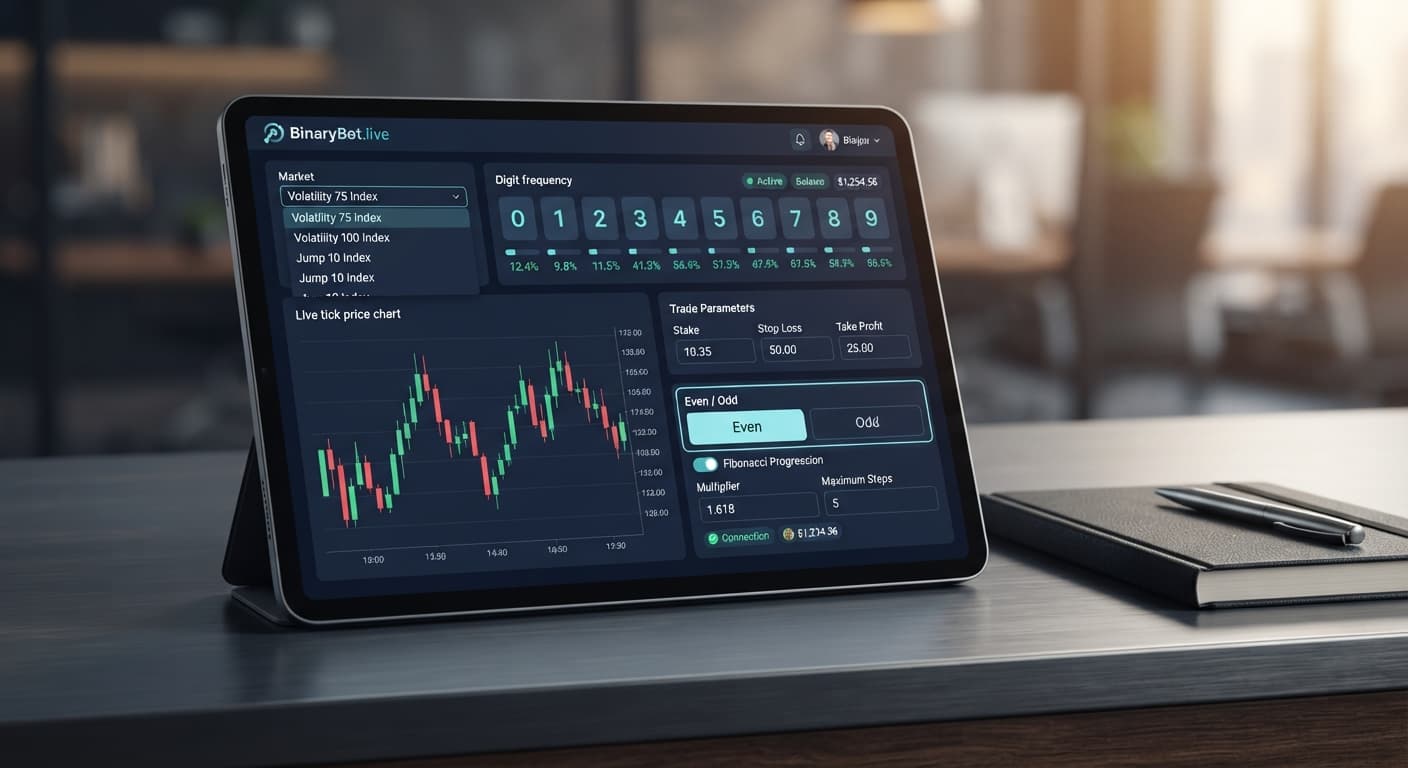
Set DIGITEVEN or DIGITODD with Fibonacci money management and a max ladder level of 5 to configure the best even odd settings for binary bots on Deriv.
Even odd vs over under digit trades on BinaryBot.live: compare 50% fixed payouts and flexible probability barrier setups across 5 configuration steps.
Deploying even odd strategy deriv bots on the Volatility 10 (1s) Index targets 50/50 probability digit payouts with a fast 1-second tick speed.
Digit match vs even odd: Even/odd contracts offer a 50% probability and 95% payout for low variance, while digit match pays 800% with a 10% hit rate.
Four exact parameters form the best digit match settings for binary bots: 1% stake, Multi Shot Recovery, Max Ladder Level 3, and 15% to 20% stop loss.
Avoid emotional bias in digit psychology in deriv by setting up a real-time digit analyzer with a 100 tick window, strict risk limits, and API tokens.
Follow these 5 steps on how to trade rise fall on deriv using an automated bot, set tick duration, and enforce stop loss limits.
Set a fixed stake and protective limits to configure a rise and fall deriv bot in five steps, using a demo account to test strategies safely.
A Deriv bot strategy comes down to two choices: which contract the bot buys, and what happens to the stake after a loss. The contract fixes your odds before a single trade is placed. Here's how the contracts compare when every last digit from 0 to 9 comes up about 10% of the time, which is how Deriv's synthetic indices behave.
| Strategy | Contract | Wins when | Chance per trade | Free bots that run it |
|---|---|---|---|---|
| Digit Differs | DIGITDIFF | the last digit is anything except your digit | 90% | Solid Trading Bot, LDP Analyzer Pro, Sniper Bot V3, Sniper Bot V2, Digit Pad, LDP Analyzer, AutoPilot |
| Digit Match | DIGITMATCH | the last digit is exactly your digit | 10% | LDP Analyzer Pro, LDP Analyzer, AutoPilot |
| Even/Odd | DIGITEVEN, DIGITODD | the last digit is even (or odd) | 50% | Solid Trading Bot, LDP Analyzer Pro, Sniper Bot V3, Sniper Bot V2, Digit Pad, LDP Analyzer, AutoPilot |
| Over/Under | DIGITOVER, DIGITUNDER | the last digit is above (or below) your barrier | Set by the barrier: Over 4 is 50%, Under 7 is 70% | Solid Trading Bot, LDP Analyzer Pro, Sniper Bot V2, LDP Analyzer, AutoPilot, Multi Shot |
| Rise/Fall | CALL, PUT | the exit price is higher (or lower) than the entry | About 50% | AutoPilot, Tick Picker, Sniper Bot V3, Sniper Bot V2, Solid Trading Bot, LDP Analyzer Pro, Multi Shot |
| Touch/No Touch | ONETOUCH, NOTOUCH | price touches (or never touches) a barrier before expiry | Set by the barrier distance | Sniper Bot V3, Sniper Bot V2 |
| Accumulator | ACCU | price stays inside the range until take profit closes the trade | Lower at each step up in Growth Rate | Accumulator Bot, AutoPilot |
Payouts run the other way. A 90% contract pays a small fraction of your stake, a 10% contract pays several times it, and Deriv prices all of them so the house keeps an edge. No strategy changes the next tick either: ticks are independent, so a digit that hasn't shown up for 40 ticks is still a 10% draw.
Whatever you pick, run it on a Deriv demo account first and watch at least one losing streak play out before real money goes in.
The bots offer different ways to size the next stake. Sniper Bot V3 has Fixed Stake, Martingale, Anti-Martingale, Fibonacci, D'Alembert and % of Balance. Tick Picker has Fixed Stake, Martingale and Mesamilano, which spreads a recovery over several trades instead of doubling on the next one.
Martingale is the one that surprises people. With a $1 stake and a 2x multiplier:
| Losses in a row | Next stake | Lost so far |
|---|---|---|
| 3 | $8 | $7 |
| 6 | $64 | $63 |
| 8 | $256 | $255 |
| 10 | $1,024 | $1,023 |
On Digit Differs, six losses in a row is roughly a one-in-a-million run. On Even/Odd it's 1 in 64 for any given six trades, and across 300 trades you should expect to see it at least once. Set Stop Loss and Target Profit in dollars before you press start, and on Sniper Bot V3 use MAX LEVEL to cap how far the ladder can climb.
No strategy wins over time, because Deriv prices its payouts below the true odds. The best one to start with is the one whose losses you understand: Digit Differs wins 90% of trades but gives back several wins on each loss, while Even/Odd is a 50/50. Test either on a demo account first.
No. Synthetic index ticks are random and independent, so every contract has a losing outcome and every bot hits losing streaks. A bot or file sold as no-loss is misleading you. What you can control is how much a losing run costs, with a fixed stake and a Stop Loss.
It turns many small wins into occasional large losses. With a $1 stake and a 2x multiplier, six losses in a row have already cost $63 and the seventh stake is $64. If you use it, cap it with a stop loss or, on Sniper Bot V3, a MAX LEVEL.
A fixed stake with Stop Loss set in dollars. Martingale needs a balance many times the base stake to survive an ordinary losing streak, which makes it the worst fit for a small account.