Strategies & Risk
Even Odd vs Over Under: Setup Guide for BinaryBot.live
Even odd vs over under digit trades on BinaryBot.live: compare 50% fixed payouts and flexible probability barrier setups across 5 configuration steps.

Choosing between an over under vs rise fall contract setup comes down to payout probability versus market direction. DIGITOVER and DIGITUNDER contracts trade against a static digit barrier with variable payouts, while Rise/Fall (CALL/PUT) contracts predict tick movement over time with fixed returns. On BinaryBot.live, picking the wrong contract type for your chosen synthetic index destroys bankrolls quickly—either by running high-probability DIGITUNDER trades into instant streak losses or running short-duration Rise/Fall trades during flat market conditions where broker commission eats your margin.
This guide breaks down how to configure both contract classes across automated deriv bots, how tick durations alter risk, and which setup fits your trading balance.
The single biggest mistake traders make with binary bots is running DIGITOVER or DIGITUNDER strategies as if they were simple direction bets. Deriv synthetic index ticks are independent events. The last digit of a Volatility 75 Index tick has no memory of the previous tick's digit. When you deploy a DIGITUNDER 8 contract, you gain an 80% theoretical statistical edge on every single tick, but the payout drops to around 20%. If your automated logic hits two loss ticks in a row—where the tick ends on 8 or 9—recovering those losses requires five consecutive winning trades just to break even on a fixed stake.
[Digit Range: 0 to 9]
DIGITUNDER 8 Wins: 0, 1, 2, 3, 4, 5, 6, 7 (80% Win Chance | ~20% Payout)
DIGITUNDER 8 Loses: 8, 9                  (20% Loss Chance | 100% Loss)
Conversely, trading Rise/Fall (CALL/PUT) ignores the final digit entirely and looks at relative tick movement. A CALL contract wins if the exit tick is higher than the entry tick, regardless of whether the digit is a 0 or a 9. The payout sits around 95%, but your win probability drops to roughly 50%.
Traders often run 1-tick Rise/Fall contracts during low-volatility periods. When the index moves sideways, micro-fluctuations result in random outcomes. You pay the standard spread risk without giving the index enough tick duration to establish a directional move. To trade these effectively on BinaryBot.live, you must align your duration, target digits, and recovery parameters before sending trades to the live API.
To fix this structural imbalance, match the contract selection to the duration and payout ratio. If you want high-frequency wins and can handle sudden drawdown spikes, use DIGITUNDER or DIGITOVER with high probability barriers. If you want symmetrical risk-to-reward ratios where a single win recovers a single loss, use Rise/Fall across 5 Ticks or longer.
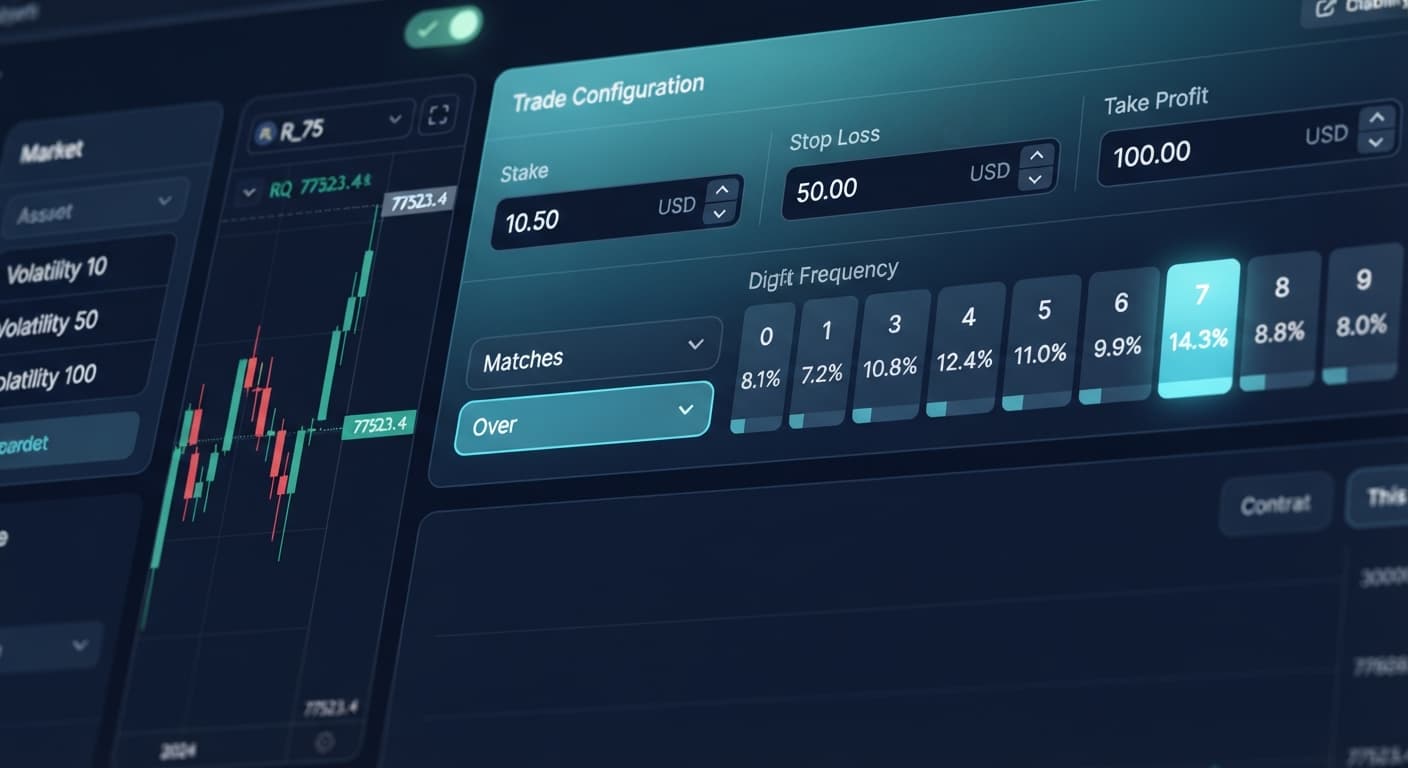
The tool connects straight to the Deriv WebSocket API using your API token, executing contracts directly on your Deriv account balance. Here is how a clean comparative setup maps out inside the bot dashboard:
| Control Name | DIGITUNDER Setup | Rise/Fall (CALL/PUT) Setup | Direct System Effect |
|---|---|---|---|
| Market / Asset | Volatility 100 (1s) Index | Volatility 75 Index | Determines tick generation speed and volatility profile |
| Contract Type | DIGITUNDER | Rise/Fall | Sets the underlying execution engine on Deriv |
| Prediction / Barrier | Digit 7 | N/A (Directional Entry) | Defines the winning digit threshold for digit contracts |
| Duration | 1 Ticks | 5 Ticks | Sets contract length before mandatory settlement |
| Money Management | Multi Shot's Recovery | Fixed Stake | Controls stake adjustments following win/loss signals |
| Stop Loss | 20% of Account Balance | 15% of Account Balance | Terminates execution instantly upon reaching threshold |
| Target Profit | 10% of Account Balance | 10% of Account Balance | Halts execution to lock in session gains |
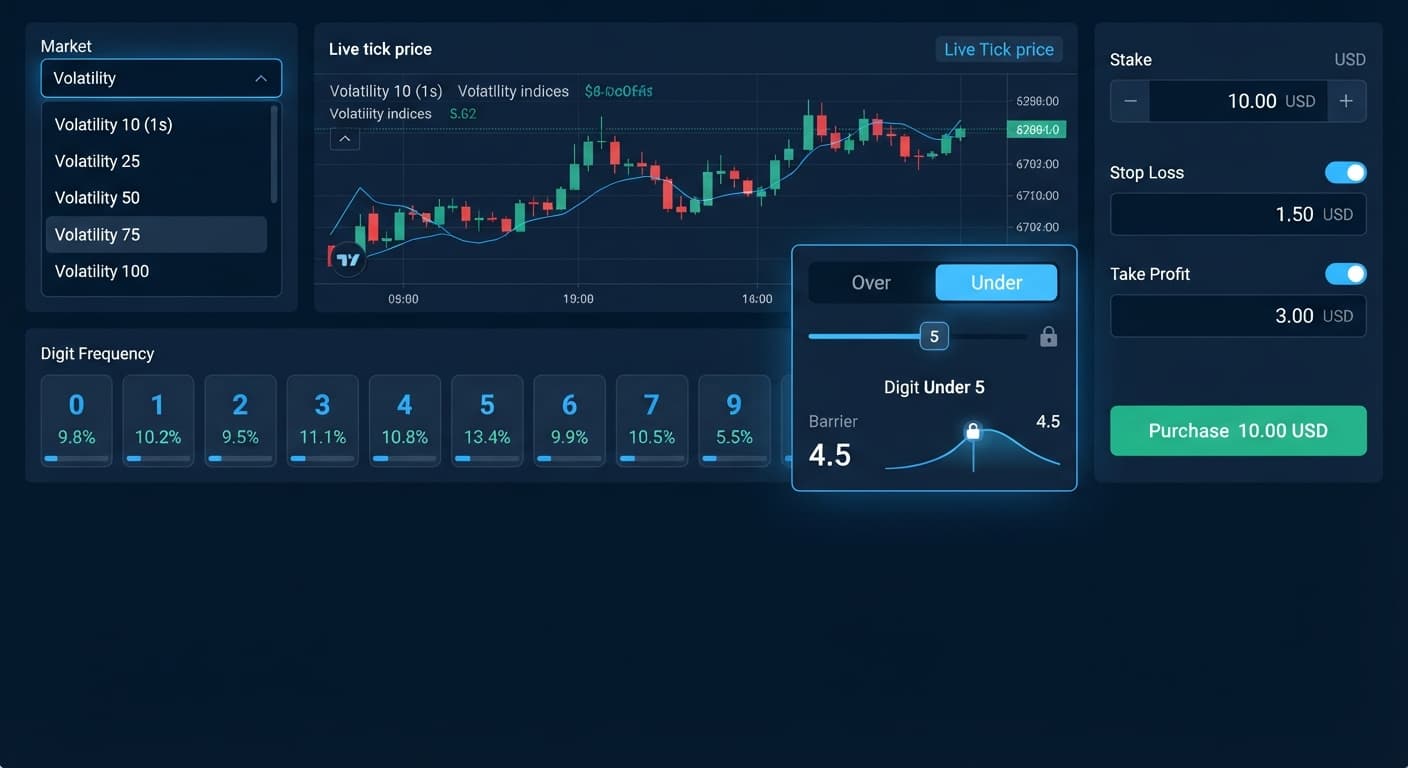
Open your chosen tool on BinaryBot.live. Select your target market from the asset dropdown. Use Volatility 10 (1s) or Volatility 25 for smoother directional movement when running Rise/Fall contracts. Pick Volatility 100 or Volatility 75 (1s) when running digit strategies like DIGITOVER or DIGITUNDER to ensure constant tick generation every single second.
In the contract configuration tab, select your core contract class:
If you choose a digit contract, enter your target digit in the prediction field. Setting DIGITUNDER to 7 means digits 0 through 6 win, while 7, 8, and 9 lose.
Set your contract duration based on the chosen mode:
Select your stake management mode under the Money Management menu:
Before switching the bot toggle to live execution, connect your API token while logged into your Deriv demo account. Run the bot for a minimum of 50 automated executions. Verify in the execution log that ticks trigger without latency delays, payouts align with expectations, and the automated stop loss triggers immediately if maximum drawdown is hit.
Evaluating an over under vs rise fall setup requires looking at entry conditions, contract settings, and target trader profiles side by side. The matrix below outlines how these variables perform across live synthetic market conditions.
| Strategy Mode | Contract Setting | Duration | Payout Ratio | Bot Behavior & Execution Flow | Target Trader Profile |
|---|---|---|---|---|---|
| High-Win Digit | DIGITUNDER 8 | 1 Ticks | ~20% | Executes on every tick; wins on digits 0-7, loses on 8-9. High hit rate, slow gain. | Conservative traders seeking steady micro-gains with tight Stop Loss limits. |
| Aggressive Digit | DIGITOVER 2 | 1 Ticks | ~35% | Wins on digits 3-9, loses on 0-2. Requires managing 30% loss probability. | Balance-building traders using dynamic dynamic stake recovery modes. |
| Conservative Directional | Rise/Fall (CALL) | 5 Ticks | ~95% | Evaluates entry tick; requires higher exit tick after 5 seconds to settle in profit. | Trend-following traders who want 1:1 risk-to-reward dynamics. |
| Precision Digit | DIGITDIFF 5 | 1 Ticks | ~9% | Wins on every digit except 5. Win rate ~90%, but single loss takes 10 wins to recover. | High-capital traders testing structural digit anomalies using Tick Picker. |
| Asymmetrical Digit | DIGITMATCH 0 | 1 Ticks | ~800% | Wins only when final digit hits 0. Low hit rate (~10%) with massive single-payout potential. | High-risk traders using micro-stakes to capture outlier payouts. |
If forced to pick a single operational profile for everyday automated trading on BinaryBot.live, the Rise/Fall (CALL/PUT) at 5 Ticks with a Fixed Stake offers the most stable long-term profile. The ~95% payout structure avoids the hidden mathematical trap of high-win digit strategies, where a brief streak of bad digits wipes out hours of micro-gains. Paired with a strict Stop Loss set at 15% of your bankroll, 5-tick Rise/Fall contracts give you predictable drawdown curves that don't depend on recovering asymmetrical payouts.
This comparative configuration framework is not a universal solution. Automated strategies break down under specific market and technical conditions:
If your live logs show latency over 150ms or your chosen asset is printing flat micro-ranges, stop execution immediately. Switch back to virtual testing or adjust your contract duration before risking real account capital.
Try comparing contract execution setups on the free bot library using a demo balance first.
If you don't have one yet, create a free Deriv account.
Trading involves risk. Past performance does not guarantee future results.
Related: Even Odd vs Over Under: Setup Guide for BinaryBot.live
Related: How to Trade Over Under on Deriv: Digit Bot Setup
Related: Digit Differs vs Digit Match on Volatility 10 Index
How the strategies behind the bots actually work — Digit Differs, Over/Under, Even/Odd, Rise/Fall, and the money management that decides whether they survive a losing streak.
Try 9 Strategies on Solid →DIGITOVER and DIGITUNDER trade against a static digit barrier with variable payouts based on statistical probability. Rise/Fall contracts predict relative tick movement over time with fixed returns, ignoring the final digit entirely.
During low-volatility periods, micro-fluctuations result in random outcomes instead of a clean directional move. This exposes you to spread risk without giving the index enough tick duration to establish a trend.
It wins if the last digit of a tick lands between 0 and 7, giving you an 80% theoretical win chance with a lower payout of around 20%. However, because the payouts are low, hitting a couple of losses in a row requires multiple consecutive wins just to break even.
You should use Rise/Fall across 5 ticks or longer. This setup provides symmetrical risk where a single win can recover a single loss, unlike high-probability digit trades that need multiple wins to bounce back from drawdowns.
Guides closest to this one.
Even odd vs over under digit trades on BinaryBot.live: compare 50% fixed payouts and flexible probability barrier setups across 5 configuration steps.
Learn how to trade over under on deriv with the BinaryBot.live Digit Over Under bot. Follow this step-by-step deriv bot trading strategy. Try it free!
Compare digit differs vs digit match on binary bots. Learn payout odds, probability mechanics, and how to configure strategies on BinaryBot.live today.