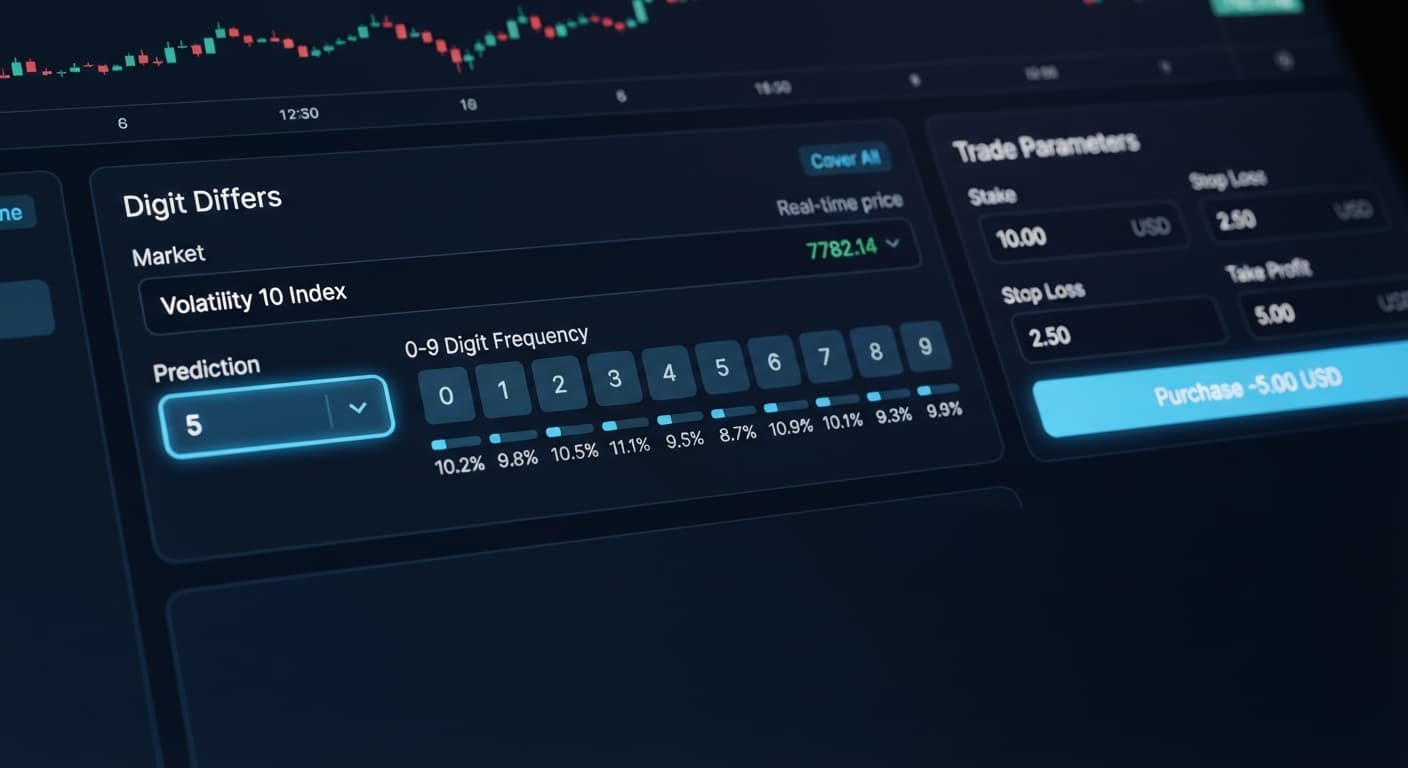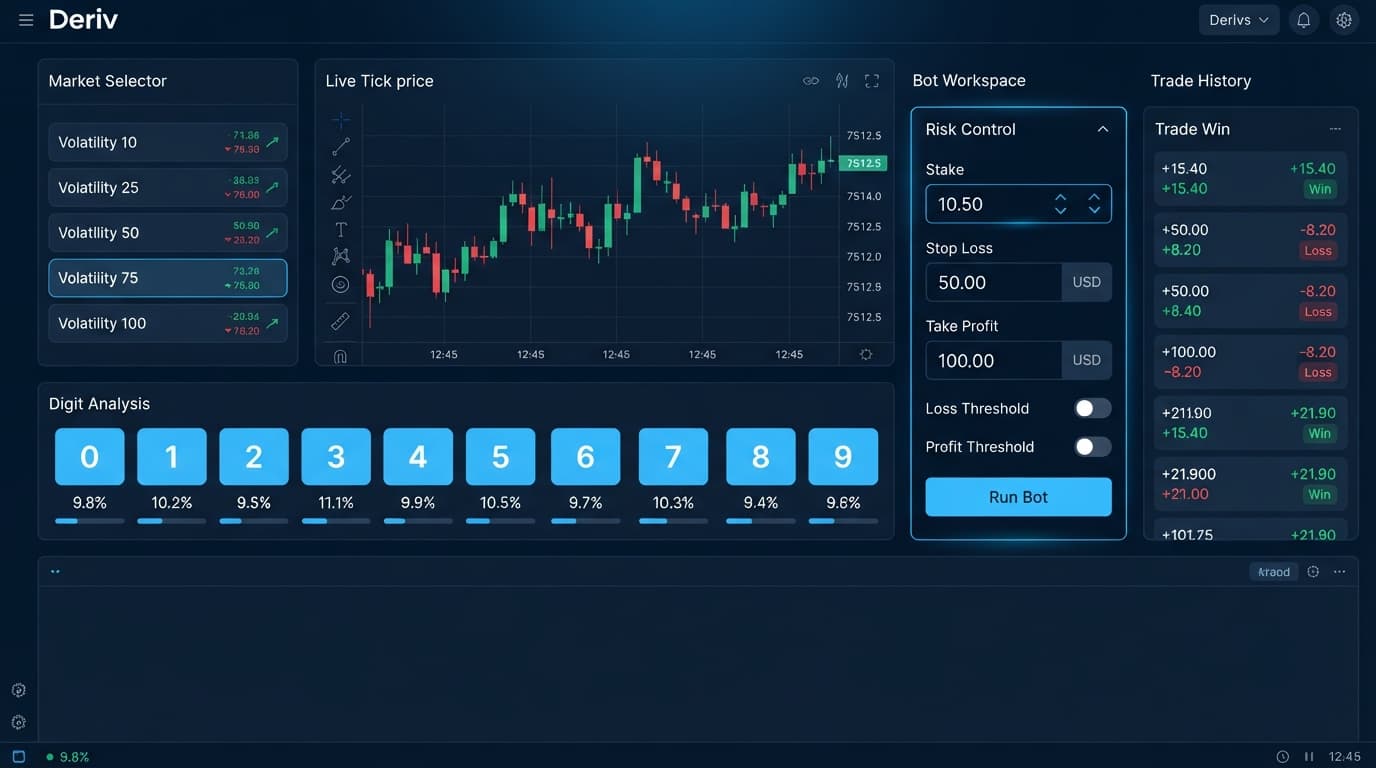

Strategies & Risk
Digit Match Strategy Deriv Bots: Setup & Risk Controls
Master a digit match strategy deriv bots setup for 800% payouts on synthetic indices by managing long tick droughts and configuring strict risk controls.
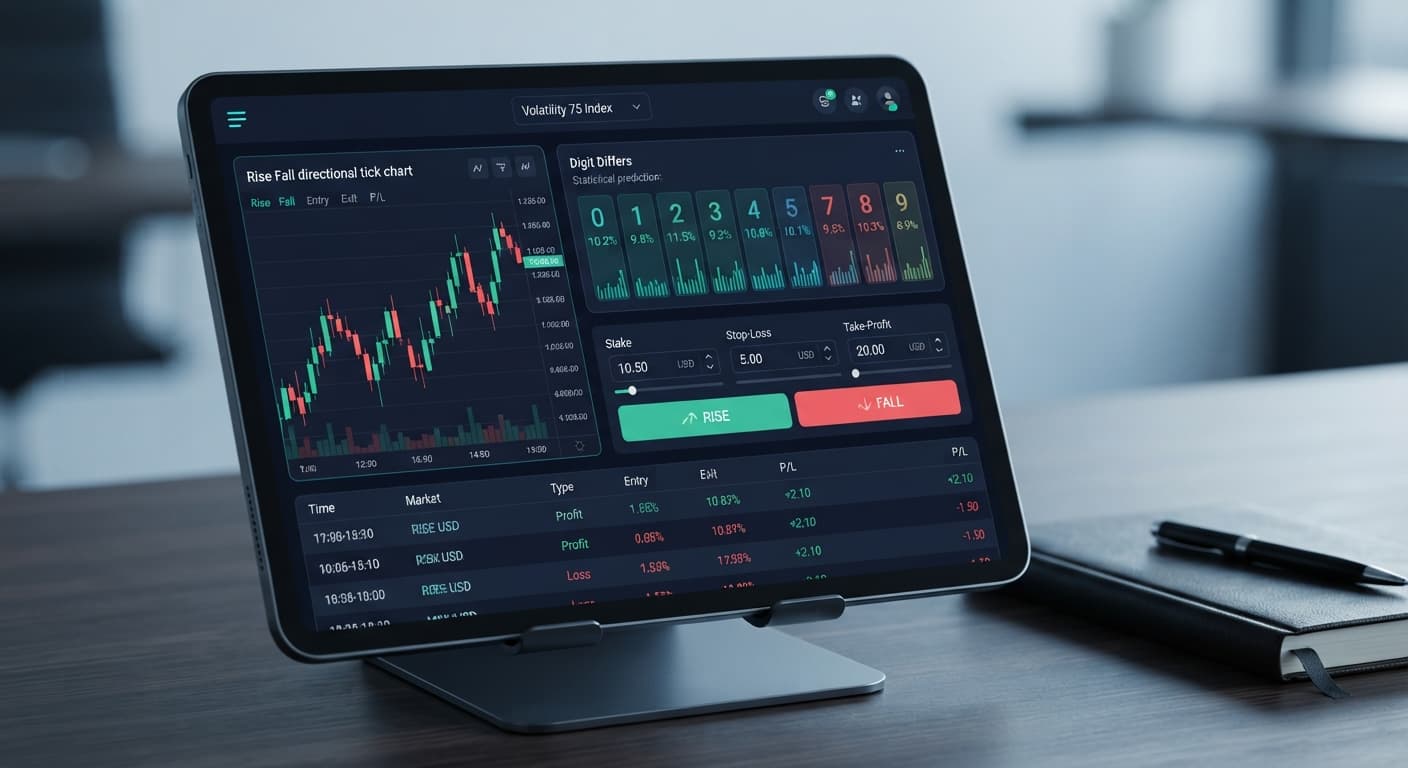
When choosing between rise fall vs digit differs, the decision comes down to payout structure versus win frequency. Rise/Fall contracts pay around 95% return per win by asking you to predict market direction over a set tick duration, requiring roughly a 53% win rate to break even. DIGITDIFF (Digit Differs) contracts offer a ~9.9% return with a 90% theoretical probability on every single tick, making them high-frequency, low-yield operations. If you want steady micro-wins with rare deep drawdowns, Digit Differs is your contract; if you want standard binary risk-reward where individual losses don't wreck your bankroll, stick with Rise/Fall.
When building setups for deriv bots, matching contract selection to your balance goals keeps your trading clean. Here's how the two options compare at a glance:
Choose Rise/Fall (CALL/PUT) if:
Choose Digit Differs (DIGITDIFF) if:
Understanding structural differences prevents surprises when you deploy binary bots live. Rise/Fall relies on price motion between entry and exit ticks, while DIGITDIFF checks only the last digit of the final tick price against your selected prediction digit.
| Structural Dimension | Rise/Fall (CALL/PUT) | Digit Differs (DIGITDIFF) |
|---|---|---|
| Win Condition | Exit tick price ends higher (CALL) or lower (PUT) than entry tick | Last digit of exit tick price does NOT match prediction digit |
| Theoretical Win Rate | ~50.0% (market direction) | ~90.0% (9 out of 10 digits win) |
| Standard Payout | ~95% of trade stake | ~9.9% of trade stake |
| Loss Penalty | Loses 100% of trade stake (1x stake loss) | Loses 100% of trade stake (wipes out ~10 prior wins) |
| Ideal Trade Duration | 5 to 10 ticks | 1 tick |
| Primary Risk Factor | Short-term market trend reversals | Mathematical tail-risk hit on the exact predicted digit |
| Analysis Focus | Price direction and market momentum | Digit distribution and tick frequency |
A standard deriv bot trading strategy using CALL/PUT gives you room to breathe. When a Rise/Fall contract loses, it costs you exactly what you put in, and one win puts you almost back to even. With a digit differs strategy, your win rate feels effortless until a loss strikes. Because the payout is ~9.9%, a single loss erases roughly ten winning contracts in a row.
Here's how exact control inputs alter bot execution across both contract types. Every entry listed below represents an active setting inside our automated tools.
| Control & Setting Value | How the Bot Acts Differently | Recommended Trader Profile |
|---|---|---|
| Duration: 5 Ticks (CALL/PUT) | Evaluates entry spot against price action 5 ticks later, smoothing short noise | Directional traders following trend momentum |
| Duration: 1 Tick (DIGITDIFF) | Evaluates the immediate next tick's last digit for maximum trading speed | High-frequency statistical traders |
| Stake Management: Fixed Stake | Keeps trade sizes flat regardless of win or loss outcomes | Conservative traders capping maximum drawdown |
| Stake Management: Multi Shot's Recovery | Dynamically resizes the next trade after a loss using live payout rates | Traders using DIGITDIFF who want automated single-win recovery |
| Target Profit: 2% of Balance | Stops the bot immediately upon reaching a conservative session goal | System operators running high-speed micro-sessions |
| Max Ladder Level: 3 | Hard-caps consecutive stake progression steps to prevent account exhaustion | Risk-conscious traders using recovery money management |
I always pick 5 Ticks on Rise/Fall paired with Fixed Stake when setting up standard directional automated trades. A 5-tick window gives price momentum enough room to play out without exposing your entry to long-term reversal risk.
Neither contract type guarantees profit, and both carry structural flaws you must manage. If you treat either option as bulletproof, your account balance will suffer.
Rise/Fall struggles with short-term index noise. On a 1-tick or 2-tick duration, price movements on synthetic indices like Volatility 75 often look like coin tosses. A sudden tick spike right at contract expiry can turn a winning CALL trade into a loss instantly. If you run Rise/Fall without confirming direction across higher tick counts, your win rate will hover right around 50%, which falls short of the ~53% needed to overcome broker payout margins.
DIGITDIFF faces a completely different trap: math fatigue. It feels easy to run a digit odd even bot or digit differs automated script because the green trade logs stream past quickly. However, Deriv synthetic index ticks are independent random events. A digit not appearing for 20 ticks doesn't mean it won't appear on tick 21. When that prediction digit hits, your bot takes a 100% stake loss against a 9.9% yield. If you're running Martingale or Fibonacci money management without capping Max Ladder Level, a short cluster of lost differs contracts will drain your bankroll fast.
If you want to evaluate rise fall vs digit differs performance systematically, follow this operational sequence to compare results without risking unnecessary capital.
Step 1: Connect your Deriv API token to the LDP Analyzer Pro dashboard or open the Digit Pad tool on a Deriv demo (virtual) account to inspect real-time digit distributions.
Step 2: Run a 50-trade DIGITDIFF test session using Fixed Stake and a strict stop loss set to 10% of your virtual balance to observe how 9.9% payouts accumulate against random tick outputs.
Step 3: Switch to directional trades by launching Rise/Fall contracts on the free bot library with a 5-tick duration to measure your baseline directional accuracy.
Step 4: Compare total session drawdown and trade duration between the two methods before deciding which setup matches your personal risk tolerance.
Always run thorough tests on a Deriv demo account before loading live money into any automated tool. Comparing contract mechanics under live execution conditions is the only reliable way to understand how risk controls impact your balance over time.
Try it yourself on Solid Trading Bot using a demo balance first. If you don't have one yet, open a free Deriv account. Trading involves risk. Past performance does not guarantee future results.
Related: Digit Match Strategy Deriv Bots: Setup & Risk Controls
Related: Binary Bots vs Manual Trading: Digit Differs vs Over Under
Related: Why Your Rise Fall Strategy Is Not Working on Deriv Bots
How the strategies behind the bots actually work — Digit Differs, Over/Under, Even/Odd, Rise/Fall, and the money management that decides whether they survive a losing streak.
Try 9 Strategies on Solid →Rise/Fall contracts pay around a 95% return per win and require roughly a 53% win rate to break even. They rely on predicting market direction over a set tick duration, usually between 5 to 10 ticks.
Digit Differs offers a low yield of about 9.9% return per successful trade with a 90% theoretical probability on every single tick. Because of this small payout, a single loss will wipe out roughly ten prior winning contracts.
Rise/Fall is better if you want a standard binary risk-reward where single losses only take away your initial stake. In contrast, a Digit Differs loss wipes out about ten wins in a row due to its high-frequency, low-yield structure.
Digit Differs contracts operate on a fast 1-tick duration to catch micro-profits on every tick. Rise/Fall contracts typically run across 5 to 10 ticks to let market trends and price direction develop.
Guides closest to this one.
Master a digit match strategy deriv bots setup for 800% payouts on synthetic indices by managing long tick droughts and configuring strict risk controls.
Master the digit differs strategy deriv bots on Volatility 10. Learn setup steps, Martingale rules, and risk controls. Read the market guide today.
Your rise fall strategy deriv bots fails due to tick duration mismatch and aggressive stake sizing. Fix it with Fixed Stake and longer durations.