
Strategies & Risk
Build a Rise and Fall Deriv Bot (Beginner Guide)
Set a fixed stake and protective limits to configure a rise and fall deriv bot in five steps, using a demo account to test strategies safely.
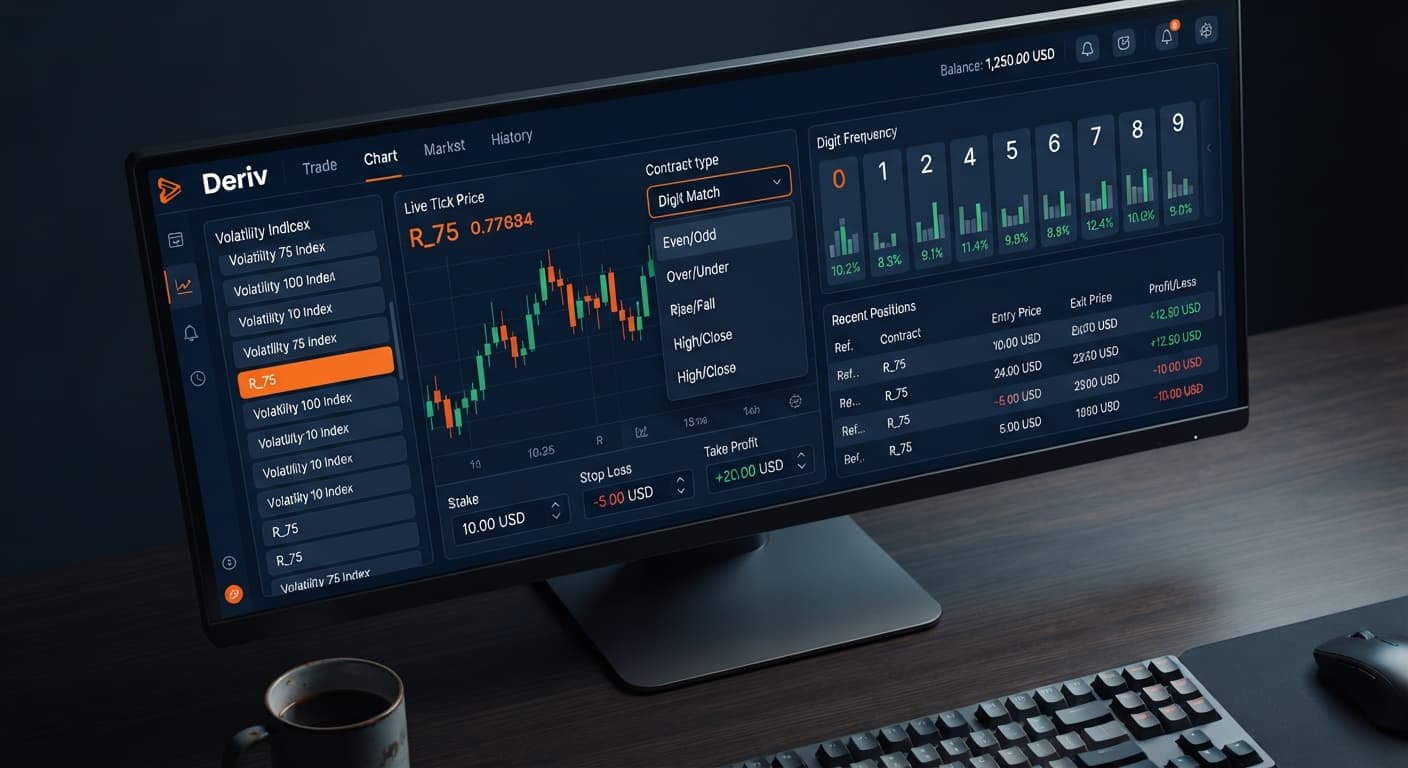
When weighing digit match vs even odd contracts on Deriv, DIGITEVEN and DIGITODD offer a 50% underlying probability with a 95% profit payout, making them the best choice for traders who want low account variance. DIGITMATCH pays out 800% profit but hits only 10% of the time, creating deep losing streaks that quickly drain smaller bankrolls. Beginners should stick to even/odd strategies until they fully understand how variance impacts short-term balances.
Most new traders lose money during their first month of automated trading on deriv bots. It's not because the platform breaks or the API fails. They lose money because they select high-multiplier contracts like DIGITMATCH without calculating the run length of inevitable losing streaks.
Deriv synthetic indices generate synthetic tick streams where every tick's last digit is completely independent of the tick before it. A digit pattern doesn't make the next tick more likely to land on a specific number. Past outputs won't force the next tick to balance out a short-term trend.
When you trade DIGITEVEN or DIGITODD, you're betting on half of all possible outcomes (digits 0, 2, 4, 6, 8 for even; 1, 3, 5, 7, 9 for odd). You won't hit massive multi-hundred-percent spikes on a single win, but your balance stays far more stable. Comparing digit match vs even odd execution comes down to choosing between frequent small wins and long dry spells punctuated by occasional high payouts.
Before you run automated scripts, you need to know exactly what the contract parameters mean on your dashboard. Here's what those terms mean in live trading:
The underlying maths of digit match vs even odd contracts shows why high payouts aren't free money. Every synthetic tick last digit has a 1-in-10 chance of hitting any digit from 0 through 9.
For DIGITEVEN, five out of ten outcomes win. That gives you a 50.0% true probability. A standard $10 contract on Volatility 10 Index pays back $19.50 on a win ($9.50 net profit, or a 95.0% payout). To break even over time, your bot needs to win at least 51.28% of its trades ($10 / $19.50). The house edge sits right at 1.28%.
For DIGITMATCH, only one out of ten outcomes wins. Your true mathematical probability drops to 10.0%. A $10 stake pays back $90.00 on a win ($80.00 net profit, or an 800.0% payout). To break even, your bot needs an 11.11% hit rate ($10 / $90.00). The house edge here is slightly lower at 1.11%, but the distribution variance is massive.
| Metric | DIGITEVEN / DIGITODD | DIGITMATCH |
|---|---|---|
| Winning Outcomes | 5 out of 10 digits | 1 out of 10 digits |
| True Mathematical Odds | 50.0% | 10.0% |
| Example Stake | $10.00 | $10.00 |
| Net Profit on Win | $9.50 (95%) | $80.00 (800%) |
| Break-Even Hit Rate | 51.28% | 11.11% |
| Normal Losing Streak (50 trades) | 4 to 7 trades | 20 to 35 trades |
In a sample of 50 trades, a digit odd even bot will rarely suffer more than 6 or 7 consecutive losses. A DIGITMATCH setup regularly sees 25 to 30 consecutive losses within that same 50-trade sample. If you don't hold a deep bankroll, that variance wipes you out before the matching digit hits.
Always run new setups on a virtual balance before risking real funds. You can inspect the execution speed, test stop controls, and watch how payout cycles hit your equity curve without losing cash.
Head over to open the free bot library and launch your preferred automation interface. You don't need to install local software or submit payment details.
Log into your Deriv account, navigate to Account Settings, and generate a Read/Trade API token. Paste that token into the bot settings bar. Confirm your top dashboard header shows your Virtual Demo balance rather than real USD.
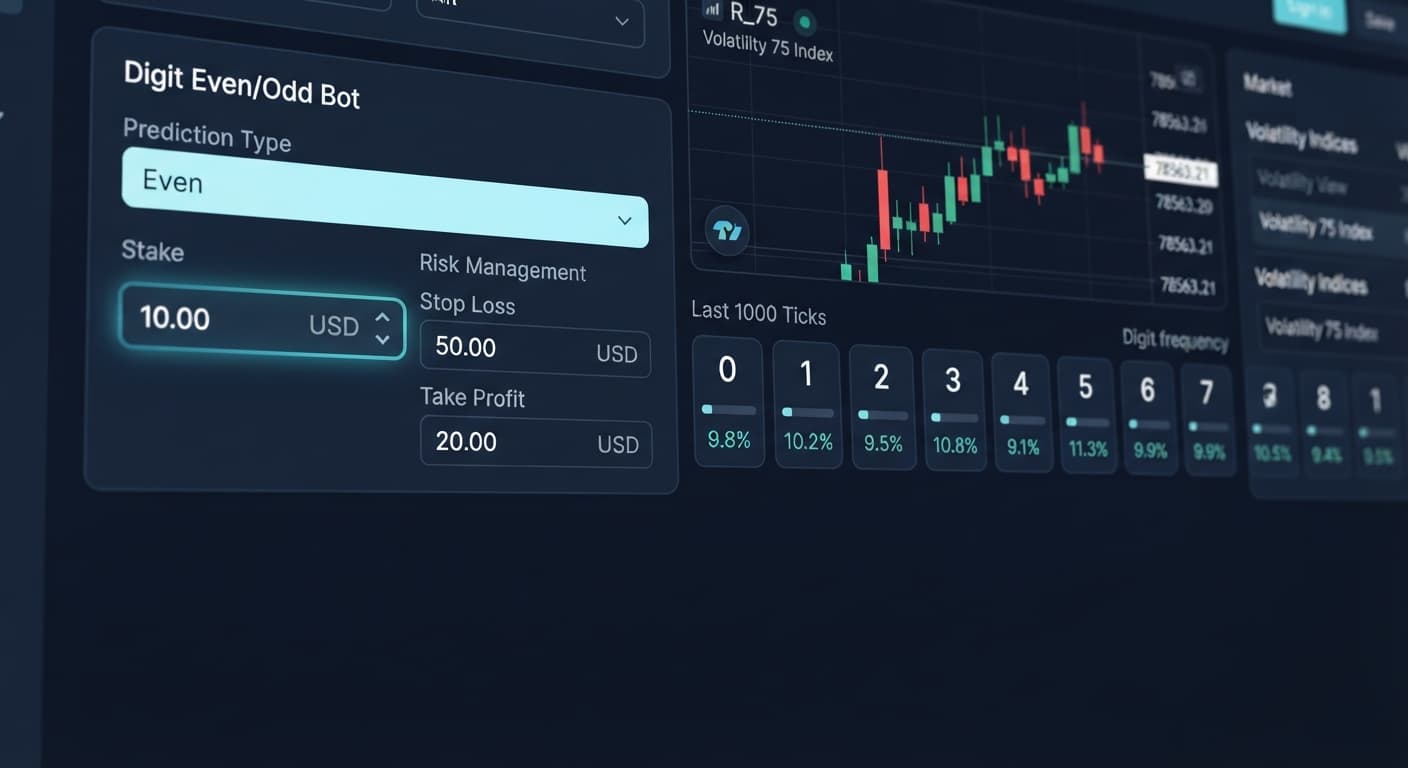
Set your market selection to Volatility 10 Index. Choose DIGITEVEN as your core contract target. Set your duration to 1 Ticks to ensure fast feedback during initial testing.
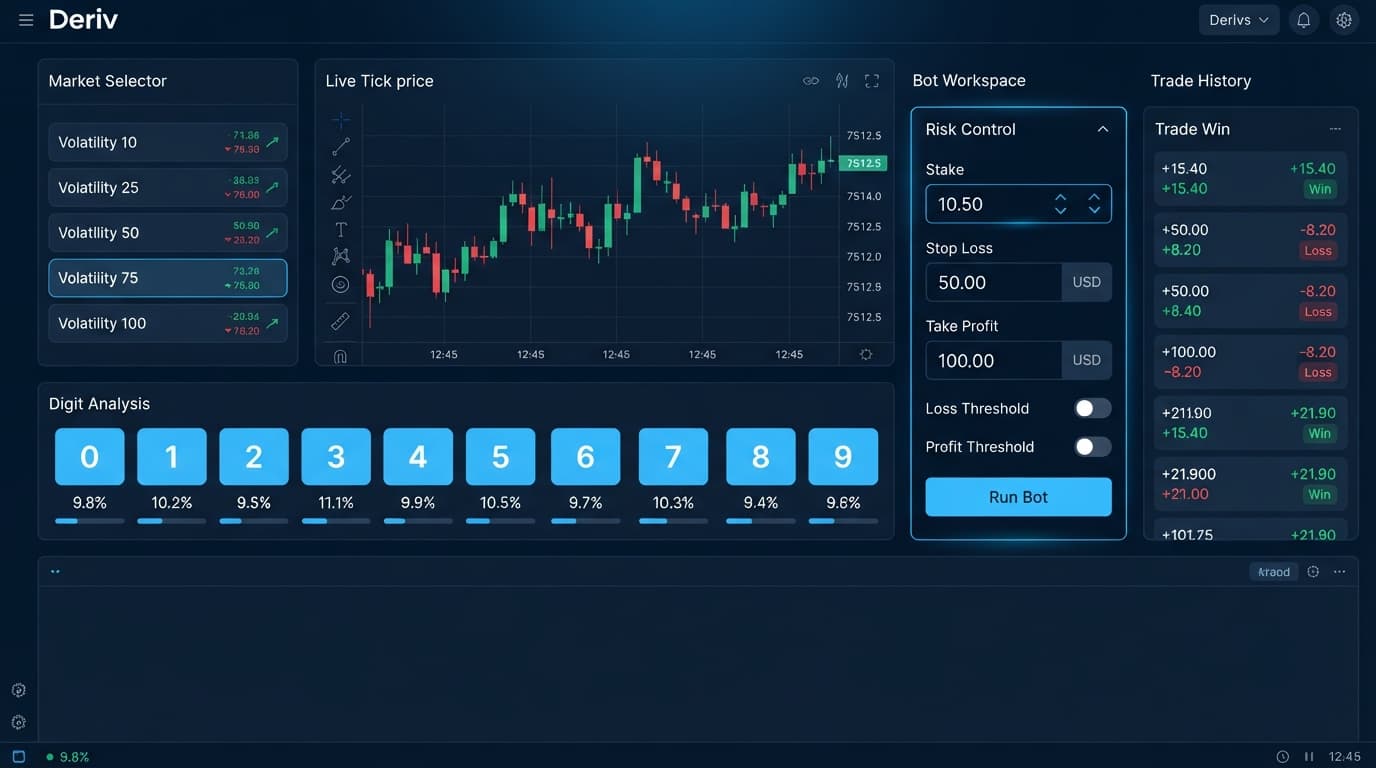
Set your Fixed Stake to $1.00 or 1% of your virtual balance. Enter a hard stop loss of $10.00 and a take profit target of $5.00. Never leave these fields blank when testing running scripts.
Click the Start button. Let the script run until it completes 50 total contracts or hits your target profit. Watch the execution output window to verify that every trade opens instantly on tick updates without dropping connection messages.
Understanding digit match vs even odd performance helps you spot problems early. Here are the three most common execution mistakes on synthetic indices:
Traders often look at tools like open the LDP Analyzer and assume that if the digit 7 hasn't appeared in 40 ticks, it's due to hit next. Synthetic index ticks don't have a memory. A digit that hasn't appeared for 50 ticks still has an exact 10% chance of appearing on tick 51. Don't increase your stake just because a digit appears rare in recent history.
Applying Martingale or aggressive recovery multipliers to a contract with a 10% win rate is the fastest way to blow an account. A sequence of 15 straight misses on DIGITMATCH is completely normal. If you double your stake after each loss, a $1 starting stake turns into a $16,384 stake on trade 15. Keep recovery strategies restricted to DIGITEVEN or DIGITODD, or stick strictly to fixed stakes.
Selecting random markets with slow tick intervals can lead to execution delays when running automated scripts. Stick to primary continuous synthetic indices like Volatility 10 Index or Volatility 100 Index. These assets generate uniform 1-second ticks, giving your binary trading strategy consistent pricing conditions on every run.
Try testing these setups on the free Solid Trading Bot with a virtual balance before risking real money.
If you don't have a practice login yet, create a free Deriv account to start.
Trading involves risk. Past performance does not guarantee future results.
Related: Build a Rise and Fall Deriv Bot (Beginner Guide)
How the strategies behind the bots actually work — Digit Differs, Over/Under, Even/Odd, Rise/Fall, and the money management that decides whether they survive a losing streak.
Try 9 Strategies on Solid →Even/Odd contracts give you a 50% chance of winning with a 95% profit payout, while Digit Match pays out an 800% profit but only hits 10% of the time. Choosing between them means balancing frequent small wins against long dry spells with high payouts.
Beginners should stick to Even or Odd strategies because they offer low account variance and prevent the deep losing streaks that quickly drain smaller bankrolls. High-multiplier contracts like Digit Match often cause new traders to lose money during their first month.
The house edge sits right at 1.28% for Even/Odd contracts, which require a 51.28% win rate to break even. For Digit Match, the house edge is slightly lower at 1.11%, but it comes with massive distribution variance.
No, past outputs won't force the next tick to balance out a short-term trend because every synthetic tick's last digit is completely independent of the tick before it. A digit pattern doesn't make the next tick any more likely to land on a specific number.
Guides closest to this one.
Set a fixed stake and protective limits to configure a rise and fall deriv bot in five steps, using a demo account to test strategies safely.
Learn how to trade even odd on deriv using the BinaryBot.live digit bot. Configure an alternating pattern strategy step by step. Start trading today!
Your rise fall strategy deriv bots fails due to tick duration mismatch and aggressive stake sizing. Fix it with Fixed Stake and longer durations.