Strategies & Risk
How to Trade Even Odd on Deriv with BinaryBot.live
Learn how to trade even odd on deriv using the BinaryBot.live digit bot. Configure an alternating pattern strategy step by step. Start trading today!
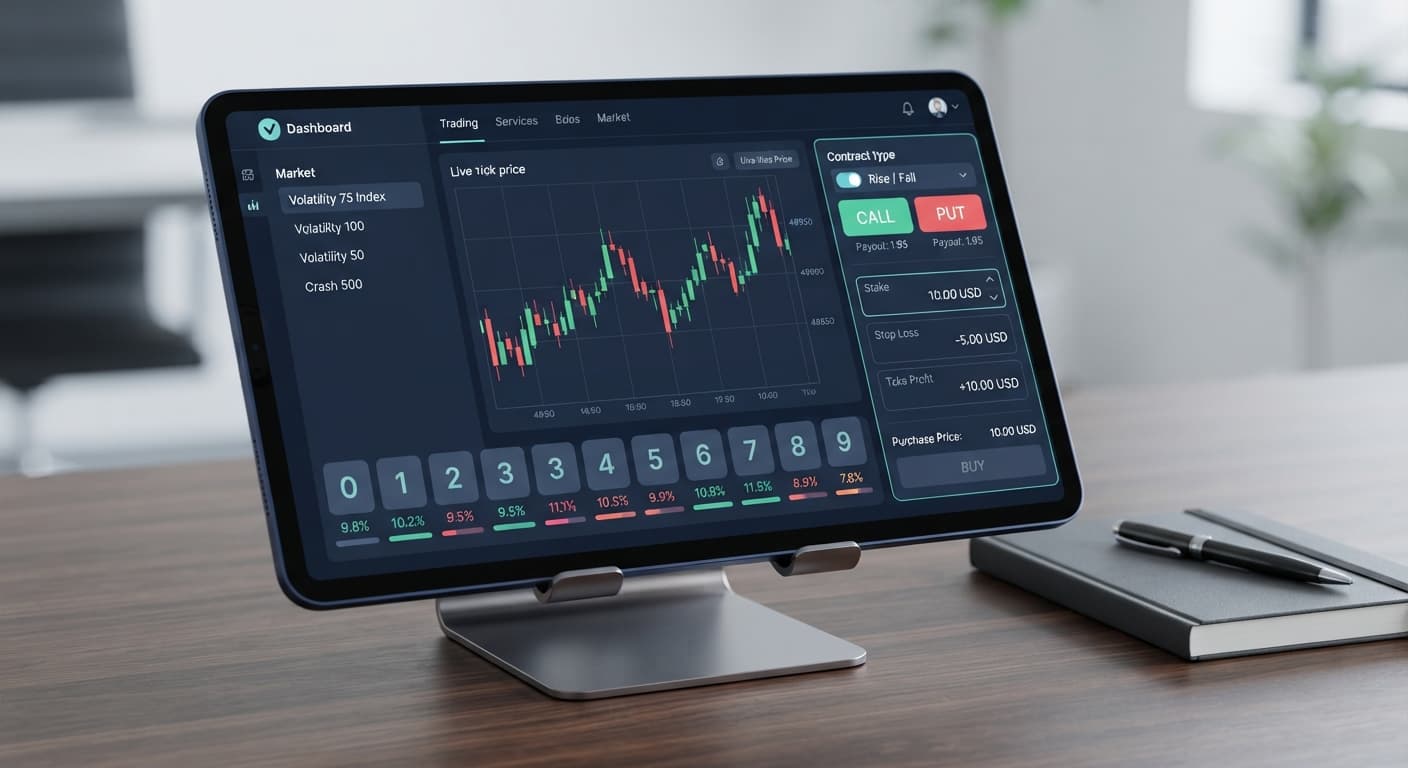
To configure a rise and fall deriv bot, you select a target market like Volatility 100 Index, pick a CALL or PUT contract, set a fixed stake, and define strict profit and loss ceilings. These automated scripts execute directional trades on Deriv based on your parameters without needing manual clicks. You can test your configuration directly by accessing browse the free bot library and connecting your API token.
Trading automated contracts requires knowing exactly what happens behind the scenes when a trade opens. Here are the core terms you'll encounter on screen:
When using automated tools, every trade executes instantly over a direct network connection. No funds ever get deposited into third-party web tools—the execution happens directly inside your own Deriv account.
Directional trading on synthetic volatility indices boils down to predicting price direction over a brief period. You choose the duration, usually ranging from 1 to 10 ticks.
If you purchase a $10 CALL contract on Volatility 75 Index with a 5-tick duration, the bot notes the entry price immediately. If price updates five times and settles even 0.001 points higher than entry, you collect a standard payout of roughly 95%, returning $19.50 ($10 stake back plus $9.50 profit). If the price ends equal to or lower than the entry point, the entire $10 stake is lost.
Unlike traditional stock markets, price distance doesn't change your profit amount. A tiny movement pays the exact same percentage as a massive market surge. That makes speed and clear rules far more important than holding positions for hours.
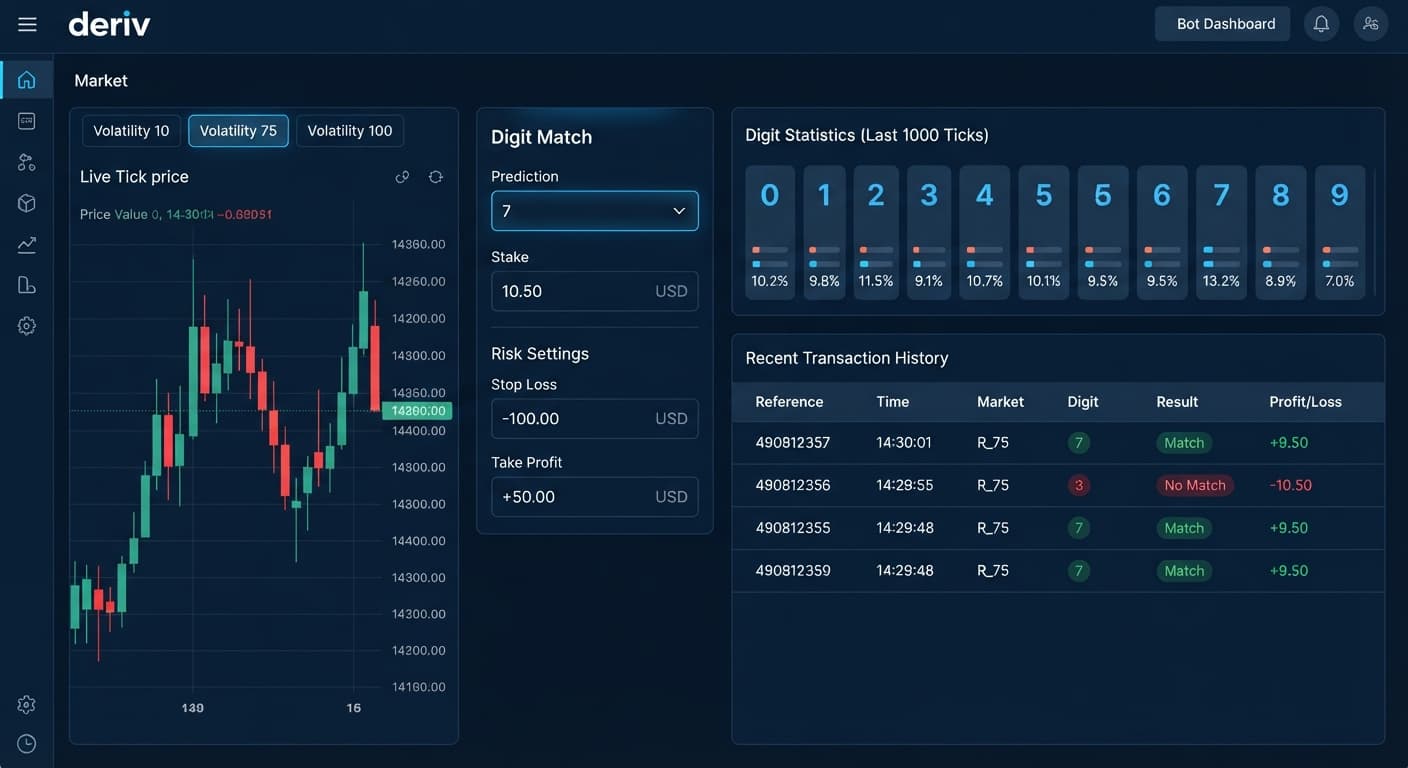
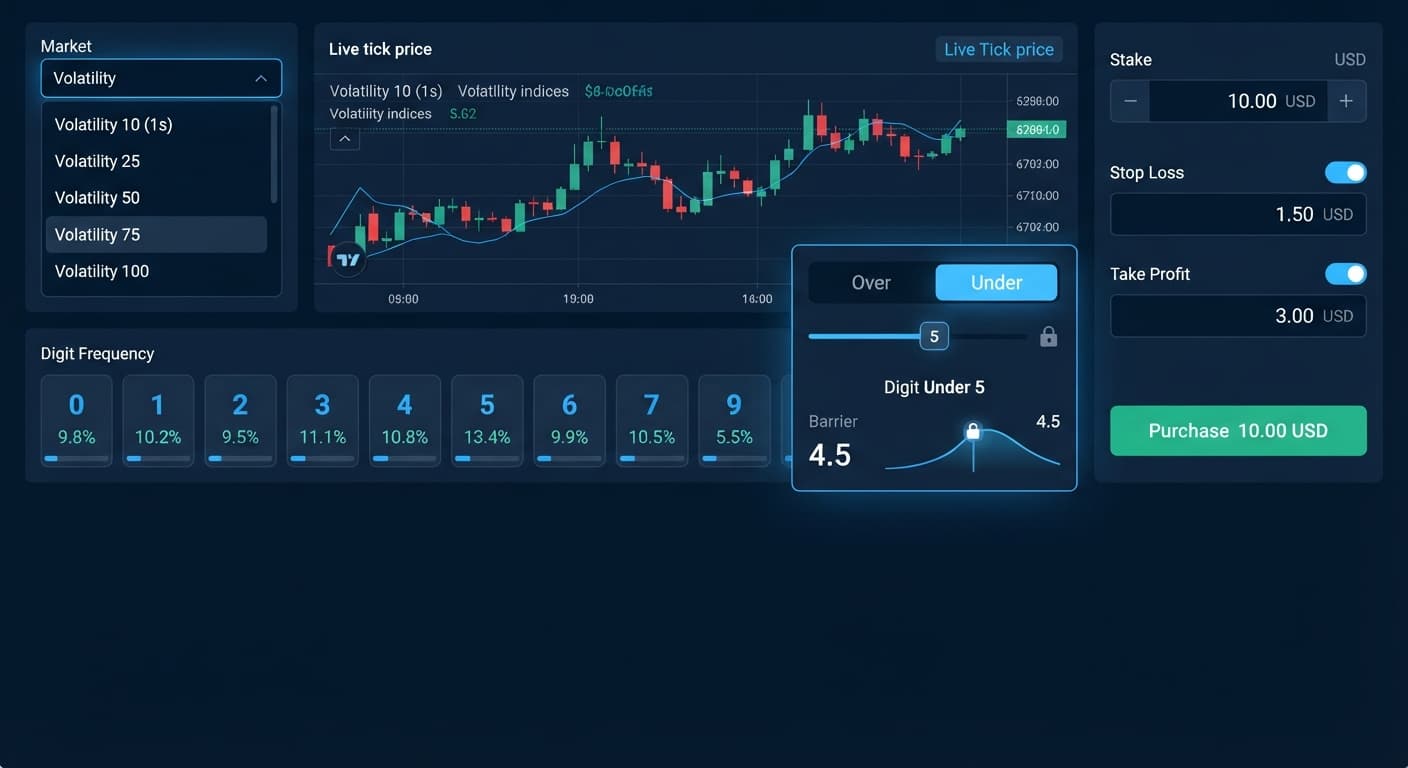
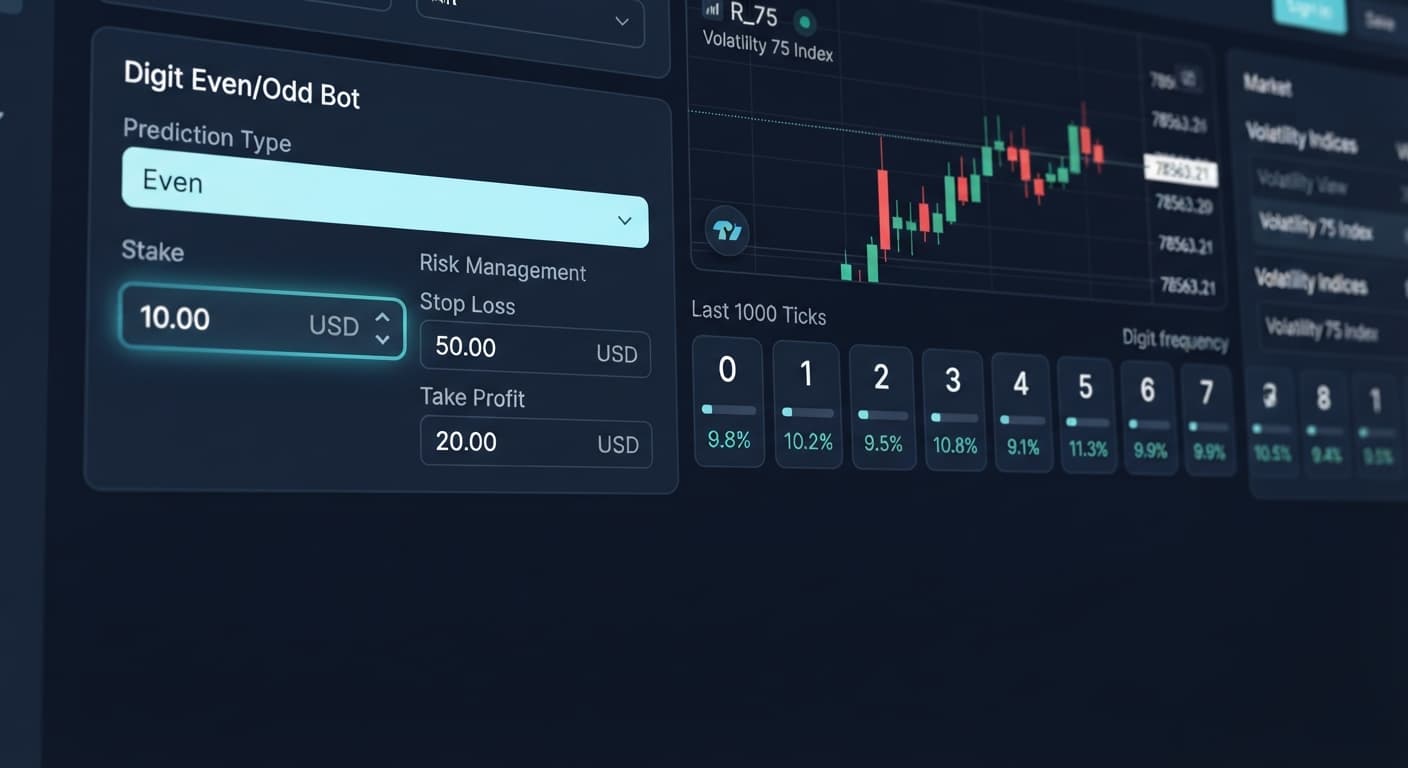
Synthetic index prices end in specific digits from 0 to 9 on every tick update. Tracking digit frequencies helps you see recent market conditions before setting up binary bots.
Here is a realistic snapshot of 500 consecutive ticks recorded on the Volatility 75 Index using open the LDP Analyzer:
| Last Digit | Occurrences (Out of 500 Ticks) | Frequency Percentage |
|---|---|---|
| 0 | 48 | 9.6% |
| 1 | 51 | 10.2% |
| 2 | 36 | 7.2% |
| 3 | 54 | 10.8% |
| 4 | 49 | 9.8% |
| 5 | 52 | 10.4% |
| 6 | 45 | 9.0% |
| 7 | 64 | 12.8% |
| 8 | 53 | 10.6% |
| 9 | 48 | 9.6% |
In this sample, digit 7 ran hot at 12.8%, while digit 2 ran cold at 7.2%. Seeing digit 7 appear more often might make a short-term trend look obvious, but every single tick remains mathematically independent.
Past distributions show what already happened. They don't force the next tick to follow suit. A cold digit can stay cold for another hundred ticks, and a hot digit can drop off instantly. Use frequency tables to monitor market behavior, not as a guarantee of what comes next.
Always use a virtual demo account when configuring a new strategy. Never run untested rules on real funds.
Log into your Deriv dashboard, go to account settings, and select Security & Limits, then API Token. Create a token with read and trade permissions, give it a label like "Bot Connection", and copy the generated key string.
Open launch the Solid Trading Bot interface. Paste your copied API key into the token input box and select connect. Your demo account balance will display in the corner of the dashboard.
Select your market, such as Volatility 100 Index. Set the contract direction to Rise/Fall (CALL/PUT) and select a short trade duration like 5 ticks. When you build a rise and fall deriv bot, choosing shorter durations lets you gather trade log data rapidly during testing.
Select Fixed Stake as your stake management strategy and enter a baseline value of $1.00. Next, enter your protective limits: set stop loss to $10.00 and take profit to $5.00. These guardrails instantly halt execution if either threshold is reached.
Click the start button to launch your automated run. Watch the real-time execution log closely for 20 trades. Verify that wins pay out as expected, contract durations match your inputs, and the script stops cleanly if your limits are hit.
Beginners often make setup mistakes that lead to unnecessary drawdowns when deploying binary bots. You can prevent most failures by configuring the correct risk controls inside your dashboard.
| Mistake | What Happens | Preventive Control | Recommended Value |
|---|---|---|---|
| Unlimited Losses | The bot runs through a bad streak and wipes out the entire balance. | stop loss | 10% to 20% of session bankroll |
| Profit Surrender | A winning session runs too long, turning gains into net losses. | take profit | 5% to 10% of session bankroll |
| Aggressive Multipliers | A loss triggers huge stake multipliers that exceed balance limits. | Fixed Stake | 1% or less of total bankroll per trade |
| Infinite Recovery Runs | The bot keeps compounding trade sizes through extended losing trends. | max ladder level | Limit progression steps strictly to 3 or 4 |
A common mistake when running a rise and fall deriv bot is forgetting to set a strict stop loss. Without a hard exit rule, bad market conditions will drain your balance while you're away from the screen. Always set hard numeric targets before pressing start.
If you want to test alternative trading modes later on, you can also explore contract types like DIGITEVEN, DIGITODD, DIGITOVER, DIGITUNDER, DIGITMATCH, or DIGITDIFF. Advanced strategies like Anti-Martingale, Fibonacci, D'Alembert, % of Balance, Mesamilano, or Multi Shot's Recovery offer different ways to manage trade sizing, but sticking to flat stakes is best while learning the basics on deriv bots.
Test your setup strategies directly using Solid Trading Bot on demo funds first.
If you don't have an active account yet, create a free Deriv account to get started.
Trading involves risk. Past performance does not guarantee future results.
Related: How to Trade Even Odd on Deriv with BinaryBot.live
How the strategies behind the bots actually work — Digit Differs, Over/Under, Even/Odd, Rise/Fall, and the money management that decides whether they survive a losing streak.
Try 9 Strategies on Solid →An API token is a unique alphanumeric key generated in your Deriv account settings that lets external bots place trades on your balance. It's safe because it doesn't reveal your account password or permit withdrawals.
A CALL contract wins if the market's exit price sits higher than your entry price when the trade duration ends. Even a tiny upward movement secures the standard payout.
No funds ever get deposited into third-party web tools when using automated tools. Trade execution happens directly inside your own Deriv account over a direct network connection.
No, past distributions only show what already happened and don't force the next tick to follow suit. Every single tick remains mathematically independent, meaning a cold digit can stay cold or a hot digit can drop off instantly.
Guides closest to this one.
Learn how to trade even odd on deriv using the BinaryBot.live digit bot. Configure an alternating pattern strategy step by step. Start trading today!
Learn how to trade digit match on deriv using the BinaryBot.live automated platform. Follow this step-by-step setup guide to build your strategy.
Learn how to trade over under on deriv with the BinaryBot.live Digit Over Under bot. Follow this step-by-step deriv bot trading strategy. Try it free!