Markets
Digit Differs on Volatility 75 with Binary Bots
Learn how to configure and execute digit differs on volatility 75 using free BinaryBot.live tools for synthetic indices. Start trading today.
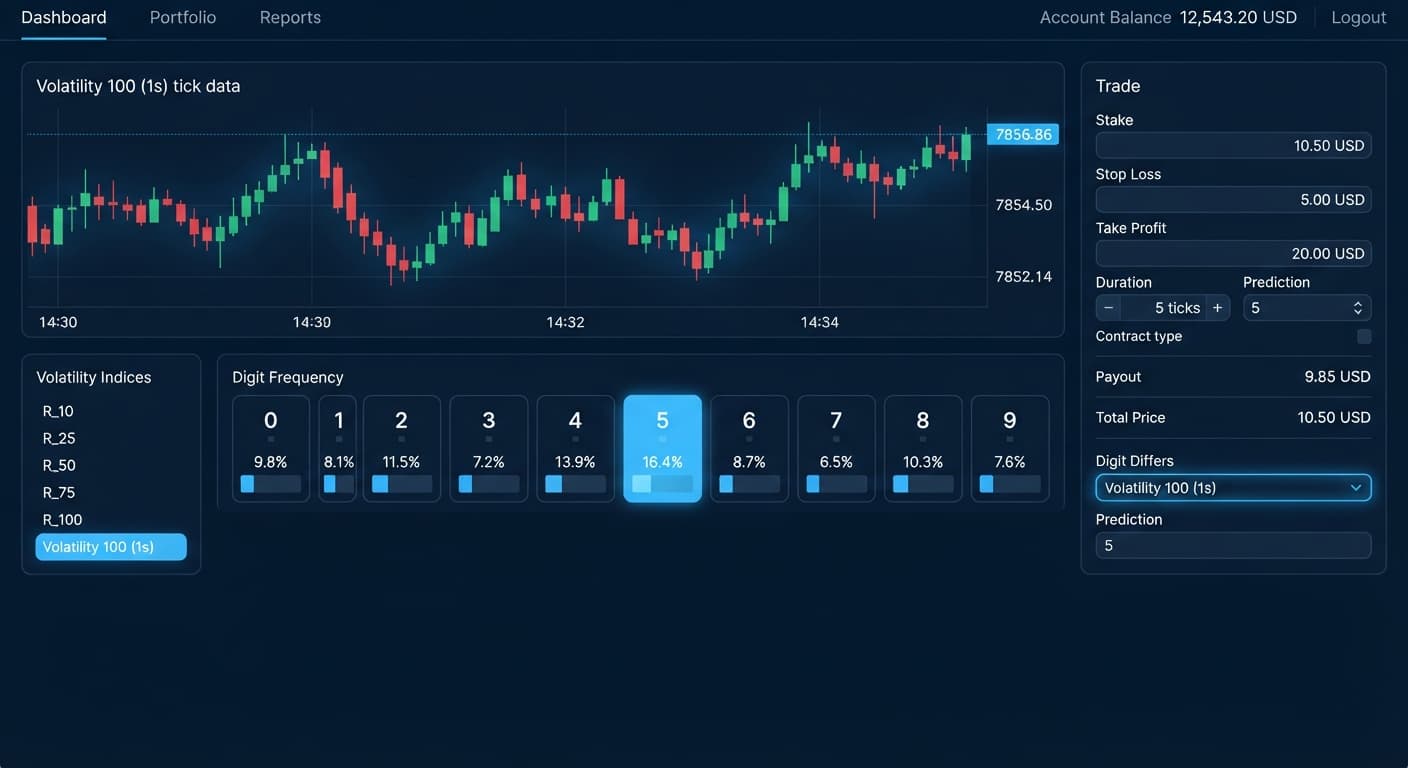
Running digit differs on volatility 100 contracts gives you a 90% statistical probability per tick because you win whenever the final digit of the tick stream does not match your chosen target digit. You collect a payout of roughly 9.9% on your stake per winning contract, which makes it ideal for fast, automated tick strategies. However, because a single loss erases ten consecutive wins, you need precise execution and firm risk parameters to stay ahead.
This guide breaks down how to run these contracts effectively, how tick streams work on synthetic markets, and how to configure free web tools to run your strategy automatically. This content is for educational purposes and isn't financial advice. Always test your strategies on a virtual balance before risking real money.
The short answer is yes, but only if you understand how the payout structure balances against the risk. Volatility 100 updates rapidly, offering price updates every second on the standard symbol and every second on the 1s variant. That high tick frequency allows automated scripts to process entries continuously without waiting for slow market movements.
When you purchase a DIGITDIFF contract on Volatility 100, your trade lasts between 1 and 10 ticks. If your target barrier is 5, and the tick finishes on any number from 0 to 9 except 5, you collect your profit instantly.
Tick sequence example: 4021.34 -> 4021.39 -> 4021.37
Target digit: 5
Last digit: 7 (Result: WIN)
Because the mathematical probability of avoiding a single digit on a random 0-9 distribution is 90%, Deriv sets the return at approximately 9.9%. If you stake $10, a win pays $0.99. A single loss costs you the $10 stake. That asymmetry means you cannot afford unpredictable execution delays or sloppy target selection when running automated trade routines.
Setting up deriv bots for DIGITDIFF contracts requires balancing your run duration with strict account protection settings. The table below outlines standard values you can configure on BinaryBot.live tools.
| Control Name | Verified Setting Value | Practical Execution Behavior | Target Trader Profile |
|---|---|---|---|
| Symbol | Volatility 100 (1s) Index | Reads new tick data every second for rapid automated execution | Traders wanting short, intense trading sessions |
| Contract Type | DIGITDIFF | Triggers a winning trade as long as the last digit avoids the prediction | High-frequency systematic traders |
| Prediction Digit | 0 through 9 | Defines the single barrier digit your contract must avoid | Traders filtering out high-frequency digits |
| Duration | 1 Tick | Evaluates and closes the trade on the very next price update | Traders targeting rapid automated trade cycles |
| Stop Loss | 20% of Session Capital | Automatically halts the bot if a sequence of losses hits your limit | Risk-focused accounts prioritizing capital protection |
| Take Profit | 10% of Session Capital | Closes the trading session immediately once target profit is reached | Disciplined traders locking in small, consistent gains |
I'd personally choose a 1-tick duration on the Volatility 100 (1s) Index paired with a strict 20% stop loss. Executing on 1-tick durations minimizes time exposure, letting the bot exit each trade instantly while relying on strict automated limits to shield your account from rare loss streaks.
Deriv synthetic indices operate on a cryptographically secure random number generator. That means every single tick on Volatility 100 is completely independent of the tick before it.
A common mistake among beginners who build strategies for binary bots is assuming that if the digit 4 has appeared three times in a row, it's less likely to appear on the next tick. That's a classic misconception known as the gambler's fallacy. The probability that the next tick ends in 4 remains exactly 10%, regardless of what happened over the last ten seconds.
Tick 1: 5214.83 (Digit 3)
Tick 2: 5214.93 (Digit 3)
Tick 3: 5215.03 (Digit 3)
Tick 4 Probability: Digit 3 STILL has a 10% chance
Why monitor tick statistics at all if every tick is independent? Watching live stats helps you spot temporary variance in short sample sizes. Over 10,000 ticks, digits distribute evenly at 10% each. Over a short window of 50 ticks, however, random distribution creates temporary clusters where certain digits appear less frequently. Traders use tools like the LDP Analyzer or LDP Analyzer Pro to identify these temporary cold spots and set their DIGITDIFF barrier to that under-represented digit.
You don't need to write code or download software to automate your trades. You can configure and run automated strategies directly from your web browser using free tools that connect to your trading account.
Navigate to the Solid Trading Bot dashboard in your browser. Paste your API token from your Deriv account settings into the connection field. The tool connects directly to Deriv over their official API, ensuring your trade commands trigger without middleman delays or manual confirmation steps.
Select Volatility 100 Index or Volatility 100 (1s) Index from the market selection drop-down. Under the contract settings, select DIGITDIFF. Set your contract duration to 1 Tick and set your baseline stake amount. Make sure you enter explicit values for Stop Loss and Take Profit before moving forward.
Open the Digit Pad tool in a separate tab to monitor live digit frequency. Set the tick history length to 50 or 100 ticks. Identify which digit is currently showing the lowest appearance percentage. Switch back to your bot setup and set your Prediction Digit to match that under-represented number.
Select your demo account balance inside the interface before starting the automation. Click the start button to begin executing automated digit differs on volatility 100 contracts. Watch the trade log to verify that the software processes ticks cleanly, accounts for profit targets, and respects your stop loss boundary without error.
When running automated routines, keeping an eye on execution speed is vital. Because DIGITDIFF strategies rely on a 90% win rate to offset standard payout rates, a delayed trade entry can alter your results if your execution slips across ticks.
If your web browser loses connection or suffers high latency, your running bot might miss a tick cycle or delay sending the next contract command. Fortunately, because trades settle on Deriv's servers rather than your local browser, any contract already submitted will close properly on their platform regardless of your internet connection status. If you see execution lag in your trade log, refresh your tab, re-verify your API connection, and ensure you aren't running heavy background downloads while running active sessions on binary bots.
When you run digit differs on volatility 100 systematically with proper controls, you remove human emotion from high-frequency execution. Keep your targets modest, use automated limits, and always test new parameters on virtual funds first.
Try it yourself on Solid Trading Bot using a demo balance first.
If you don't have an account yet, create a free Deriv account.
Trading involves risk. Past performance does not guarantee future results.
What actually differs between V10, V25, V50, V75 and V100, the 1-second variants, the Jump indices, and how each one behaves under a digit bot.
Trade These Markets →You get a 90% statistical probability per tick because you win whenever the final digit of the tick stream doesn't match your chosen target. Deriv sets the payout at roughly 9.9% of your stake for each winning contract to balance this out.
A single loss erases ten consecutive wins because one loss costs your full stake, while a win only pays about 9.9%. That payout asymmetry means you need firm risk parameters and precise execution to stay ahead.
You should use a 1-tick duration to evaluate and close the trade on the very next price update. This minimizes time exposure and lets the bot exit each trade instantly.
A verified stop loss setting is 20% of your session capital, which automatically halts the bot if a sequence of losses hits your limit. You should also pair this with a strict take profit set at 10% of your session capital.
Guides closest to this one.
Learn how to configure and execute digit differs on volatility 75 using free BinaryBot.live tools for synthetic indices. Start trading today.
Learn how to configure and run digit differs on volatility 50 using Deriv bots. Master synthetic indices setup on BinaryBot.live. Start trading today.
Master digit differs on volatility 10 using BinaryBot.live. Learn to configure synthetic indices bots safely and test strategies today.