Markets
Digit Differs on Volatility 75 with Binary Bots
Learn how to configure and execute digit differs on volatility 75 using free BinaryBot.live tools for synthetic indices. Start trading today.
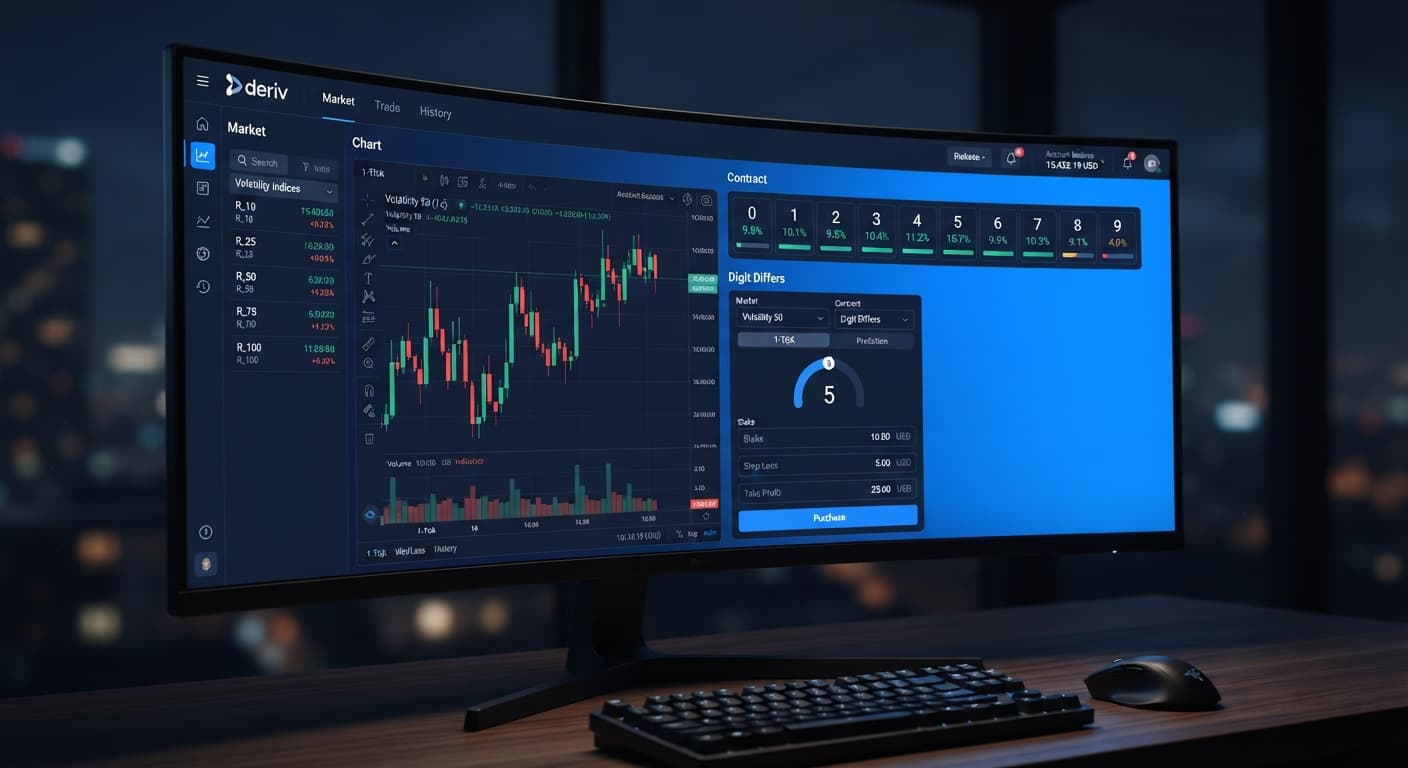
To set up a digit differs on volatility 50 strategy, you configure an automated trader to buy DIGITDIFF contracts on the Volatility 50 index, predicting the final digit of the current tick price won't match your target digit. Because a DIGITDIFF payout triggers on nine out of ten possible numbers, you win whenever any digit except your chosen barrier appears. You can execute this setup smoothly using free binary bots that connect directly to your Deriv account using an official API token.
Running a digit differs on volatility 50 setup gives you consistent, high-frequency execution on a market that never closes. Here's how the market moves, how to analyze its tick digits, and how to program the tools on BinaryBot.live.
Deriv synthetic indices rely on a cryptographic random number generator rather than real-world market news, central bank decisions, or economic reports. The underlying system creates price changes around the clock.
The number 50 in Volatility 50 refers to the simulated market volatility level. It is programmed to maintain an annualized volatility of 50%. This places it right in the middle of the standard synthetic index ladder, between Volatility 25 and Volatility 75.
Price quotes use standard floating-point numbers with specific decimal precision. When your bot places a contract, it looks exclusively at the last digit of the spot price at the exact moment the tick registers. On the API side, this asset is listed under the symbol R_50. Because price movement comes purely from an algorithm, digit distribution stays uniformly random across millions of ticks over the long run.
You have two choices when selecting this asset inside your trading tools: the standard Volatility 50 Index and the Volatility 50 (1s) Index.
Standard Volatility 50 generates a new price tick every two seconds. This slower pace gives manual traders time to monitor screens, but automated deriv bots handle both variants without slowing down.
The Volatility 50 (1s) Index generates one tick every single second. It moves twice as fast as the standard index.
Standard Volatility 50:  |--- 2 Seconds ---|--- 2 Seconds ---|  (30 ticks/min)
Volatility 50 (1s):      |- 1 Sec -|- 1 Sec -|- 1 Sec -|- 1 Sec -|  (60 ticks/min)
If you want fast execution and higher session volume, the 1s variant fits better. If you prefer space between automated orders so you can check your dashboard logs comfortably, stick with standard Volatility 50. The payout ratios and math mechanics for DIGITDIFF contracts stay identical on both markets.
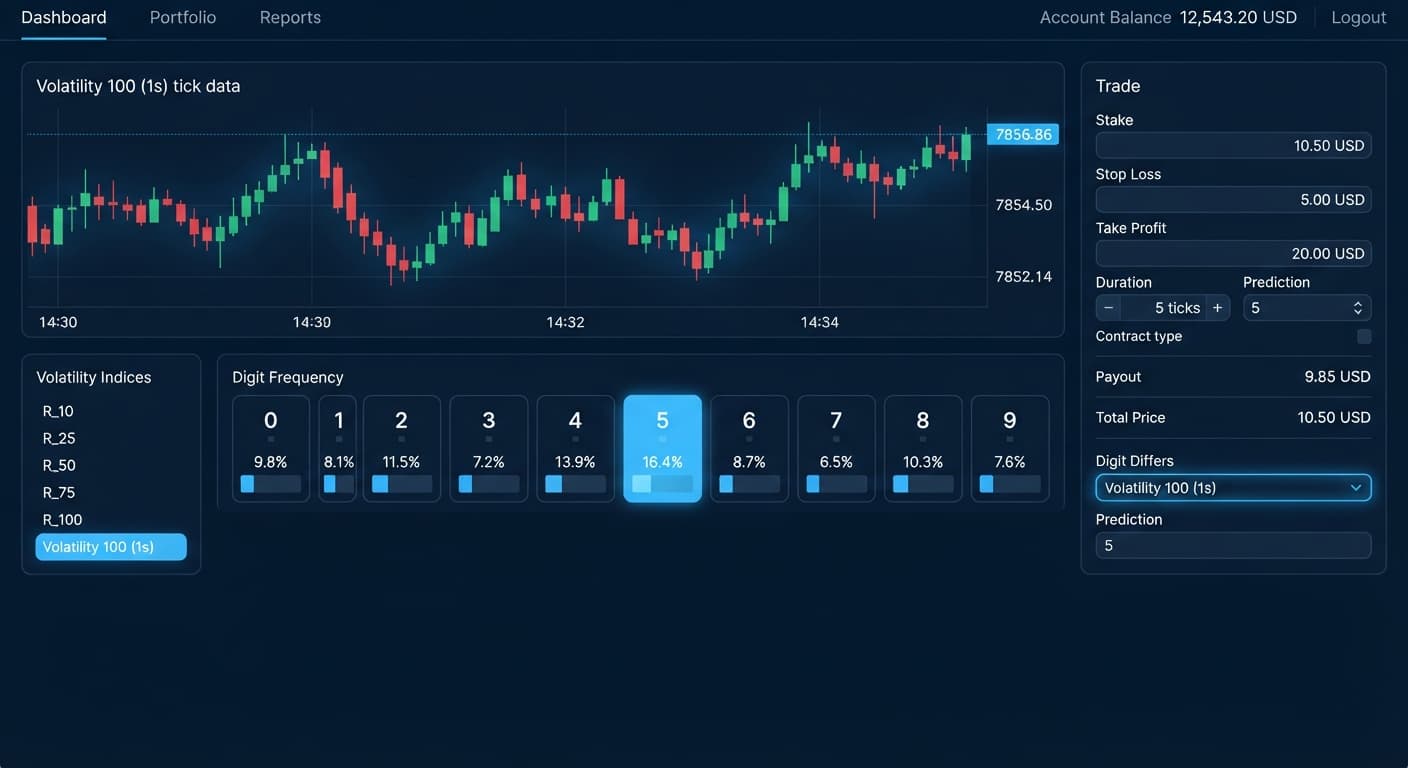
Before launching a bot, traders check digit tools like the LDP Analyzer Pro dashboard to see recent distribution stats. Below is a sample reading taken over 500 consecutive ticks on Volatility 50.
| Digit | Occurrences | Percentage | Status |
|---|---|---|---|
| 0 | 52 | 10.4% | Normal |
| 1 | 41 | 8.2% | Cold |
| 2 | 58 | 11.6% | Hot |
| 3 | 48 | 9.6% | Normal |
| 4 | 55 | 11.0% | Hot |
| 5 | 39 | 7.8% | Cold |
| 6 | 51 | 10.2% | Normal |
| 7 | 53 | 10.6% | Normal |
| 8 | 56 | 11.2% | Hot |
| 9 | 47 | 9.4% | Normal |
In this sample run, digit 5 registered lowest at 7.8% (39 occurrences), while digit 2 hit highest at 11.6% (58 occurrences).
When traders see digit 5 running cold, they often select 5 as their DIGITDIFF prediction target. The logic seems simple: if a digit hits less frequently during a brief cluster, avoiding it feels safer.
Here is the plain truth: previous tick statistics describe historical data, not future outcomes. Every tick on a Deriv synthetic index stays completely independent of the last. A cold digit can hit three times in a row, and a hot digit can disappear for two minutes straight. Frequency charts help you spot short-term session trends on your screen, but they do not alter the 10% mathematical probability of any single digit landing on the next tick.
You can set up your contract execution using the automated tools available on BinaryBot.live. Follow these instructions step by step to run your digit differs on volatility 50 automation correctly.
Go to the web interface and enter your API token generated inside your Deriv account settings. The bot connects directly to Deriv using their official connection protocol without routing funds through external servers. Always test your strategy using virtual funds on a demo balance first.
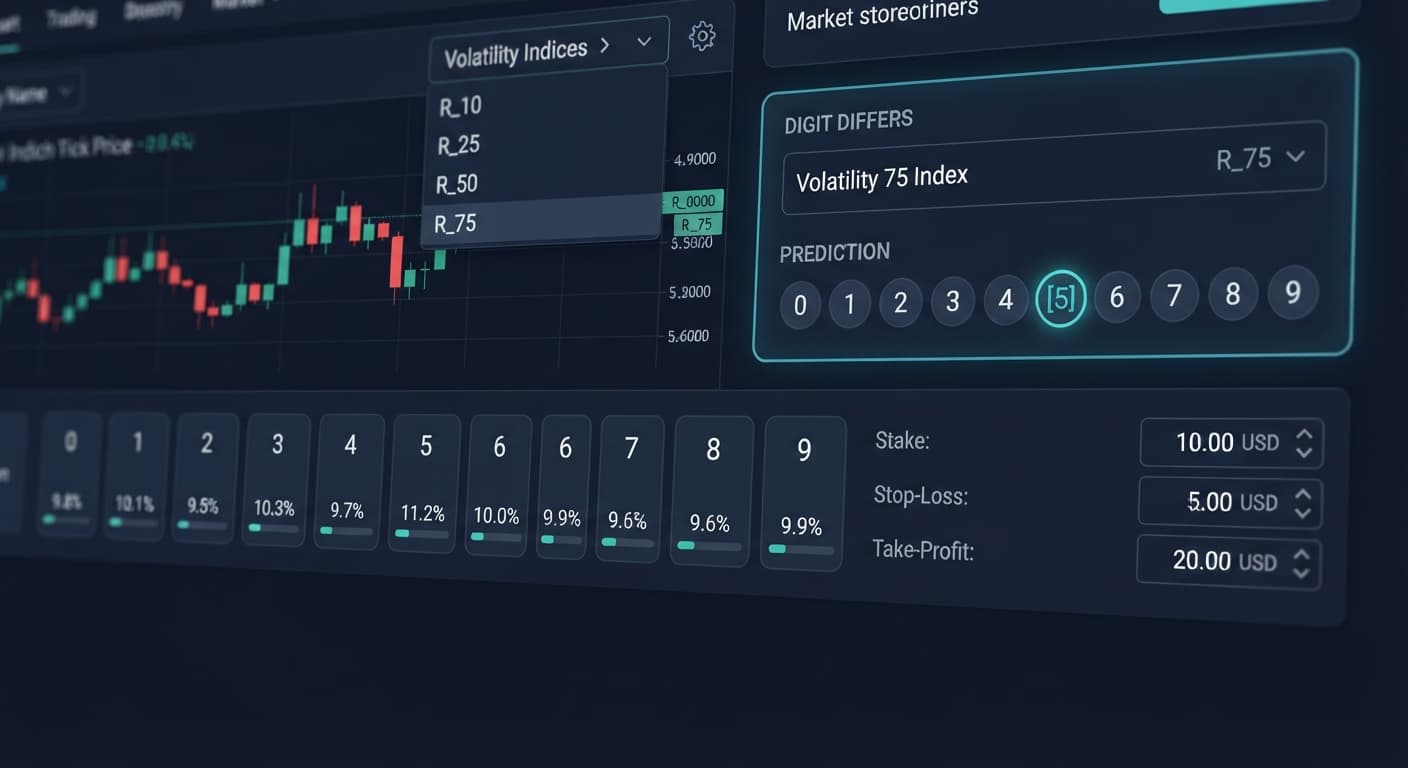
Choose Volatility 50 Index (or R_50) from the asset selection menu. Set the contract type to DIGITDIFF.
Set your trade duration to 1 tick. Pick your prediction target digit (0 through 9) based on your chosen strategy or recent digit analysis.
Define your initial stake, profit target, and total session stop loss. Because DIGITDIFF yields small payouts per win (around 9% return on stake), risk controls must be set firmly.
Here is a quick reference table showing optimal parameter configurations for setting up binary bots on Volatility 50:
| Setting Control Name | Recommended Value | Notes |
|---|---|---|
| Market / Asset | Volatility 50 Index | Select Volatility 50 (1s) Index for faster ticks |
| Trade Type | DIGITDIFF | Wins on any digit except target |
| Duration | 1 Tick | Quickest entry and exit cycle |
| Prediction | 0 to 9 | Choose based on cold stats or fixed target |
| Stop Loss | 15% to 20% of session bankroll | Protects against sudden repeating digit hits |
| Take Profit | 5% to 10% of session bankroll | Lock in gains early during steady runs |
When you launch a digit differs on volatility 50 bot on a live market, keep your session short. High win rates can lull you into leaving a bot unmonitored. That is usually where traders run into trouble.
A single loss on DIGITDIFF wipes out roughly eleven winning trades because of the asymmetric payout structure. If you suffer two losses close together, stop the bot immediately. Do not increase stake multipliers aggressively to chase losses; that approach burns accounts fast when a target digit clusters.
Check your internet connection stability before clicking start. If your browser drops connection while a trade processes, the platform's backend still completes the trade on Deriv, but your screen logs might fail to refresh instantly. Keep your dashboard open and clear your session logs every few hundred trades to maintain crisp browser performance.
You can try it yourself on the free tools using a demo balance first.
If you don't have an account yet, create a free Deriv account to get started.
Trading involves risk. Past performance does not guarantee future results.
What actually differs between V10, V25, V50, V75 and V100, the 1-second variants, the Jump indices, and how each one behaves under a digit bot.
Trade These Markets →It's a synthetic index that maintains an annualized volatility of 50 percent using a cryptographic random number generator. Price quotes use floating-point numbers, and the asset is listed under the symbol R_50 on the API side.
Standard Volatility 50 generates a new price tick every two seconds, while the 1s variant generates a tick every single second. Both share identical payout ratios and math mechanics for DIGITDIFF contracts.
It's an automated setup that buys DIGITDIFF contracts predicting the final digit of the current tick price won't match a chosen target digit. You win whenever any number appears except your selected barrier, since the contract triggers on nine out of ten possible numbers.
You can use free binary bots on platforms like BinaryBot.live that connect directly to your Deriv account using an official API token. This allows you to execute automated setups smoothly without slowing down.
Guides closest to this one.
Learn how to configure and execute digit differs on volatility 75 using free BinaryBot.live tools for synthetic indices. Start trading today.
Learn how to trade digit differs on volatility 100 using free Deriv bots on BinaryBot.live. Master setup and execution steps today. Try it now!
Master digit differs on volatility 10 using BinaryBot.live. Learn to configure synthetic indices bots safely and test strategies today.