Markets
Digit Differs on Volatility 50 Deriv Bots Setup
Learn how to configure and run digit differs on volatility 50 using Deriv bots. Master synthetic indices setup on BinaryBot.live. Start trading today.
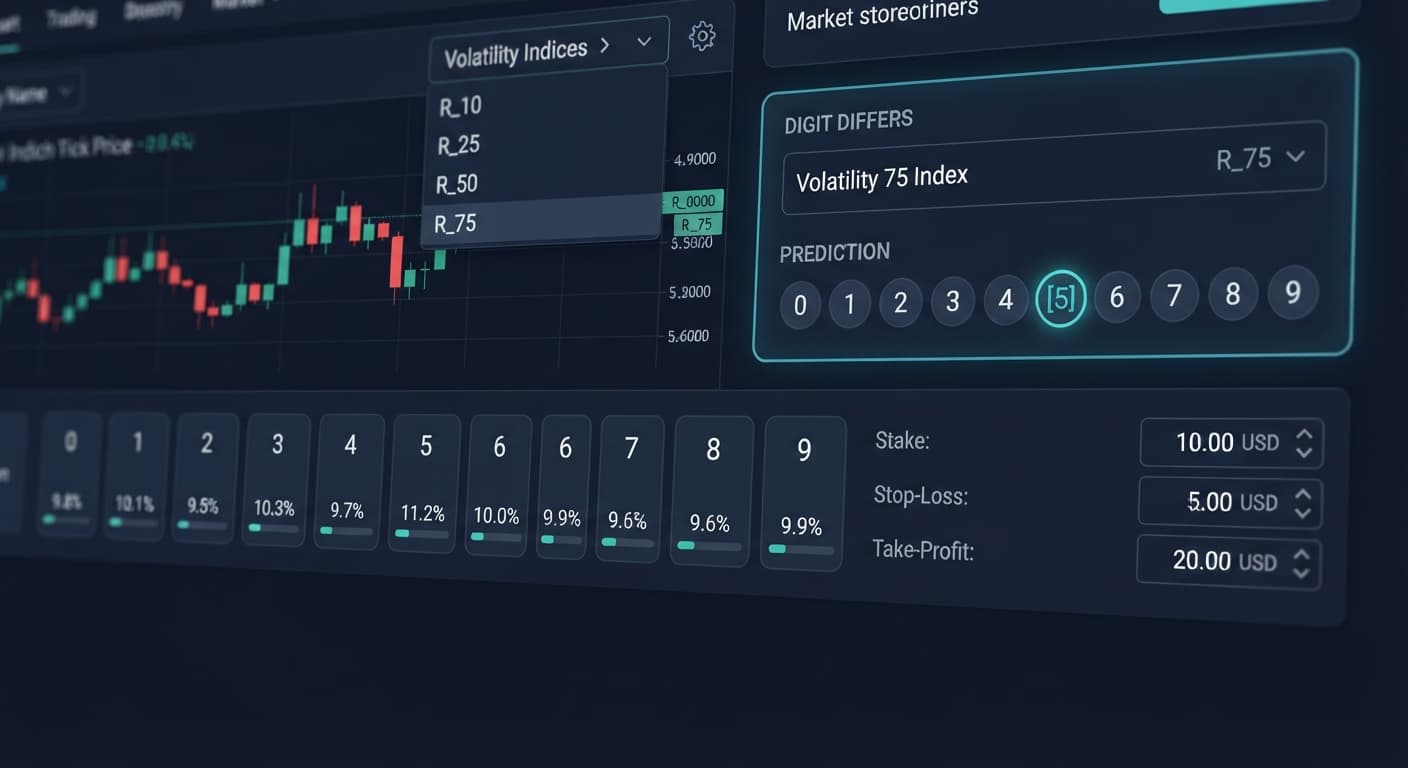
Executing a strategy for digit differs on volatility 75 means predicting that the last digit of the index tick won't match your selected prediction digit. Because nine out of ten possible digits result in a win, DIGITDIFF contracts feature a high theoretical hit rate of 90%, paired with a low return of roughly 9.8% per winning trade. Using automated binary bots to run this setup removes human latency, placing 1-tick contracts instantly when your configured tick conditions are met.
Volatility 75 is a synthetic index driven by a cryptographic algorithm that operates continuously, completely independent of real-world financial market news. The number 75 represents its simulated annualized volatility of 75%. That high volatility creates large price jumps between ticks, but it doesn't change how last digits work. The final digit of every tick is extracted directly from the smallest decimal place of the index price display.
Whether the index price leaps 50 points or drops 100 points on a single tick, the final decimal place holds an equal 10% theoretical probability for every digit from 0 through 9. It's easy to assume that rapid price swings alter digit distributions, but they don't. Each tick is statistically independent of the tick before it. Traders using deriv bots for synthetic index trading target Volatility 75 because its speed keeps trade execution moving quickly without waiting for traditional market sessions to open.
Tick speed changes how fast your session runs. The standard Volatility 75 index creates a new tick every two seconds. The Volatility 75 (1s) index produces a new tick every single second.
When trading digit differs on volatility 75 on the 1s variant, your 1-tick contract opens and settles in exactly one second. That's twice as fast as the standard index. High tick frequency means binary bots process trading logic much faster, letting you hit your session targets in fewer total minutes.
However, higher speed also accelerates your drawdown if the bot runs into a clustering of loss ticks. The underlying last-digit math stays identical across both market variants; only the execution pace changes. Choosing between them comes down to connection stability and how quickly you want contracts to settle.
Before putting live funds into DIGITDIFF contracts, you need to understand the payout math. There are ten possible last digits (0 through 9). When you buy a DIGITDIFF contract, you pick one digit to avoid. Nine digits win; one digit loses. That gives you a 90% static probability of winning any single trade.
Deriv pays approximately $0.98 on a $10.00 trade stake for a winning DIGITDIFF contract. That's a 9.8% net payout. If your trade loses, you forfeit your full $10.00 stake.
Here's the exact arithmetic to find your break-even win rate:
Plugging in the numbers:
To break even trading digit differs on volatility 75, you need a hit rate of 91.07%. Because the raw probability of the market gives you 90.00%, the platform holds a built-in mathematical edge of 1.07%. Over a large volume of un-filtered trades, running DIGITDIFF automatically will lose ground. Winning requires short, targeted trading sessions, strict profit caps, and statistical entry filters to avoid trading directly into long runs against your selected digit.
To automate this strategy without manual clicking, you can connect tools like Solid Trading Bot or Sniper Bot V3 directly to Deriv over their official API. If you want to analyze live digit distributions before running a strategy, open LDP Analyzer Pro to monitor last-digit frequencies in real time.
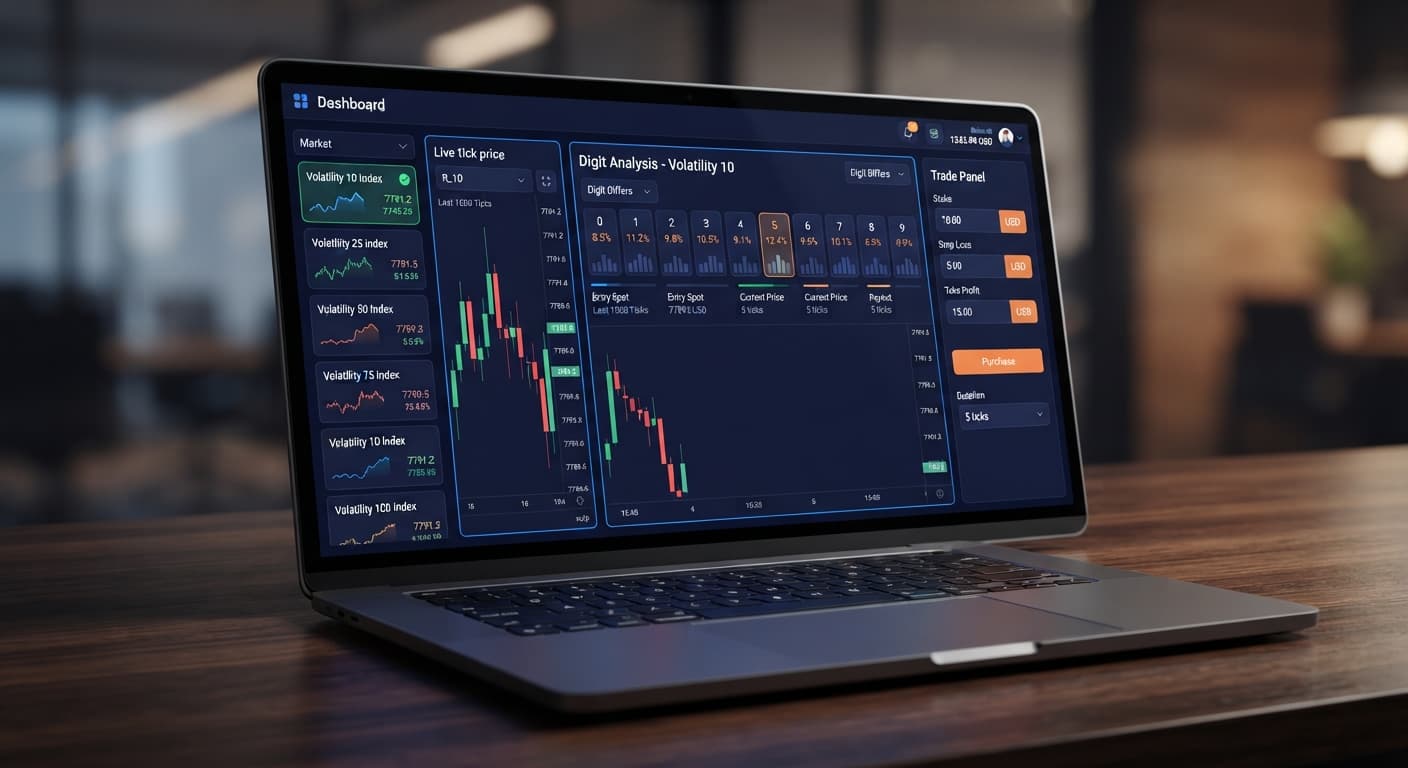
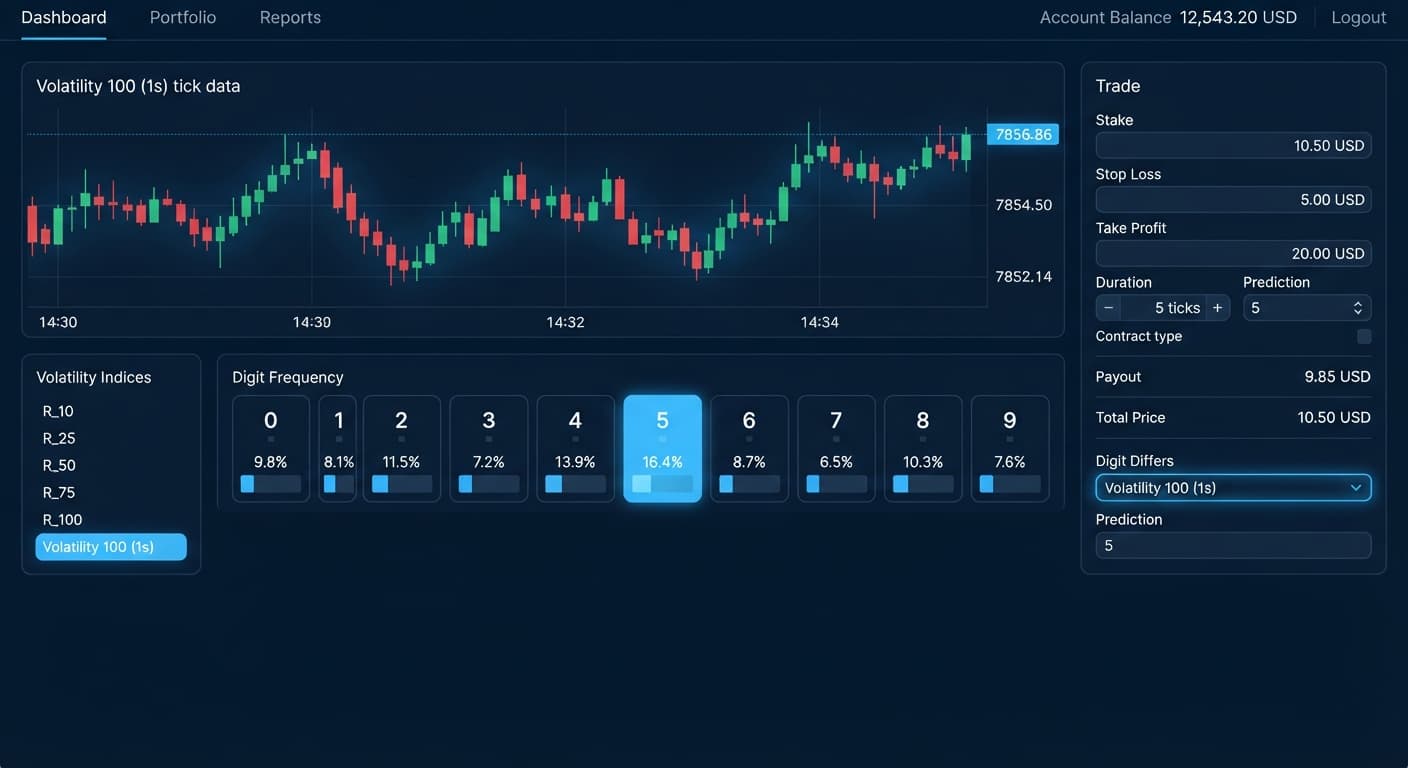
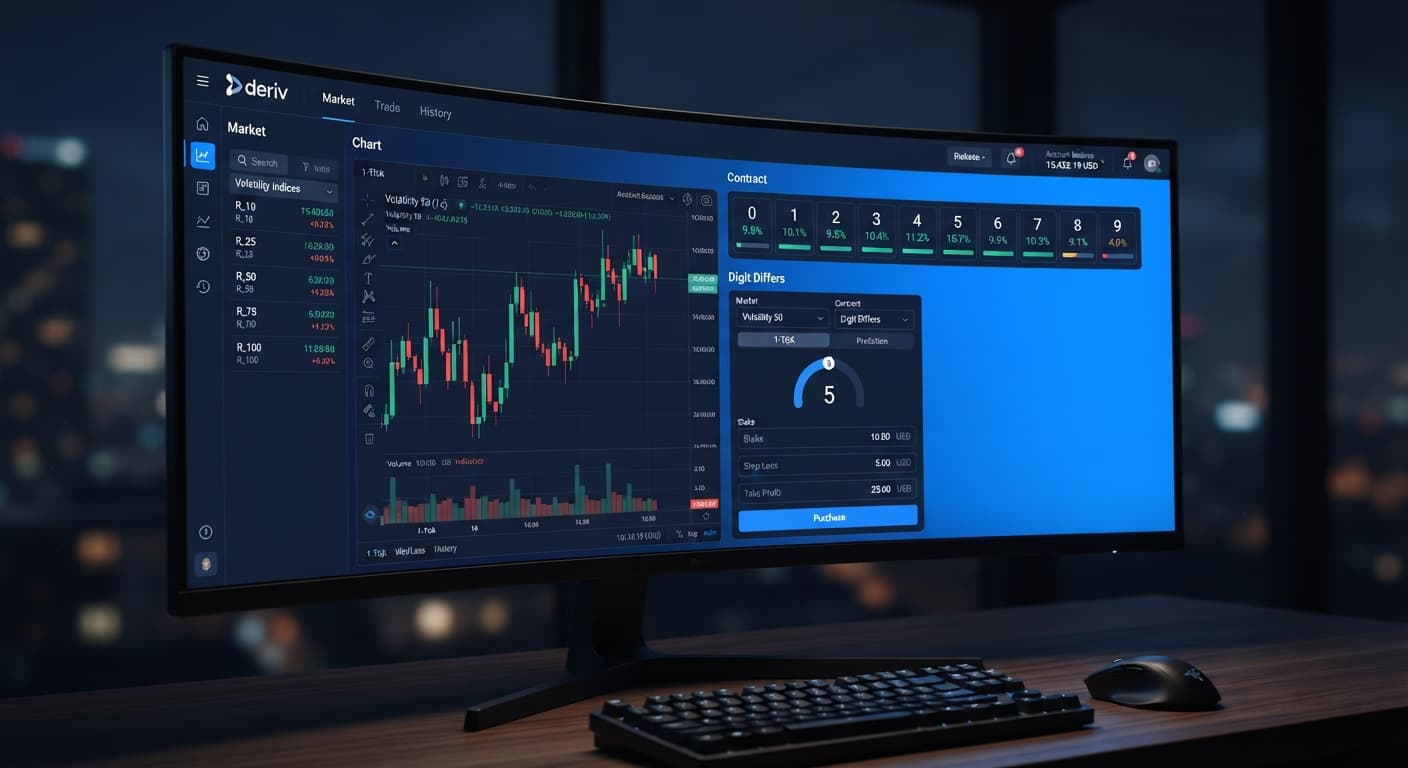
When setting up digit differs on volatility 75, your controls must match the quick tick speed of the index. Here is how key parameters look in the dashboard interface:
| Control Name | Recommended Setting | Operational Purpose |
|---|---|---|
| Market / Symbol | Volatility 75 Index (or 1s) | Selects the target synthetic asset |
| Trade Type | DIGITDIFF | Sets contract win condition to non-matching digits |
| Duration | 1 Tick | Settles contract immediately on the next tick |
| Prediction Digit | Coldest Digit (from analyzer) | Avoids digits currently appearing above statistical average |
| Stop Loss | 15% to 20% of session capital | Automatically halts the bot if a loss sequence occurs |
| Take Profit | 2% to 5% of session capital | Stops execution once profit targets are met |
Follow these execution steps to set up your automated session correctly.
Log into your tool dashboard on BinaryBot.live and paste your API token. Choose Volatility 75 Index (or the 1s variant) from the market selection menu. Set the contract type to DIGITDIFF and duration to 1 tick. Using deriv bots with 1-tick durations minimizes exposure time during open trades.
Use an integrated tool like Tick Picker or Digit Pad to analyze the recent 100-tick distribution. Look for a digit that has appeared significantly below its 10% theoretical average (for example, a digit that appeared only 3 times in 100 ticks). Set your bot prediction parameter to that cold digit. While past ticks don't guarantee future outcomes, filtering out recently active digits avoids placing trades into temporary digit spikes.
Enter your profit and risk limits before launching automated trade execution. If your session balance is $100.00, cap your take profit target at $3.00 and set a strict stop loss at $15.00. Never start an automated run without setting these limits. Launch your strategy on a Deriv demo account first to verify that ticks, duration, and contract triggers execute properly before putting real money on the line.
Try it yourself on Solid Trading Bot using a demo balance first. If you don't have one yet, create a free Deriv account. Trading involves risk. Past performance does not guarantee future results.
What actually differs between V10, V25, V50, V75 and V100, the 1-second variants, the Jump indices, and how each one behaves under a digit bot.
Trade These Markets →Digit Differs contracts feature a 90% theoretical hit rate because nine out of ten possible digits result in a win. In return, the payout is low, offering roughly 9.8% per winning trade.
You need a hit rate of 91.07% to break even when trading digit differs on Volatility 75. Since the payout is about $0.98 on a $10 stake against a full $10 loss, it requires a very high success rate to cover losses.
The standard Volatility 75 index creates a new tick every two seconds, while the 1s variant produces a new tick every single second. This means trades on the 1s variant settle twice as fast, but it also accelerates your drawdown if the bot hits a cluster of losses.
No, large price jumps don't change how last digits work. Every digit from 0 through 9 maintains an equal 10% theoretical probability, and each tick is statistically independent of the one before it.
Guides closest to this one.
Learn how to configure and run digit differs on volatility 50 using Deriv bots. Master synthetic indices setup on BinaryBot.live. Start trading today.
Master digit differs on volatility 10 using BinaryBot.live. Learn to configure synthetic indices bots safely and test strategies today.
Learn how to trade digit differs on volatility 100 using free Deriv bots on BinaryBot.live. Master setup and execution steps today. Try it now!