Markets
Digit Differs on Volatility 75 with Binary Bots
Learn how to configure and execute digit differs on volatility 75 using free BinaryBot.live tools for synthetic indices. Start trading today.
Trading digit differs on volatility 10 involves buying Deriv contracts that pay out when the final digit of the index tick does not match your chosen barrier. On Volatility 10, a DIGITDIFF contract carries a 90% theoretical probability of winning on every single tick, returning roughly 9.9% profit on your stake. While this high win frequency makes it popular among traders, automating it requires strict capital management because a single loss erases roughly ten wins.
Volatility 10 (symbol R_10) is a synthetic index that simulates a market with a constant annualized volatility of 10%. It does not mirror any real-world financial asset, foreign exchange pair, or stock market commodity. Instead, a server-side random number generator outputs price ticks 24 hours a day, 7 days a week.
The 10% volatility setting controls how violently price ticks swing from one tick to the next. Compared to higher volatility indices like Volatility 100, price movements on Volatility 10 are small and gradual. However, digit trading does not depend on price direction or trend strength. It depends strictly on the final numerical digit of the tick price. If the index price sits at 245.834, the last digit is 4. When your bot places a contract, Deriv checks whether the last digit of the contract's exit tick matches your prediction digit. If it differs, you win.
Tick intervals on this market are fixed. Standard Volatility 10 ticks every two seconds, whereas Volatility 10 (1s) ticks every single second. Running bots on the 1-second variant cuts your execution time in half, meaning your session targets—and your drawdowns—happen twice as fast.
Every tick generates a last digit from 0 through 9 with equal statistical probability. Each digit has a 10% chance of appearing on any given tick. Because tick generation uses independent probability, past ticks have zero mathematical effect on future ticks. If the digit 3 appears three times consecutively, the probability of digit 3 appearing on the fourth tick remains exactly 10%.
Traders who monitor digit differs on volatility 10 charts often watch for long streaks where a single digit fails to appear, expecting it to hit soon. That is a statistical fallacy. The generator has no memory. Automating trades based on past digit counts will not change the underlying 90% probability of a DIGITDIFF contract.
You can run this strategy using the Solid Trading Bot available on BinaryBot.live. The tool connects directly to Deriv over their official API using your personal API token, placing trades directly inside your Deriv account without storing your funds on external servers.
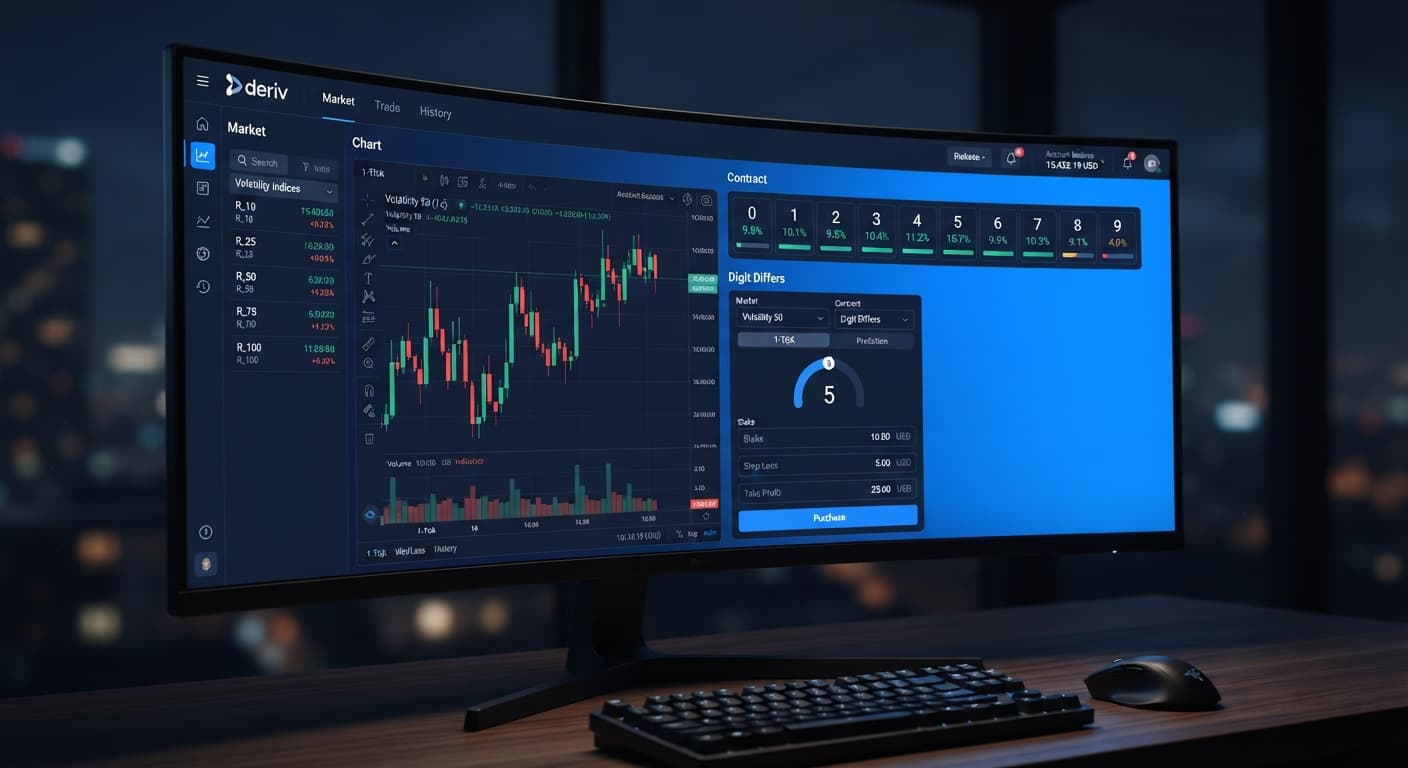
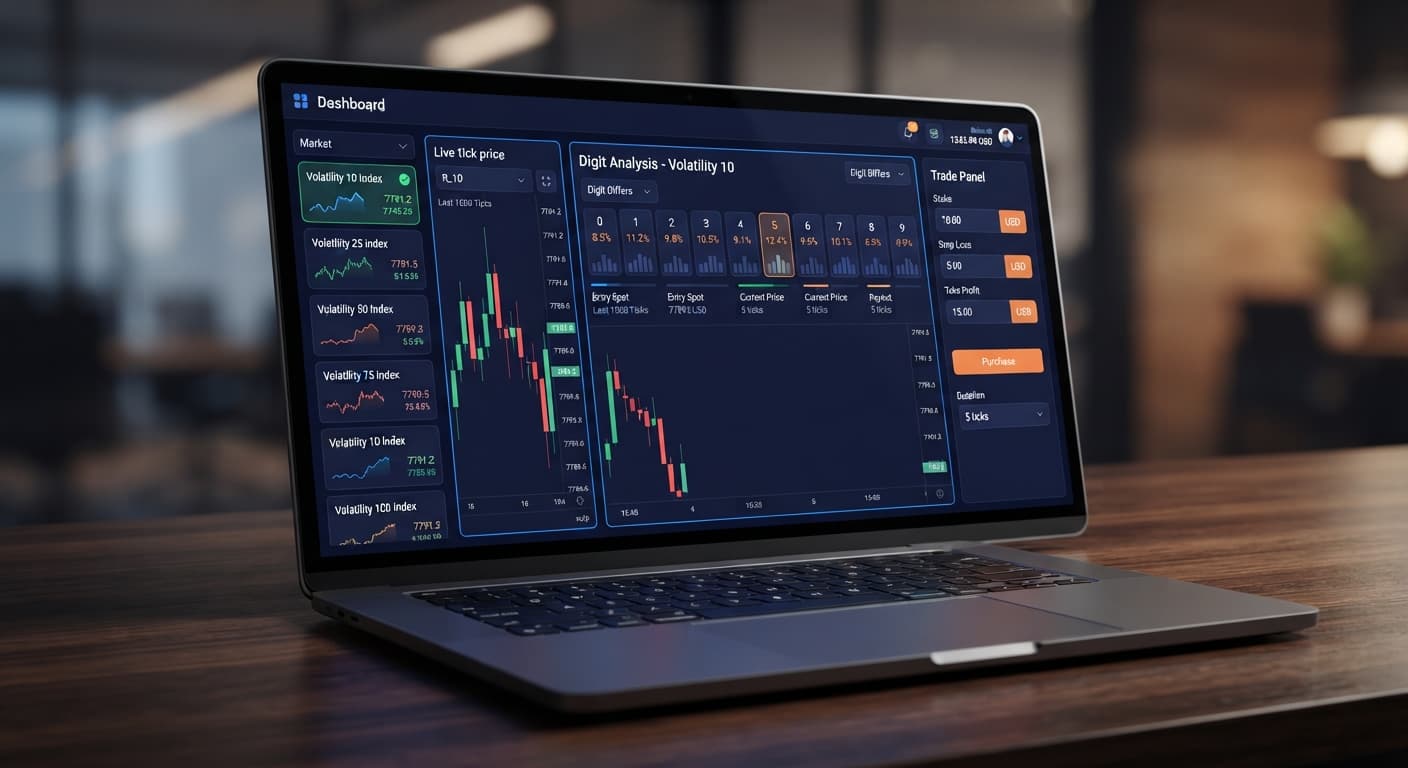
When configuring deriv bots for short-duration digit contracts, speed and API stability matter most. The Solid Trading Bot handles 1-tick durations on both Volatility 10 and Volatility 10 (1s) without manual trade entry delays. You can select standard volatility indices or jump indices, pick your contract type, and set your automated risk limits within the dashboard interface.
Automating binary bots for digit trading helps eliminate emotional discipline failures like manual over-trading. But automation executes trades rapidly. If your stake parameters are miscalculated, automated bots will cycle through your account balance long before you can stop them. You should always run your bot on a free Deriv demo account before applying real funds.
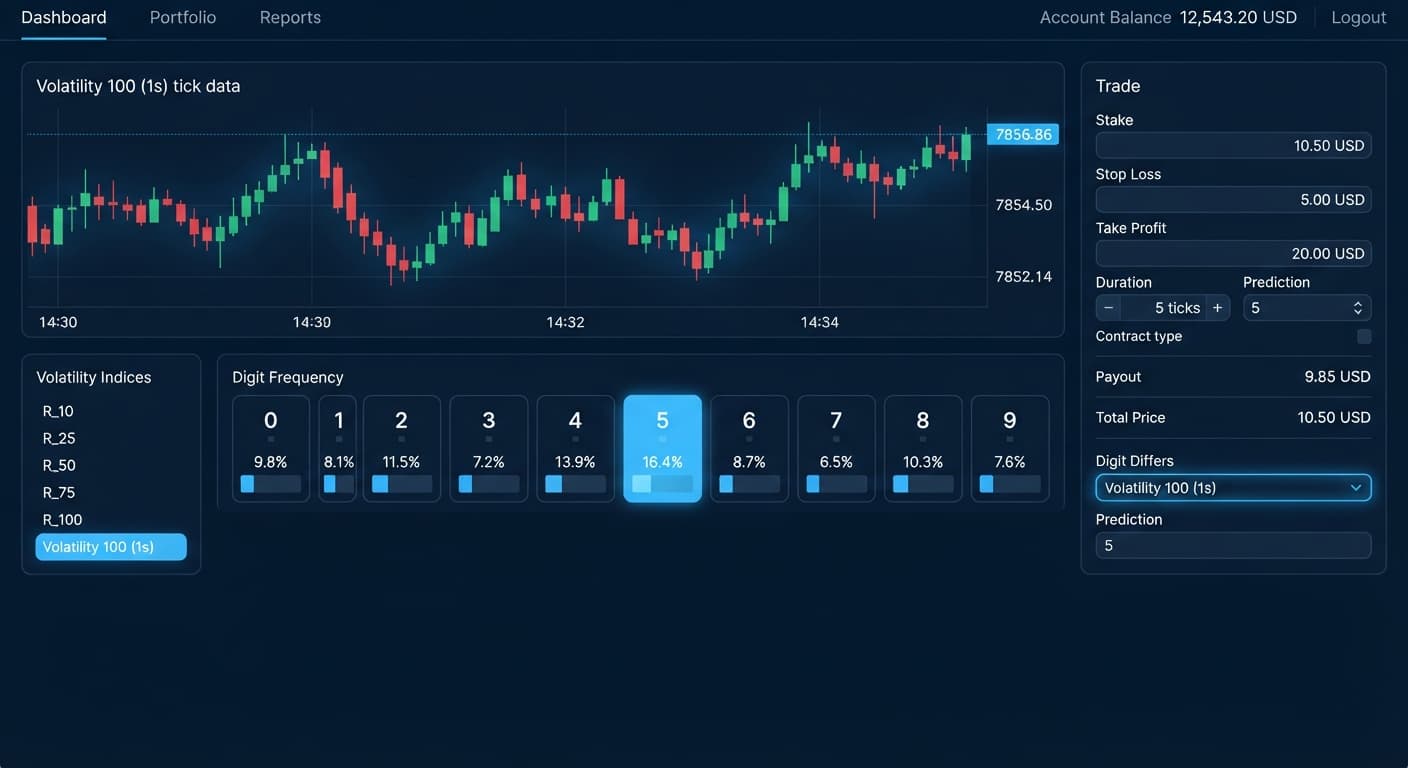
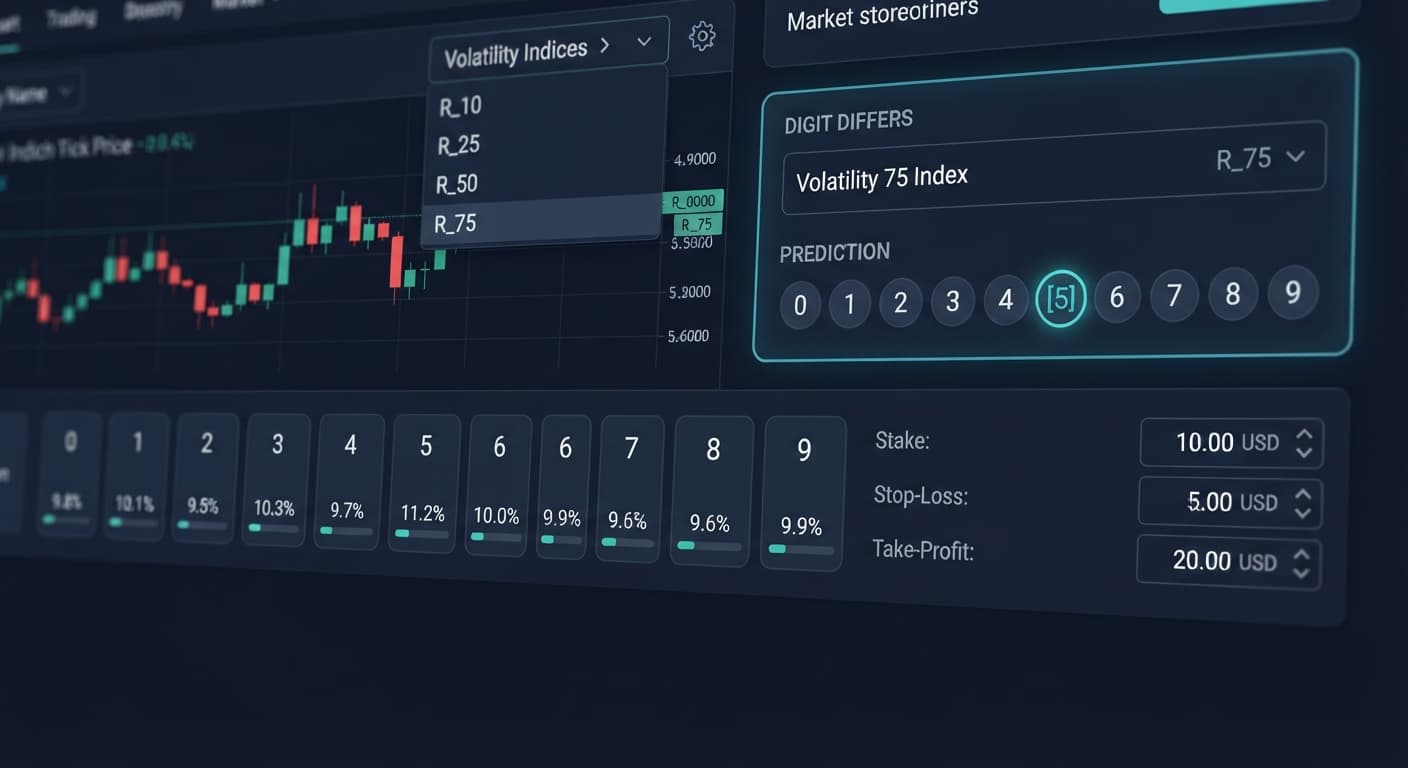
To set up a digit differs on volatility 10 automated strategy, select DIGITDIFF under the contract options, set the market to Volatility 10 or Volatility 10 (1s), set the duration to 1 tick, and pick a single prediction digit between 0 and 9.
| Control Parameter | Target Value | Direct Function |
|---|---|---|
| Symbol / Market | Volatility 10 (R_10) or Volatility 10 (1s) | Defines tick frequency (2s vs 1s) |
| Contract Type | DIGITDIFF | Payout occurs if tick digit != prediction |
| Duration | 1 Tick | Resolves contract on immediate next tick |
| Prediction | Any digit (0 to 9) | Sets the single losing barrier digit |
| Base Stake | 0.5% to 1% of total session bankroll | Prevents immediate account destruction |
Because DIGITDIFF pays out around 9.9% on winning contracts, compensating for a loss requires an aggressive stake multiplier. While even-money contracts like DIGITEVEN or DIGITODD use a 2x martingale multiplier, DIGITDIFF requires approximately an 11x multiplier to recover the original lost stake plus a small profit.
Let's walk through a real trading scenario with concrete numbers.
Assume your starting Deriv balance is $100, and you set your base stake to $10 on Volatility 10.
To recover the $10 loss on Trade 3, your bot calculates the next trade stake using an 11x multiplier ($10 base stake x 11 = $110 required stake).
At this point, your account balance sits at $91.98. You cannot even place Trade 4 because your balance is smaller than the required $110 stake. Your trading bot halts due to insufficient funds, leaving you with a $10 net loss after winning two trades and losing just one.
Now look at a larger account balance of $2,000 using that same $10 base stake:
If Trade 5 loses, your account loses $1,440 out of your $2,000 starting balance in three consecutive ticks.
This math illustrates why digit differs on volatility 10 strategies demand tiny initial stakes relative to your account bankroll. Keep your base stake under 1% of your total balance, and cap maximum consecutive martingale steps to 1 or 2.
Test your setup on the free Deriv trading tools using a virtual account first. If you do not have an active Deriv account yet, create a free Deriv account to start testing. Trading involves risk. Past performance does not guarantee future results.
Related: Trading Volatility 75 on Digit Match and Differ Bots
Related: Configuring Digit Differ Strategy Using deriv bots india
What actually differs between V10, V25, V50, V75 and V100, the 1-second variants, the Jump indices, and how each one behaves under a digit bot.
Trade These Markets →A DIGITDIFF contract on Volatility 10 carries a 90% theoretical probability of winning on every single tick. However, a single loss erases roughly ten wins, making strict capital management essential.
Standard Volatility 10 ticks every two seconds, while the 1-second variant ticks every single second. Running bots on the 1-second variant cuts your execution time in half, meaning drawdowns happen twice as fast.
No, past ticks have zero mathematical effect on future ticks because the generator has no memory. Each digit always has an independent 10% chance of appearing on any given tick.
You should always run your bot on a free Deriv demo account before applying real funds. This helps you avoid miscalculating your stake parameters and cycling through your balance too quickly.
Guides closest to this one.
Learn how to configure and execute digit differs on volatility 75 using free BinaryBot.live tools for synthetic indices. Start trading today.
Learn how to trade digit differs on volatility 100 using free Deriv bots on BinaryBot.live. Master setup and execution steps today. Try it now!
Learn how to configure and run digit differs on volatility 50 using Deriv bots. Master synthetic indices setup on BinaryBot.live. Start trading today.