Markets
Digit Differs on Volatility 100 Deriv Bots Guide
Learn how to trade digit differs on volatility 100 using free Deriv bots on BinaryBot.live. Master setup and execution steps today. Try it now!
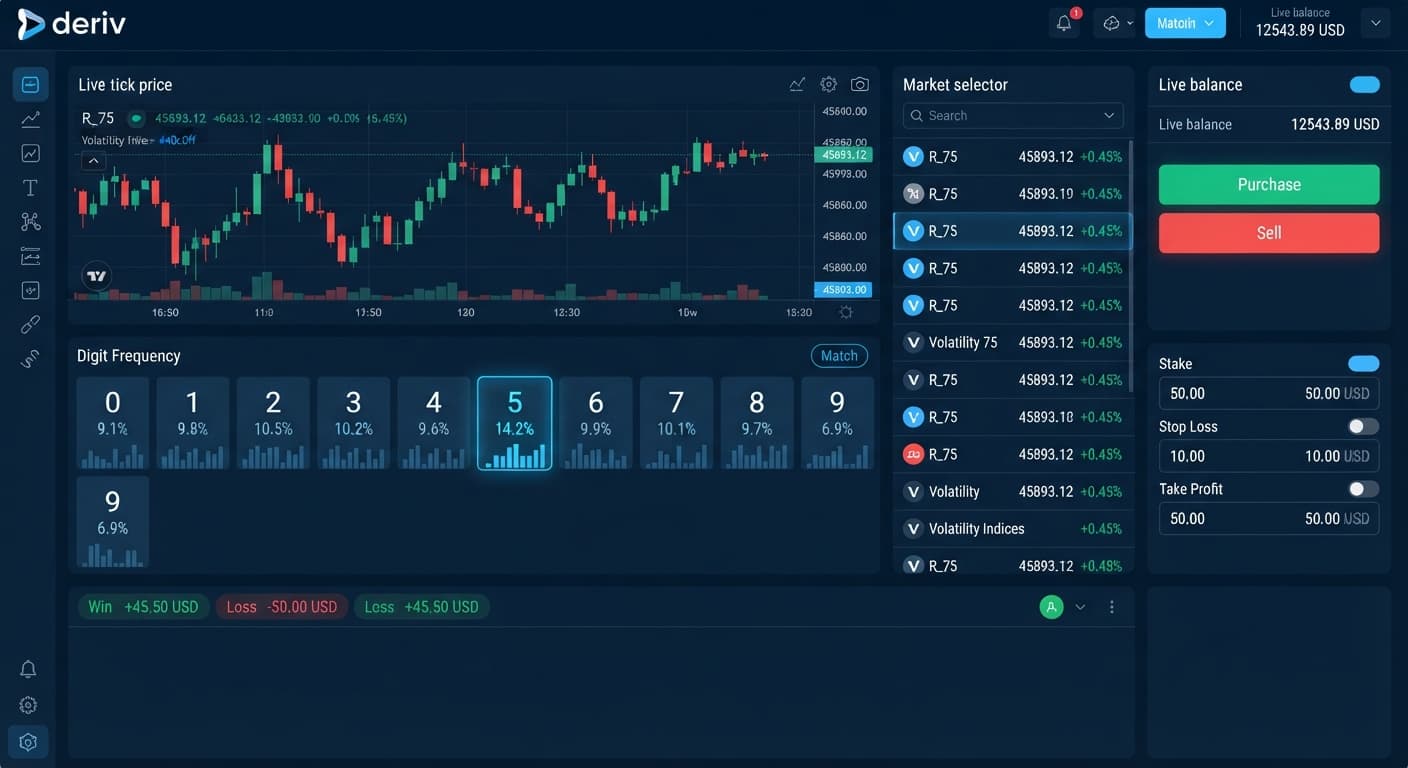
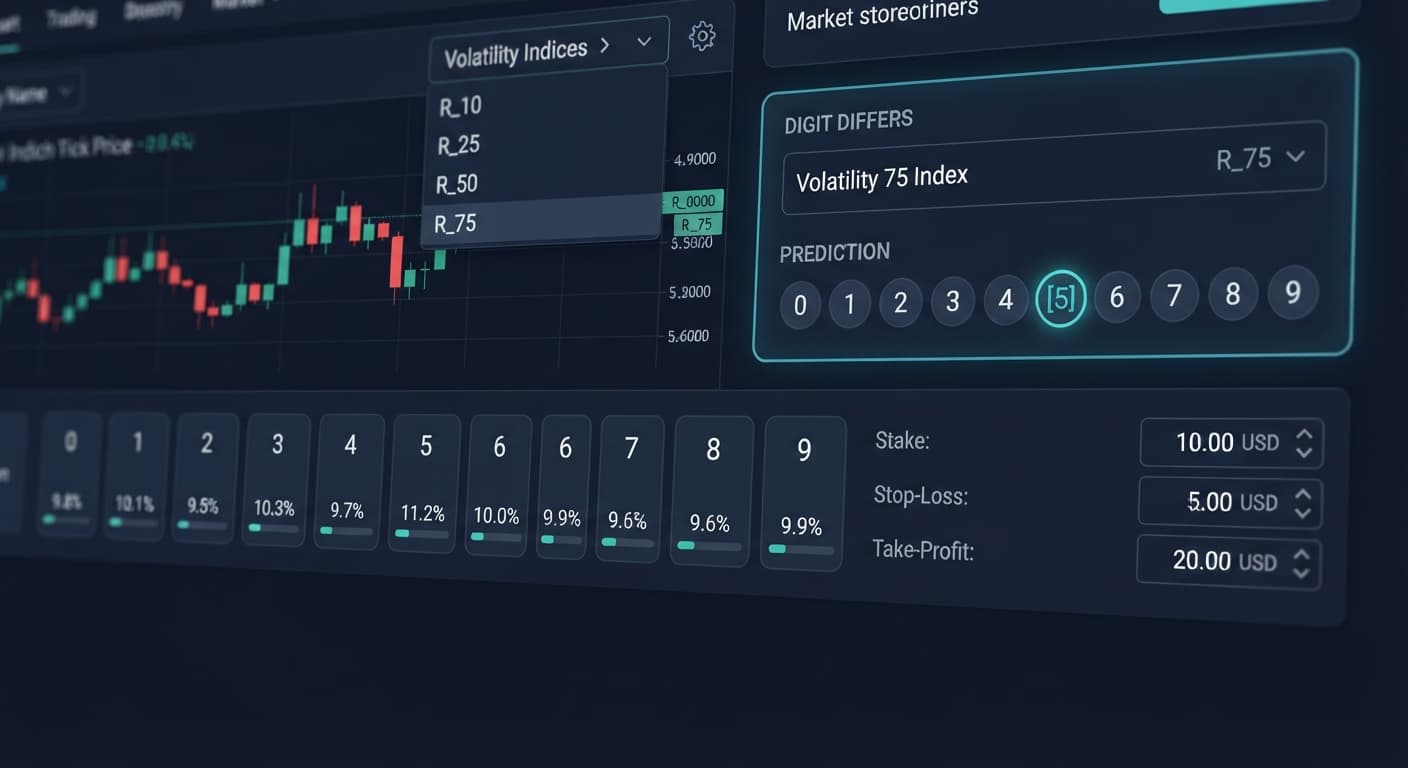
Volatility 75 (represented as symbol R_75 in the API) is a synthetic index engineered to simulate a financial market with a constant annualized volatility of 75%. Unlike currencies, commodities, or stock indices, synthetic indices operate independently of real-world economic news, central bank rate decisions, or exchange opening hours. The price moves 24 hours a day, 365 days a year.
The index price is generated by a cryptographically secure random number generator. The value "75" defines the price variance over time. On Volatility 10, price charts move in tight, smooth bands. On Volatility 75, price swings are sharp and aggressive.
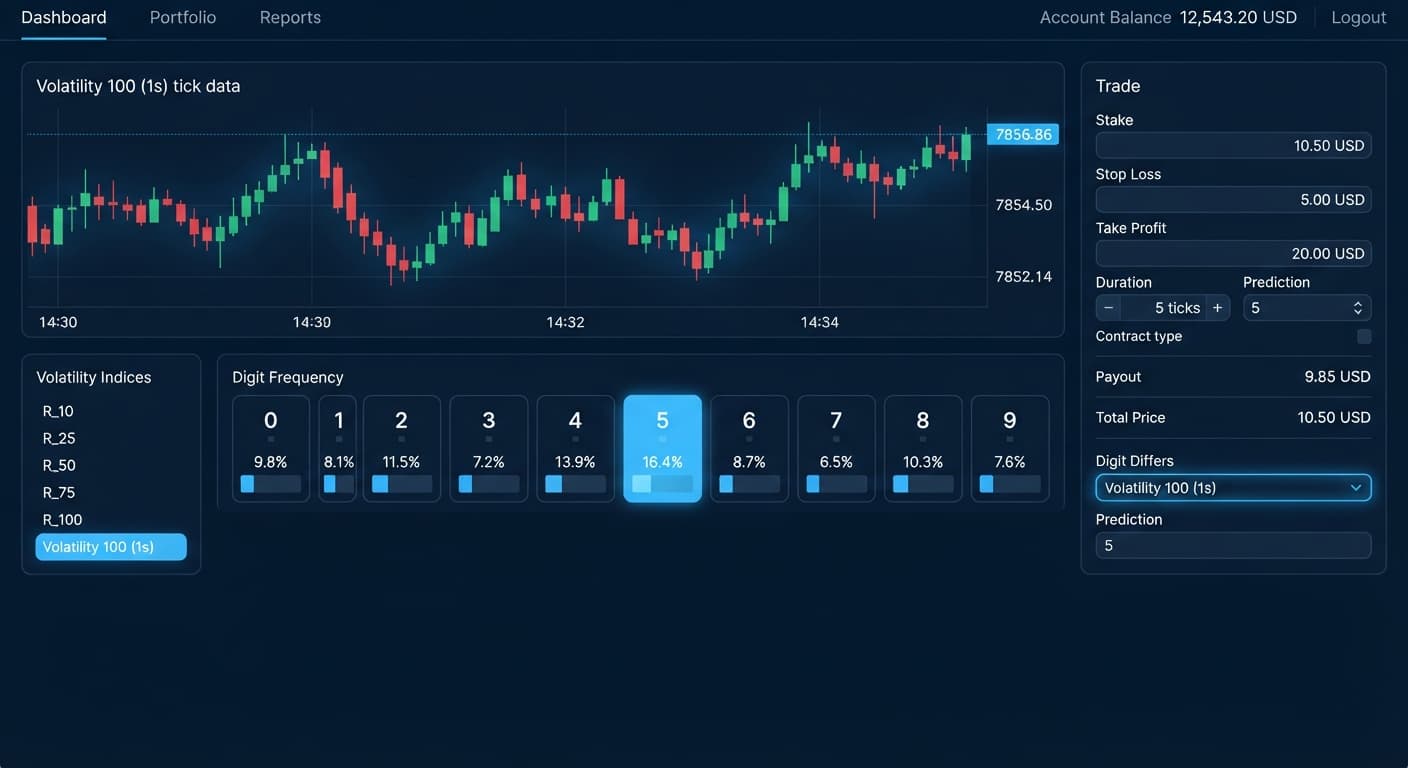
When you run digit contracts, the macro direction of the chart does not decide your win or loss. A 500-point sudden drop on Volatility 75 affects the price quote, but digit options like DIGITMATCH and DIGITDIFF look only at the very last digit of that quote. The underlying math ensures every digit from 0 to 9 has an equal probability of appearing on any given tick, regardless of how wild the chart looks.
Standard Volatility 75 updates its price quote every 2 seconds. If you select the Volatility 75 (1s) Index, the price updates every single second.
Standard Volatility 75:  1 Tick = 2 Seconds
Volatility 75 (1s):      1 Tick = 1 Second
The speed difference changes how fast your automated strategy executes. Running a bot on Volatility 75 (1s) cuts your trade duration in half compared to the standard index. That means faster session results, but it also means drawdown happens twice as fast if a strategy goes off track.
Look at how a raw price quote resolves into a digit:
| Timestamp | Quote Price | Last Digit |
|---|---|---|
| 10:00:02 | 10452.34 | 4 |
| 10:00:04 | 10458.81 | 1 |
| 10:00:06 | 10451.09 | 9 |
| 10:00:08 | 10460.70 | 0 |
The decimal portion determines the digit trade outcome. In volatility index trading, traders often try to spot patterns in these last numbers. You might see three zeroes in a row and assume a zero is unlikely on the next tick. That assumption breaks trading accounts.
Synthetic index ticks are independent random events. The probability of any specific digit (0 through 9) landing on the next tick is always exactly 10%. The probability of landing on any digit other than your selected digit is always exactly 90%. Past ticks do not change these probabilities.
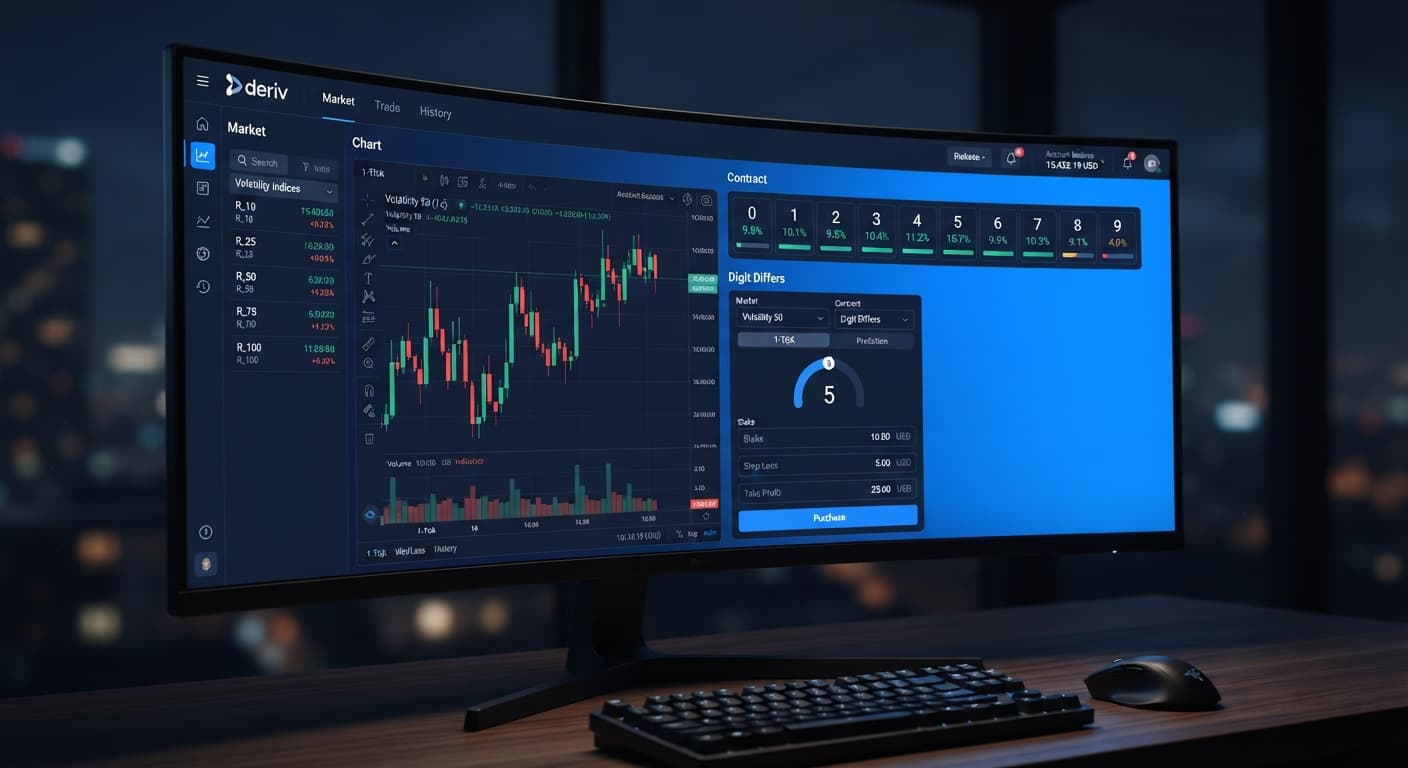
You can run DIGITMATCH and DIGITDIFF strategies directly on BinaryBot.live using automated web tools. The system connects directly to Deriv over their official API using your personal API token. Contracts execute straight on your Deriv account without passing through external balance servers.
To trade Volatility 75 with digit rules, you can browse the free bot library and select the Solid Trading Bot tool. Within the dashboard, select Volatility 75 or Volatility 75 (1s) from the market list.
The two digit modes suit entirely different risk profiles:
Configuring deriv synthetic indices bots requires matching your stake rules to the math of the specific contract. Using the same risk settings for DIGITMATCH and DIGITDIFF leads to rapid account depletion.
Set contract duration to 1 tick for standard digit automation on Volatility 75. This minimizes exposure time per trade and allows your risk engine to calculate drawdown on every tick update.
The primary danger on DIGITDIFF is the false sense of security caused by the 90% win rate. Many traders set a standard martingale multiplier to double or multiply their stake after a loss. When a loss occurs, you need a high multiplier just to recover the lost stake because the payout is only 10%.
Here is what happens when you use an 11x martingale multiplier after a DIGITDIFF loss starting with a $1 base stake:
Trade 1: Stake $1.00  ---> Loss (-$1.00 total)
Trade 2: Stake $11.00 ---> Loss (-$12.00 total)
Trade 3: Stake $121.00 -> Loss (-$133.00 total)
Trade 4: Stake $1,331.00
Four consecutive losses on DIGITDIFF feels statistically impossible, but across a 1,000-tick automated session, it happens. A $200 account running this setup blows up completely on Step 3.
To run DIGITDIFF safely on Volatility 75:
DIGITMATCH requires patience. Because the statistical win rate is only 10%, losing runs of 20 to 30 consecutive ticks are normal.
Do not use a multiplier on DIGITMATCH. Doubling your stake after every loss on a contract with a 10% win rate will drain any balance within 10 ticks.
Instead, use flat staking or a controlled linear progression:
Set your target profit low for DIGITMATCH sessions. Aiming for a 5% account gain per session is realistic. Trying to double an account in one run on DIGITMATCH usually leads to over-trading and maximum drawdown.
Before deploying real capital on any automated strategy, open the free digit tools on BinaryBot.live and test your parameters on a virtual balance. Verify how your stake sizing handles prolonged losing runs during live ticks. This guide is provided for educational purposes and does not constitute financial advice.
Test your strategy on the free automated tools using a demo balance first. If you need a trading balance, create a free Deriv account to get started.
Trading involves risk. Past performance does not guarantee future results.
What actually differs between V10, V25, V50, V75 and V100, the 1-second variants, the Jump indices, and how each one behaves under a digit bot.
Trade These Markets →Standard Volatility 75 updates its price quote every two seconds, while the Volatility 75 (1s) index updates every single second. Running a bot on the 1s version cuts your trade duration in half, but it also means drawdowns happen twice as fast if your strategy goes off track.
These digit options look only at the very last digit of the price quote's decimal portion. For a DIGITMATCH contract, your target digit must match the final tick's last digit for an approximate 800% to 850% payout, whereas DIGITDIFF wins if the final digit is anything other than your selected number.
No, past ticks don't change future probabilities because synthetic index ticks are independent random events. Every digit from 0 to 9 always has an exact 10% probability of appearing on any given tick, regardless of any patterns you might see on the chart.
You can run strategies directly on BinaryBot.live by connecting to Deriv over their official API using your personal API token. This executes contracts straight on your Deriv account without passing through external balance servers.
Guides closest to this one.
Learn how to trade digit differs on volatility 100 using free Deriv bots on BinaryBot.live. Master setup and execution steps today. Try it now!
Learn how to configure and execute digit differs on volatility 75 using free BinaryBot.live tools for synthetic indices. Start trading today.
Learn how to configure and run digit differs on volatility 50 using Deriv bots. Master synthetic indices setup on BinaryBot.live. Start trading today.