Auto Trading Bots
DualShot Not Working: Fix Deriv Bots Simultaneous Trades
Is your dualshot not working on BinaryBot.live? Fix simultaneous CALL and PUT Deriv trades, risk settings, and dual contract trading errors today.
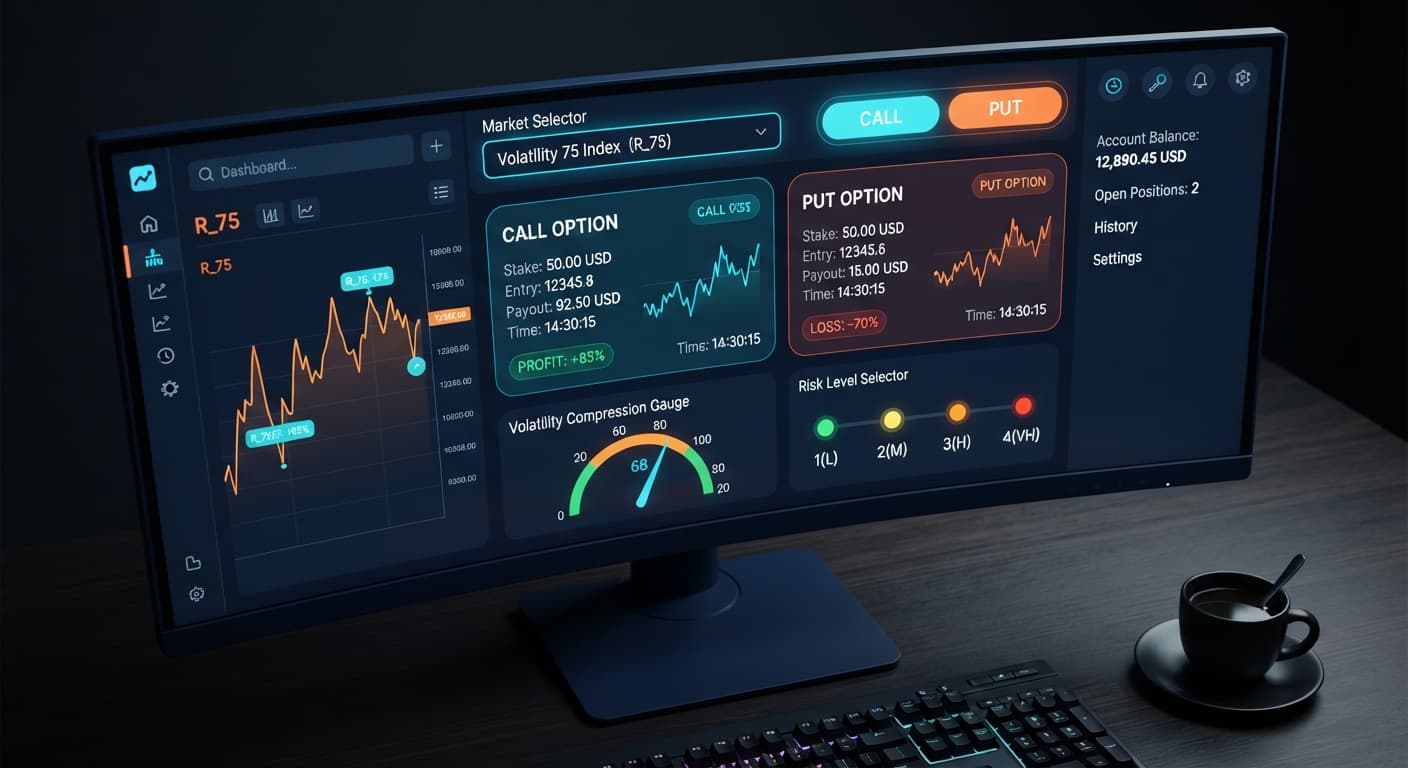
If you're searching for the dualshot best market on Deriv, Volatility 75 (V75) stands out as the primary selection for simultaneous execution. Because the bot opens a CALL and a PUT contract at the exact same instant, you need immediate directional momentum to cover the double stake expense. V75 delivers frequent price swings across brief durations, making it ideal for traders who want to capitalize on fast expansions without guessing market direction.
Understanding why V75 qualifies as the dualshot best market comes down to how synthetic rates generate price ticks. Deriv generates Volatility 75 using a cryptographic random number generator programmed to maintain an annualized volatility constant of 75%. That constant rate produces continuous price updates every single second, created independent of real-world economic news releases or bank opening hours.
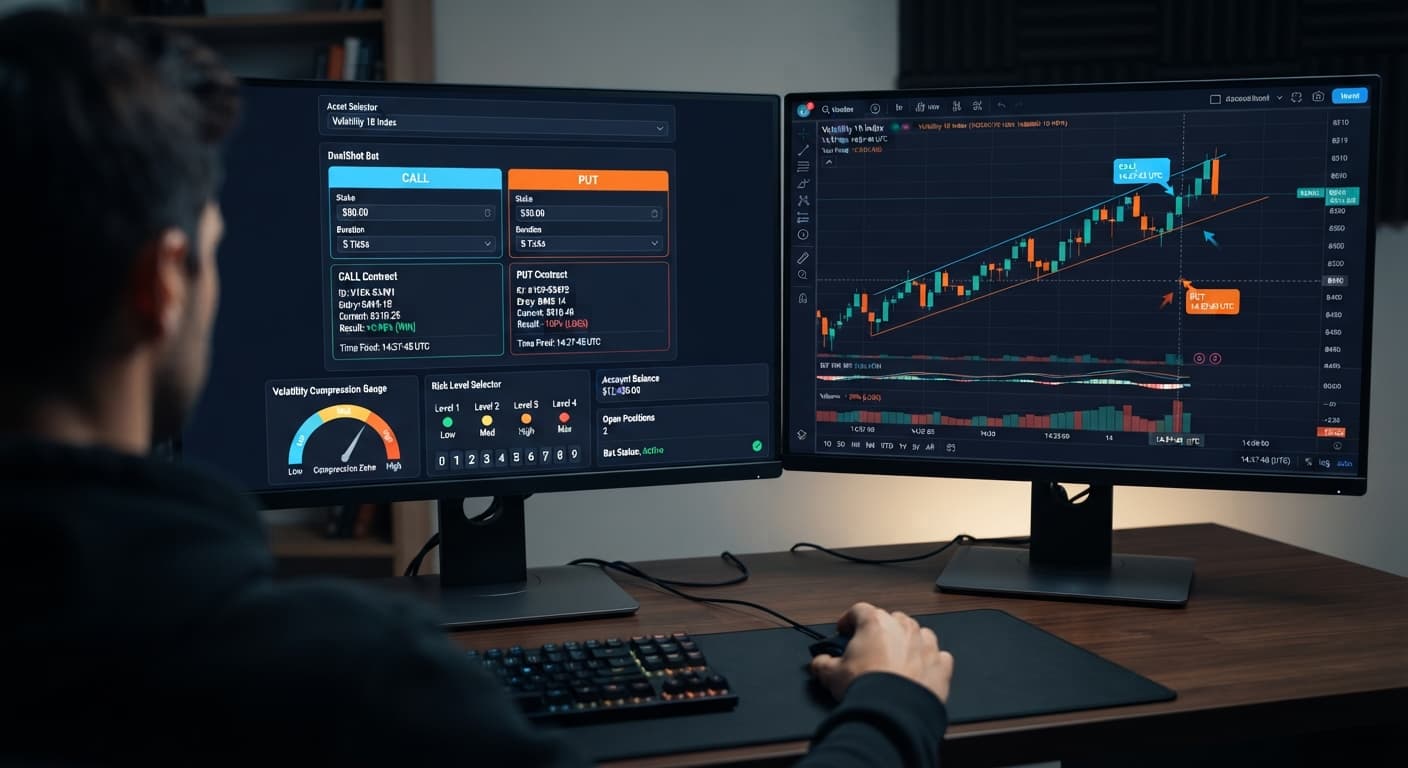
Because the baseline variance stays fixed at 75%, price charts undergo distinct structural phases. You'll observe short periods of tight range consolidation followed immediately by sharp price expansions. DualShot takes advantage of this specific cycle. The bot scans the real-time feed for volatility compression—moments where tick movement slows down into a tight band. When compression breaks into expansion, DualShot fires both trade legs simultaneously. Since the system holds a CALL and PUT side together, the final outcome depends entirely on the size of the move rather than whether the index moves up or down. A quiet market leaves both trades stuck near the entry barrier, whereas V75's high baseline volatility creates the distance needed for a win.
When evaluating the dualshot best market across the entire synthetic index family, contrasting tick behavior highlights clear structural differences. Different volatility indices scale tick movements at completely different magnitudes. Matching your bot strategy to the right market structure is what keeps trade outcomes consistent.
| Synthetic Index | Tick Update Rate | Average Tick Span (Points) | Consolidation Phase Length | Ideal Duration | DualShot Suitability |
|---|---|---|---|---|---|
| Volatility 10 (V10) | 1 tick / sec | 0.05 – 0.15 | Extended (10–30 mins) | 5–10 Ticks | Low (Chop burns double trades) |
| Volatility 75 (V75) | 1 tick / sec | 15.0 – 45.0 | Brief (1–3 mins) | 5 Ticks | Optimal (Fast expansion after squeezes) |
| Volatility 100 (V100) | 1 tick / sec | 40.0 – 110.0 | Short / Unpredictable | 5–10 Ticks | Moderate (High slippage risk) |
Lower index tiers like Volatility 10 move far too slowly for dual contract execution. On V10, prices often move less than a single point across five consecutive ticks. If DualShot fires both legs during a flat stretch on V10, neither price level travels far enough away from the initial barrier. You end up losing both trade stakes because neither contract reaches payout territory.
Volatility 100 sits on the opposite end of the scale. While V100 generates massive tick distance, its noise profile causes sharp pullbacks within the same tick candle. A trade can spike 50 points in your favor on tick three and collapse 60 points on tick four, leaving you exposed on both positions.
V75 strikes the precise balance. Its consolidation cycles are short enough that you don't wait long for a setup, and its post-compression moves carry enough multi-tick momentum to push one side into profit. That's why experienced traders running binary bots target V75 over slower alternatives.
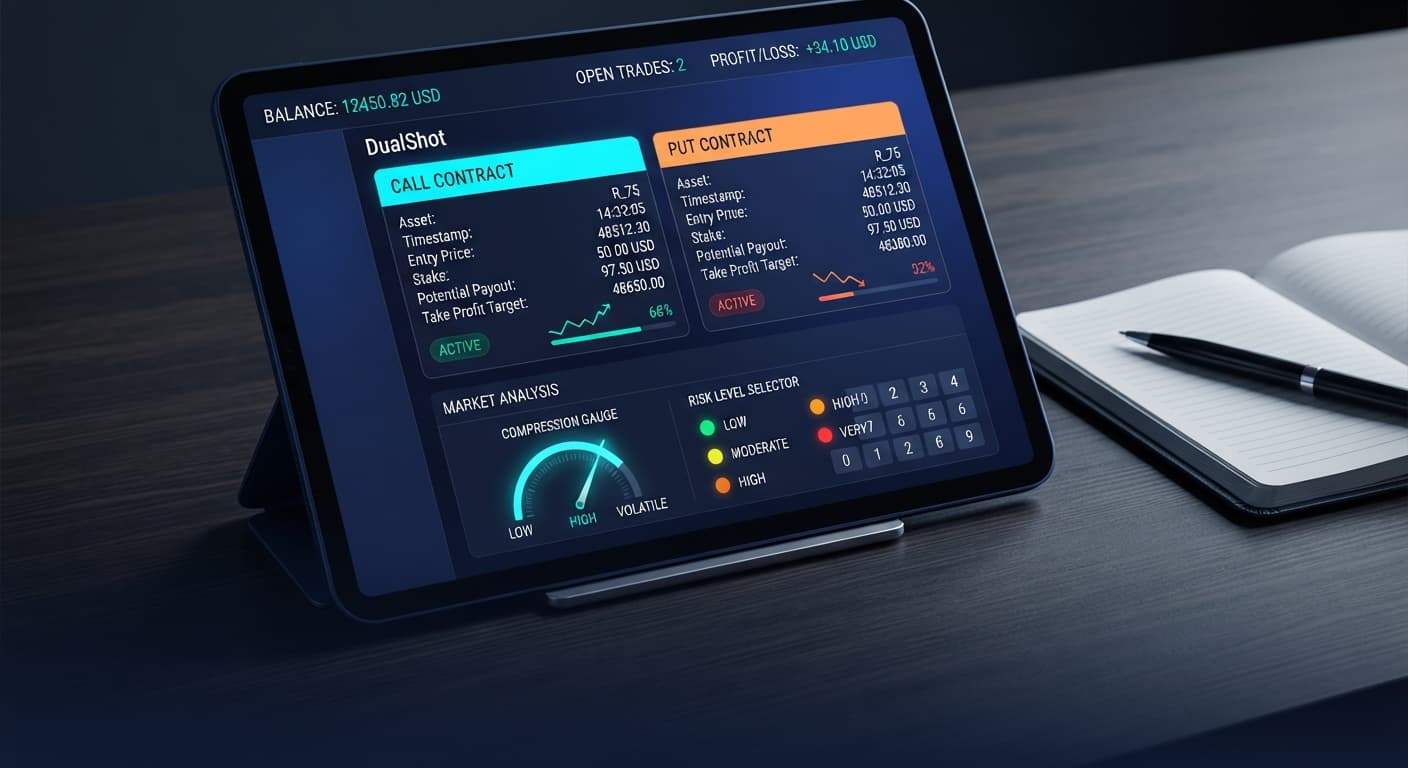
Setting up your parameters requires aligning your trade duration with the bot's internal detection sensitivity. DualShot offers four distinct risk levels that control how tight the volatility squeeze must be before triggering orders. Paired with proper tick durations and fixed stakes, you establish a controlled trading process.
| Target Duration | Risk Level Control | Stake Allocation (% Bankroll) | Stop Loss Threshold | Take Profit Goal | Operational Rationale |
|---|---|---|---|---|---|
| 5 Ticks | 🟢 Low Risk (Safer) | 1.0% | 10% of balance | 5% of balance | Requires tightest compression squeeze; highest win quality on V75 breakout. |
| 5 Ticks | 🟡 Medium Risk | 1.0% | 10% of balance | 5% of balance | Accepts moderate squeezes; slightly higher trade frequency. |
| 5 Ticks | 🟠 High Risk | 0.5% | 5% of balance | 3% of balance | Triggers on minor pauses; lower individual stake mitigates flat market chop. |
| 5 Ticks | 🔴 Very High Risk | 0.25% | 3% of balance | 2% of balance | Triggers constantly; requires tiny stake size to survive false breakouts. |
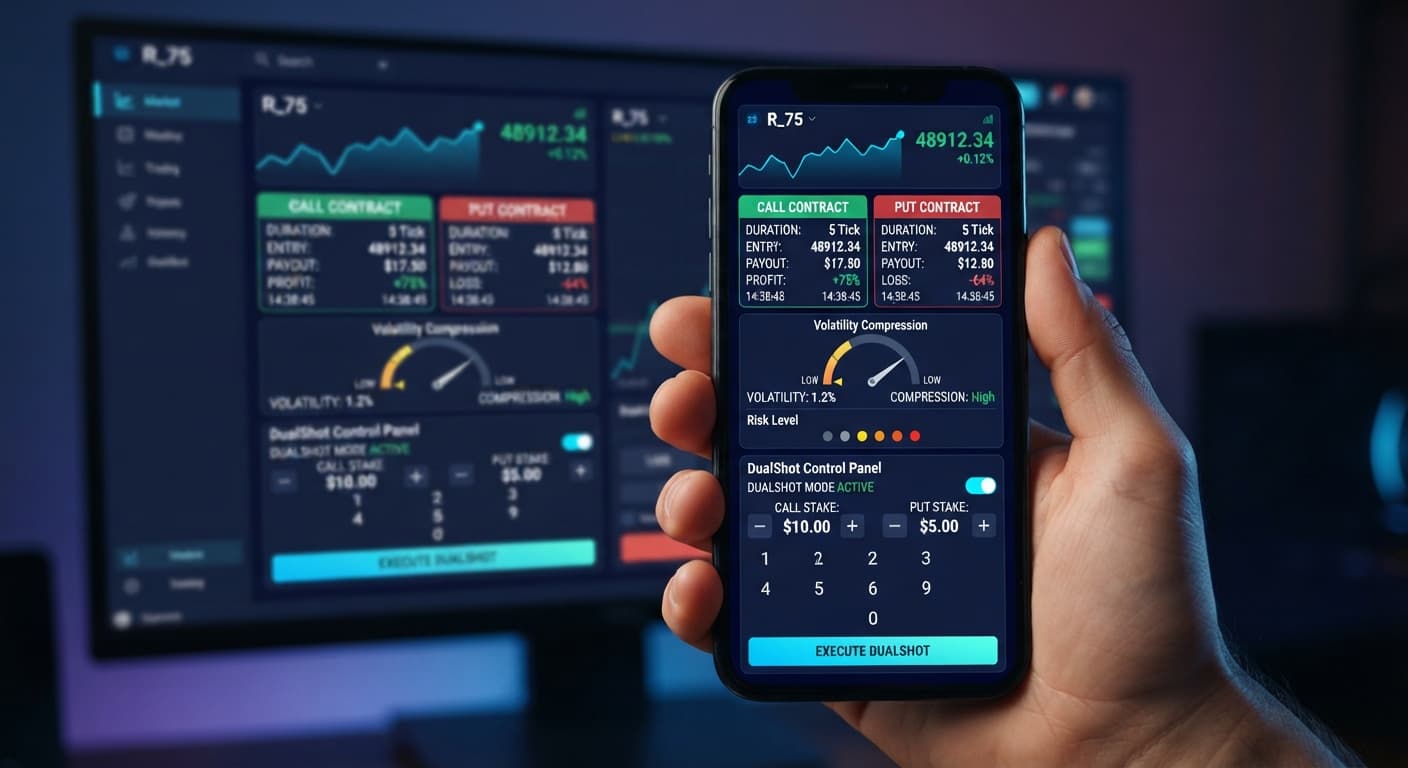
When configuring the bot interface, select your preferred settings before hitting start. Set your target Stake ($) value based on a small percentage of your overall account balance rather than arbitrary fixed amounts. Always set a defined stop loss and take profit inside your account management plan prior to trading.
Selecting 🟢 Low Risk (Safer) forces the bot to wait until V75 compresses into a narrow price channel. Once the price breaks out, five ticks give V75 ample time to move 30 to 80 points clear of your start line. If you choose 🔴 Very High Risk, the entry filter relaxes, firing trades during minor chart pauses. Because higher risk modes open more positions during low-momentum ranges, reducing your stake size protects your total bankroll against choppy conditions.
Automated setups require testing before real execution. Run your strategy on a Deriv demo balance first to see how execution times and tick movements behave under real market feeds. Unlike basic scripts on traditional deriv bots, simultaneous contract placement requires clear understanding of how market conditions impact dual losses.
Traders testing the dualshot best market for the first time often misjudge how fast V75 moves during high compression breakouts. The single biggest mistake is bringing trade habits formed on Volatility 10 or Volatility 25 directly over to Volatility 75 without adjusting expectations.
On lower volatility indices, price drifts lazily. Traders get comfortable using short tick durations or looser entry thresholds because price rarely snaps aggressively back through an entry point. On V75, individual ticks carry heavy price weight. A single tick can jump 35 points, flip direction, and jump 40 points back the other way.
When you run dual execution models on V75, flat conditions are your biggest hazard. Because DualShot opens a CALL and a PUT on the same tick, you hold double trade exposure instantly. If the market stays inside a tight 5-point range over a 5-tick duration, both contracts expire out of the money. You lose 100% of the stake on both legs in a single trade event.
To avoid blowing balance on flat charts, don't force trades during slow trading sessions or run 🔴 Very High Risk without strict capital limits. Synthetic index ticks are completely independent random draws; past tick direction or digit patterns have zero impact on where the next tick lands. No historic sequence guarantees that the next move will be an expansion tick. Respecting V75's velocity and letting the bot wait for true compression squeezes is what separates calculated execution from impulsive gambling on binary bots.
Try it yourself on DualShot using a demo balance first. If you don't have one yet, create a free Deriv account. Trading involves risk. Past performance does not guarantee future results.
Related: DualShot Not Working: Fix Deriv Bots Simultaneous Trades
Deriv best strategy bot with advanced analysis tools — executes 2 simultaneous trades in one click, firing CALL and PUT contracts at the same time with real-time volatility detection.
Open DualShot →Volatility 75 (V75) is the primary selection for DualShot because it provides frequent price swings and fast expansions. Its balance of short consolidation phases and multi-tick momentum helps cover the double stake expense of opening a CALL and a PUT at the same time.
Lower index tiers like Volatility 10 move far too slowly for dual contract execution. Prices often move less than a single point across consecutive ticks, leaving neither position with enough distance to reach payout territory.
The DualShot bot scans the market for volatility compression where tick movement slows down into a tight band. When that compression breaks into an expansion, the system opens a CALL and a PUT contract at the exact same instant.
Volatility 100 carries a high slippage risk because its noise profile causes sharp pullbacks within the same tick candle. It can easily spike in your favor and quickly collapse, leaving you exposed on both trade legs.
Guides closest to this one.
Is your dualshot not working on BinaryBot.live? Fix simultaneous CALL and PUT Deriv trades, risk settings, and dual contract trading errors today.
Set Risk Level to Low Risk (Safer) when running dualshot on volatility 10 to catch true expansion breaks and avoid losing stakes on flat market micro-ticks.
Configure dualshot take profit settings on BinaryBot.live. Learn how to manage risk for automated deriv simultaneous CALL and PUT trades. Try our free bot.