Strategies & Risk
Why Your Rise Fall Strategy Is Not Working on Deriv Bots
Your rise fall strategy deriv bots fails due to tick duration mismatch and aggressive stake sizing. Fix it with Fixed Stake and longer durations.

Having martingale on deriv bots explained comes down to one core reality: on digit contracts like DIGITDIFF, standard doubling after a loss will not cover your losses because of the ~9.9% payout structure. Martingale on automated platforms scales your trade size after a loss to recover previous hits plus a target profit, but low-yield digit diff contracts require an aggressive 11x multiplier or a specialized recovery system to break even on a single win. If you're setting up deriv bots to run this money management strategy without strict risk parameters, a two-loss streak can clean out an entire account balance before the algorithm completes a single recovery step. Always test these automated setups on a Deriv demo account before risking real capital.
DIGITDIFF is a digit contract where you predict the last digit of a synthetic index tick won't match a chosen barrier digit from 0 to 9. Since nine out of ten digits result in a win, your statistical chance of winning any individual trade is 90%. Deriv structures the payout to reflect those high odds, offering roughly 9.9% profit on your stake. A winning $10 contract returns $10.99 total, yielding $0.99 in net profit.
Traditional Martingale was designed for even-money trades like Rise/Fall, Higher/Lower, or DIGITEVEN and DIGITODD, where payouts sit near 95% to 100%. On those contracts, doubling your stake after a loss (a 2x multiplier) repays the lost stake and leaves a small profit. That math breaks down completely on DIGITDIFF.
If you stake $10 on DIGITDIFF and lose, you lose the full $10. Staking $20 on the next trade at a 9.9% payout yields just $1.98 in profit on a win. You're still down $8.02 overall. To recover that original $10 loss and gain your initial $0.99 target profit, your second trade stake must scale up to roughly $111. Instead of a 2x progression, digit diff requires roughly an 11x multiplier. When running binary bots, using a standard 2x multiplier on digit differs leaves you accumulating deep unrecovered losses even when the trade log shows consecutive winning trades.
To see how quickly an 11x recovery ladder depletes capital, look at what happens during an unfavorable streak on Volatility 75 Index. Assume you start with a $500 balance and set a base stake of $10 using an 11x recovery multiplier.
| Trade Step | Contract | Stake Amount | Outcome | Net Trade Profit/Loss | Running Account Balance |
|---|---|---|---|---|---|
| Trade 1 | DIGITDIFF | $10.00 | Loss | -$10.00 | $490.00 |
| Trade 2 | DIGITDIFF | $111.11 | Loss | -$111.11 | $378.89 |
| Trade 3 | DIGITDIFF | $1,234.56 | Blocked | N/A (Insufficient Funds) | $378.89 |
Look closely at those numbers. On Trade 1, you lose $10. Your running balance drops to $490. To recover that $10 loss plus the initial $0.99 target profit at a 9.9% payout, the bot scales Trade 2 to $111.11.
If Trade 2 wins, you receive $122.10 back ($111.11 stake + $10.99 payout), bringing your account balance to $500.99. But if Trade 2 loses, you lose another $111.11. Your cumulative drawdown hits $121.11, leaving $378.89 in your account balance.
To recover that $121.11 cumulative loss on Trade 3, the bot needs to stake $1,234.56. On a $500 starting account, your remaining balance sits at $378.89—you don't have enough money left to place the trade. Two consecutive losses on a 90% probability contract completely halt the recovery sequence, locking in a $121.11 loss permanently.
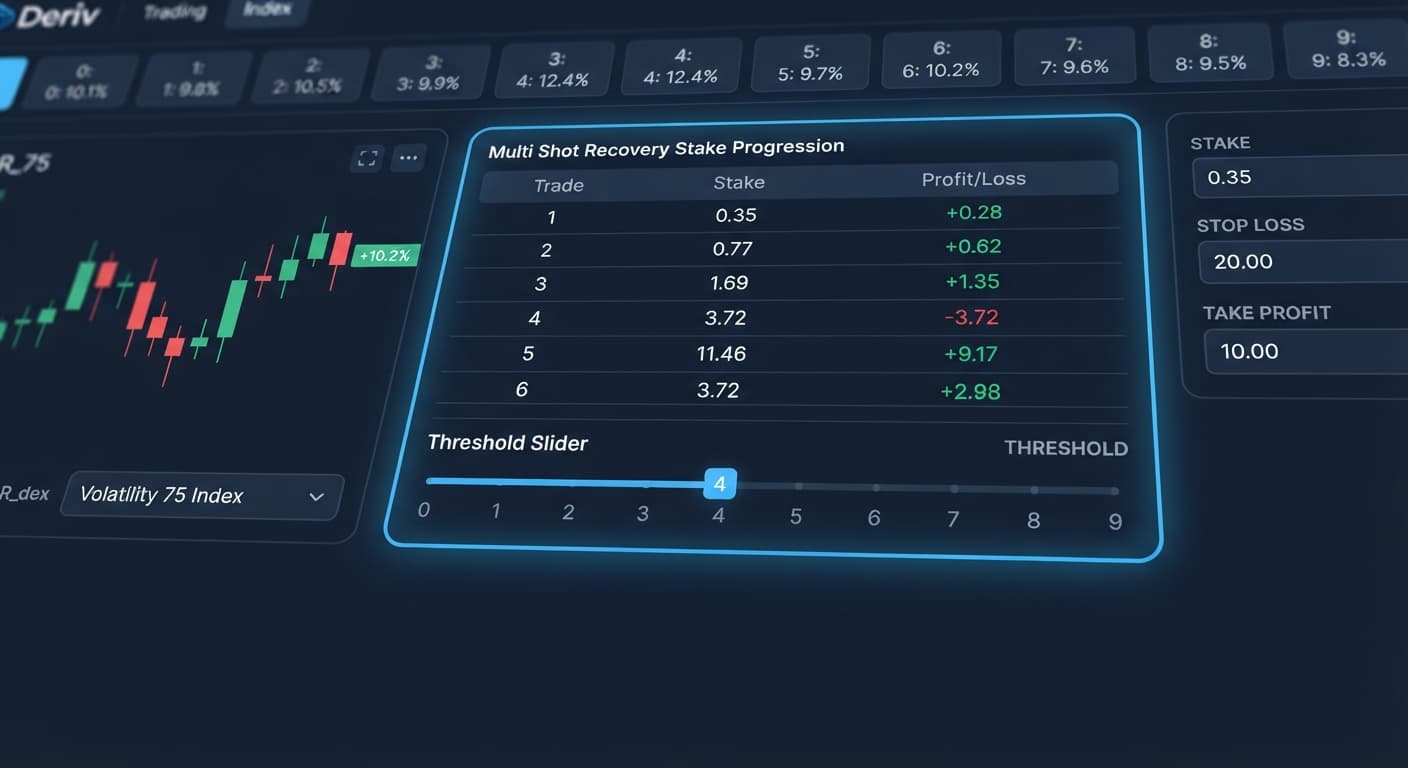
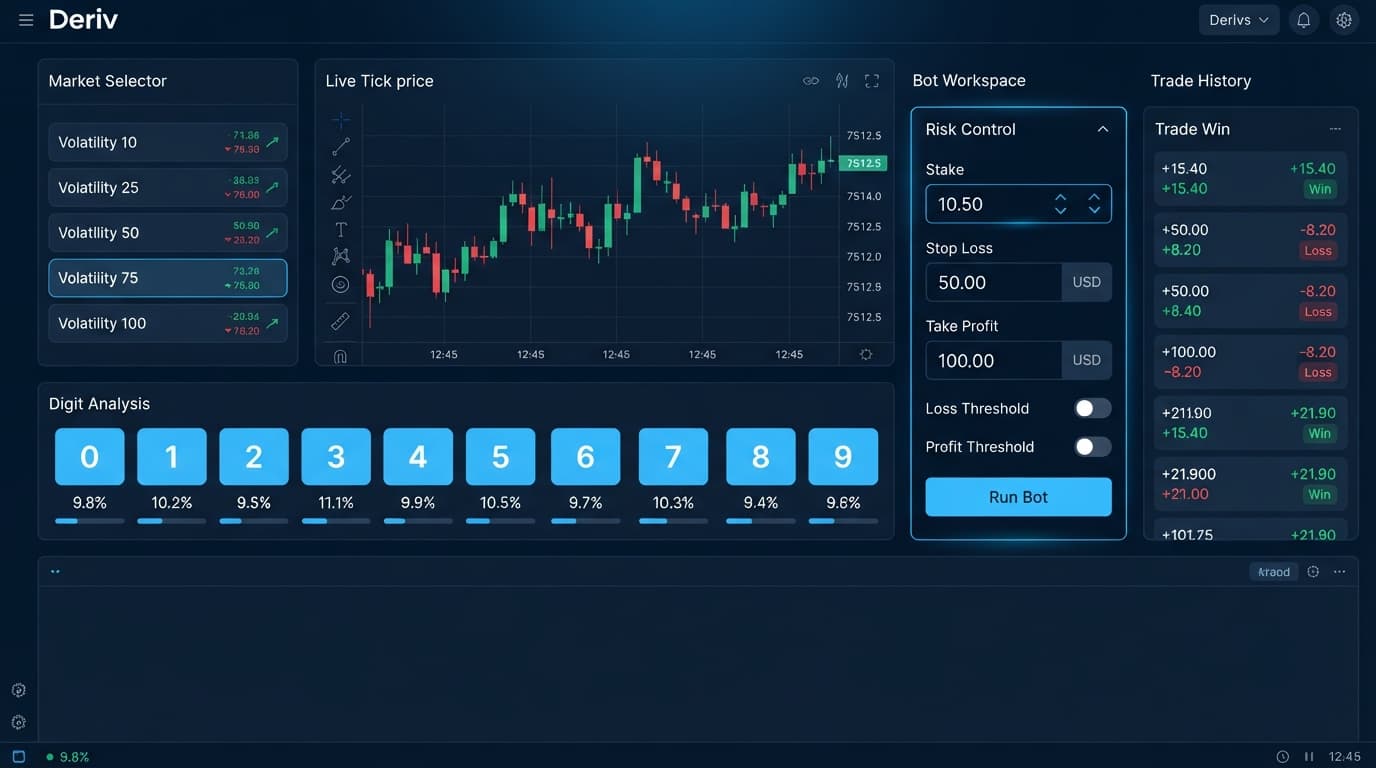
Automating this approach safely requires software designed to handle payout-based sizing. On BinaryBot.live, traders run these executions using browser tools like Solid Trading Bot or Multi Shot. These tools connect directly to Deriv over their official API using your personal API token, executing contracts instantly on your account without routing funds through external servers.
When opening the control panel on Solid Trading Bot, you'll select distinct settings designed for contract execution:
Selecting Multi Shot's Recovery instead of standard Martingale changes how the bot calculates post-loss stakes. Rather than applying a fixed static multiplication factor like 2x or 11x, Multi Shot's Recovery reads the live payout rate directly from the trade feed. If the live payout shifts slightly from 9.9% to 9.8%, the software recalculates the exact stake required so that a single winning tick restores all live cumulative drawdown.
The main failure point for traders using a digit differs binary trading strategy is a misunderstanding of market probability. Deriv synthetic index ticks are generated by algorithms designed to maintain statistical randomness. Ticks are independent events. The last digit of the previous tick has zero influence over the last digit of the next tick.
When you trade DIGITDIFF, a 90% win rate per trade doesn't mean losses are neatly spaced out every ten ticks. Random distribution causes natural clusters. You can easily see the exact same digit hit two or three times in a row. When a single digit repeats on back-to-back ticks while your bot targets that specific digit, your account hits a rapid consecutive loss sequence.
The asymmetric risk profile compounds this problem. Because you win $0.99 on a $10 stake but lose $10 when wrong, ten successful trades yield $9.90 total profit. A single unrecovered loss wipes out more than ten successful trades. If your bot hits two consecutive losses and stops due to balance limits or safety caps, you need over 120 consecutive winning trades just to recover your drawdown without using aggressive stake scaling.
If you decide to deploy martingale logic on binary bots, your survival depends entirely on setting strict risk boundaries inside the control panel before clicking run. Leaving these controls blank or setting them too wide turns automated execution into an unmanaged risk.
Configure your parameters using these concrete guidelines:
Before risking real money, test every money management variation inside a Deriv demo account. A virtual balance lets you observe real-time stake scaling, monitor live trade logs, and verify your stop loss execution without exposing live funds to market drawdowns. Keep in mind that this technical breakdown serves an educational purpose and does not constitute financial advice.
Try these settings on the free tools on Solid Trading Bot using a demo balance first. If you don't have one yet, create a free Deriv account to test the integration. Trading involves risk. Past performance does not guarantee future results.
Related: Why Your Rise Fall Strategy Is Not Working on Deriv Bots
Related: Best Over Under Settings for Binary Bots (2026)
Related: Even Odd Strategy Deriv Bots on Volatility 10 (1s) Index
How the strategies behind the bots actually work — Digit Differs, Over/Under, Even/Odd, Rise/Fall, and the money management that decides whether they survive a losing streak.
Try 9 Strategies on Solid →No, standard doubling after a loss doesn't work on DIGITDIFF contracts because of the low ~9.9% payout structure. Because of this, a 2x multiplier leaves you accumulating deep unrecovered losses even when you hit winning trades.
You need an aggressive 11x multiplier or a specialized recovery system to break even on a single win. Traditional 2x multipliers designed for even-money trades completely break down on digit diff contracts.
Because DIGITDIFF offers roughly a 9.9% payout, doubling your stake after a loss isn't enough to cover your previous losses plus a target profit. If you stake $10 and lose, a $20 follow-up trade only yields $1.98 in profit, leaving you still down $8.02 overall.
A two-loss streak can completely clean out an account balance before the bot finishes a single recovery step. For example, starting with a $500 balance and a $10 base stake requires $1,234.56 on the third trade, which instantly blocks the trade due to insufficient funds.
Guides closest to this one.
Your rise fall strategy deriv bots fails due to tick duration mismatch and aggressive stake sizing. Fix it with Fixed Stake and longer durations.
Use DIGITOVER 2 with a 5-tick duration and Multi Shot's Recovery to find the best over under settings for binary bots on Deriv.
Deploying even odd strategy deriv bots on the Volatility 10 (1s) Index targets 50/50 probability digit payouts with a fast 1-second tick speed.