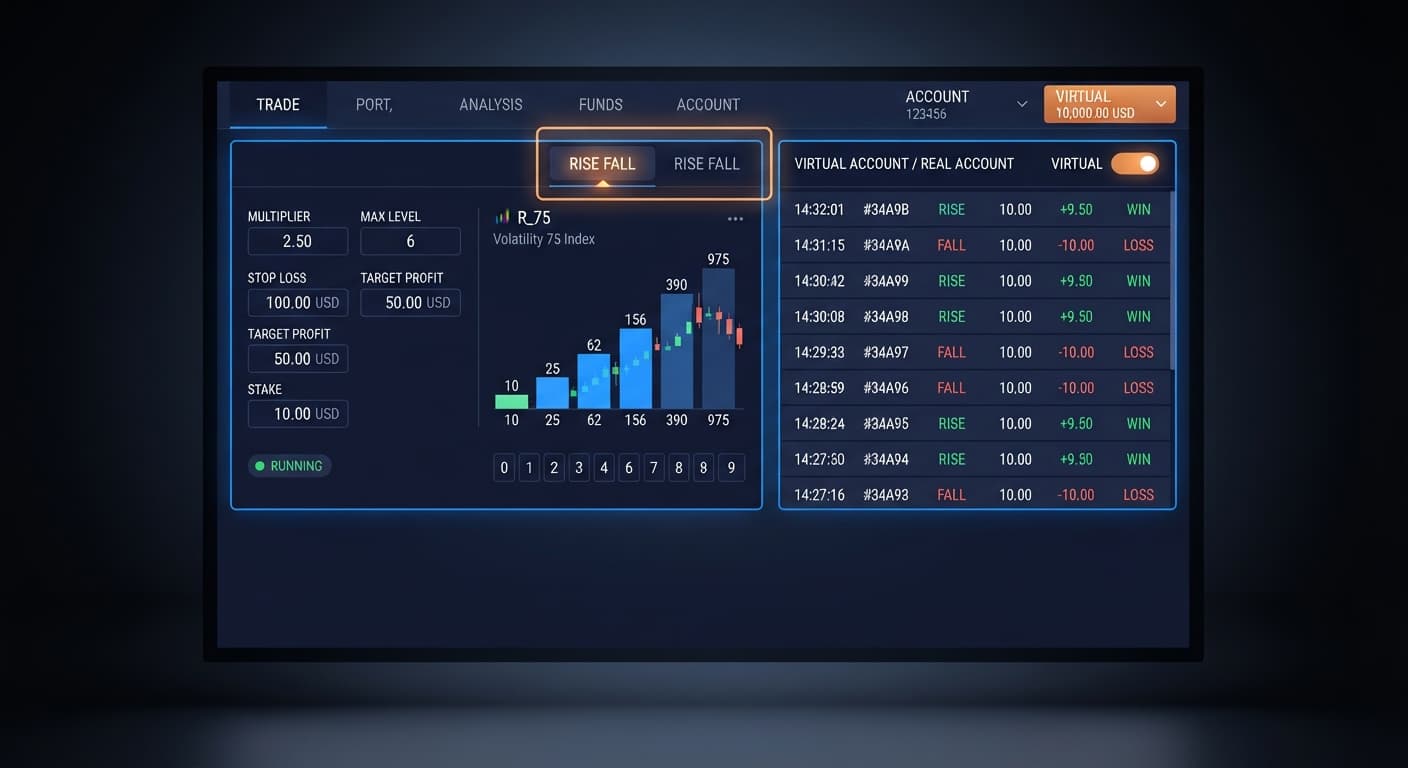
Auto Trading Bots
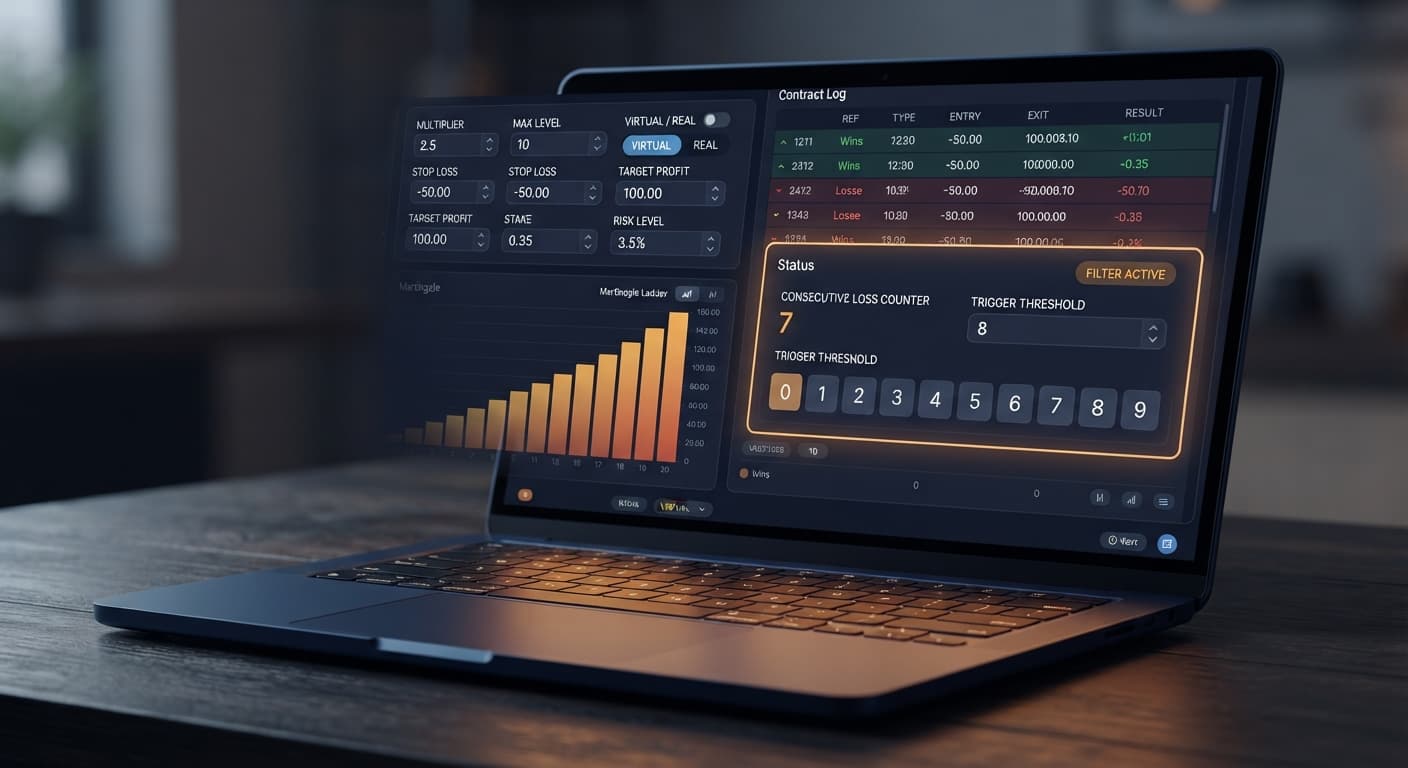
Why Sniper Bot V3 Not Working: Virtual Loss Fix
Discover why your sniper bot v3 not working on Deriv. Fix your virtual loss filter settings to resume trading on this free automated trading bot.
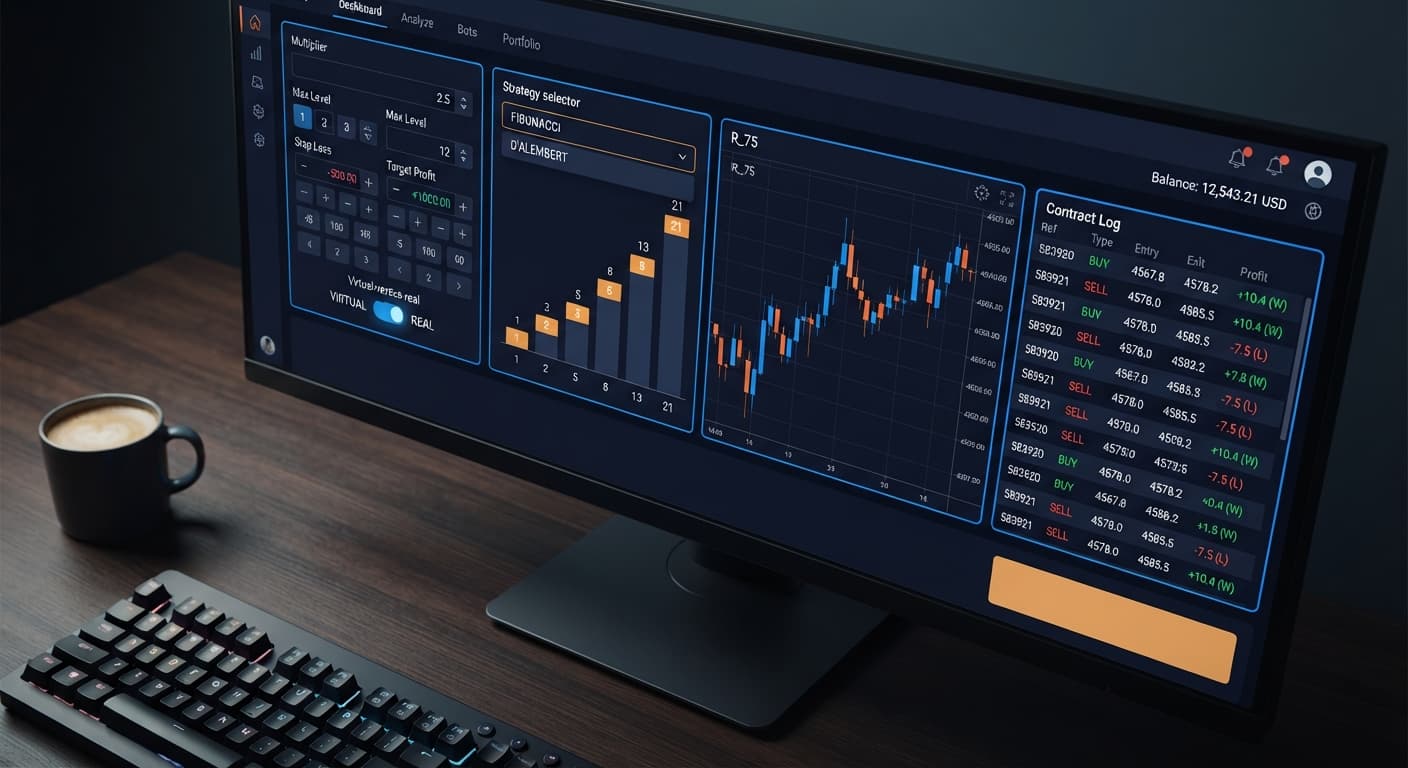
When choosing between sniper bot v3 vs tick picker for your Deriv trading setups, use Sniper Bot V3 when you need fully automated execution with structured money management modes like Fibonacci or D'Alembert, and use Tick Picker when you want to analyze manual digit bias before taking a position. For raw balance protection on automated trades, D'Alembert protects your Deriv balance significantly better than Fibonacci during extended losing runs because your stake increases linearly rather than exponentially. If you want hands-off virtual filtering alongside contract execution, Sniper Bot V3 gives you the exact automated controls to do it.
Money management determines whether your account survives an unexpected draw sequence on synthetic index markets. On Sniper Bot V3, selecting your MODE dictates how the system adjusts your stake after every completed contract.
D'Alembert operates on a simple additive ruleset: every loss adds one UNIT to your stake, and every win subtracts one UNIT. If your base UNIT is set to $1.00, five consecutive losses increase your next stake to $6.00. The recovery is gradual, requiring a sequence of wins to drag the stake back down to the base level, but the total drawdown curve remains gentle.
Fibonacci follows the classic mathematical sequence where each new stake is the sum of the previous two (1, 1, 2, 3, 5, 8, 13, 21...). After five consecutive losses with a $1.00 base UNIT, your sixth stake reaches $8.00. By loss eight, your stake hits $34.00. While Fibonacci recovers prior session losses much faster on a single win or short winning cluster, the aggressive stake expansion quickly threatens account limits if you run into a deep draw.
Using an automated tool like Tick Picker gives you visual statistics on recent tick distributions, but it does not execute stake scaling for you. That is why traders pair manual digit tools with automated platforms running explicit loss controls.
The table below breaks down how these two money-management modes operate inside Sniper Bot V3 alongside tick-analysis tools from our free bot library.
| Feature / Dimension | D'Alembert Mode (Sniper V3) | Fibonacci Mode (Sniper V3) | Tick Picker Analysis Tool |
|---|---|---|---|
| Stake Growth Type | Linear additive (+1 UNIT per loss) | Non-linear additive (Sum of last 2 stakes) | Manual tracking (No execution) |
| Stake After 5 Losses ($1 UNIT) | $6.00 | $8.00 | N/A |
| Stake After 8 Losses ($1 UNIT) | $9.00 | $34.00 | N/A |
| Primary Safety Control | MAX LEVEL & STOP LOSS | MAX LEVEL & STOP LOSS | N/A |
| Virtual Loss Integration | Compatible with VIRTUAL LOSS | Compatible with VIRTUAL LOSS | Visual digit history only |
| Execution Mechanism | Automatic API execution | Automatic API execution | Manual contract placement |
| Account Drawdown Profile | Low to moderate slope | Moderate to steep slope | Zero execution risk |
| Recovery Speed | Slow, requires sustained win rate | Fast, recovers in 1-2 winning ticks | N/A |
Select D'Alembert when you run equal-probability contracts like DIGITEVEN, DIGITODD, CALL, or PUT on high-volatility synthetic indices. Because these contracts pay out close to 95% net profit on winning trades, you do not need aggressive stake doubling to offset a minor slump. D'Alembert keeps your exposure bounded while you wait for tick distributions to normalize.
Here is how you configure D'Alembert on Sniper V3 for account preservation:
Select Fibonacci when you trade asymmetric payout contracts like ONETOUCH or DIGITMATCH where win rates are lower but payouts are substantially higher. In these scenarios, a linear progression like D'Alembert fails to cover cumulative losses when a win finally occurs. Fibonacci steps up the stake fast enough to match high-payout mechanics, provided you cap the sequence tightly.
When using Fibonacci, set MAX LEVEL no higher than 4 or 5. If you exceed 6 levels on Fibonacci without capping it, a single bad run will devour your margin. Pair this with VIRTUAL LOSS set to 2 or 3 so the bot paper-trades through initial loss clusters before placing real balance on the line.
No money management sequence changes the underlying probability of synthetic index ticks. Deriv synthetic indices generate independent draws. A run of five consecutive odd digits does not increase the odds of an even digit on the next tick.
Let's look at the actual arithmetic using standard DIGITEVEN and DIGITDIFF contracts.
1 / Payout Multiplier1 / 1.95 = 51.28%To break even on flat stakes over time on DIGITEVEN, you need a 51.28% win rate. Because the market naturally delivers 50.00%, flat staking results in a slow bleed to the house edge.
When you apply D'Alembert on DIGITEVEN, a loss moves your $1.00 stake to $2.00. If trade two wins, your payout is $2.00 * 1.95 = $3.90.
Total spent across two trades: $1.00 + $2.00 = $3.00.
Net profit: $3.90 - $3.00 = $0.90.
D'Alembert successfully closed the deficit on a 50% hit rate over two trades because the stake increment offset the 5% broker margin.
1 / 1.099 = 90.99%On DIGITDIFF, you must win 90.99% of trades just to stay even. A single loss destroys the profits of nine consecutive wins.
If you attempt to run Fibonacci on DIGITDIFF, your stake after four losses reaches 5x your base unit. Recovering a $5.00 loss on a 9.90% payout yields just $0.49 net gain, while risking a catastrophic stake loss on the fifth trade. D'Alembert and Fibonacci are both mathematically unsuited for low-payout, high-probability contracts like DIGITDIFF. For high-probability contracts, fixed staking combined with VIRTUAL LOSS filtering is the only rational approach.
Always test these mathematical relationships on a Deriv demo account before granting live API permissions.
You do not have to choose strictly between manual analysis and automated execution when evaluating sniper bot v3 vs tick picker. The cleanest workflow combines visual digit tracking with strict API execution bounds.
Use Tick Picker in your browser to monitor real-time digit stats on Volatility 100 Index or Volatility 10s Index. Watch for statistically skewed runs, such as a digit repeating far below its 10% expected frequency over 100 ticks.
Once you spot a structural bias, switch to Sniper Bot V3 to manage the trade execution automatically:
This combination removes emotional decision-making from your entries. The tick tool provides the context, while the automated engine on Sniper V3 controls the risk parameters.
Traders who rely entirely on manual clicking often hesitate after a loss or double their stake impulsively. Automated platforms running verified binary bots strip out emotion by forcing your pre-set limits on every single tick.
Whether you choose D'Alembert for steady risk containment or Fibonacci for aggressive loss recovery, never launch a session without setting STOP LOSS and MAX LEVEL on your screen. Test your logic thoroughly on demo funds, verify your stake scaling with real numbers, and protect your capital at all times.
Ready to test these settings? Try it yourself on Sniper Bot V3 using a demo balance first.
If you don't have one yet, create a free Deriv account.
Trading involves risk. Past performance does not guarantee future results.
Related: Sniper Bot V3 Review: Rise Fall Strategy on Deriv Bots
Advanced automated trading bot for Deriv with Rise/Fall, Higher/Lower, Touch/No Touch and Digit strategies, plus martingale, anti-martingale, Fibonacci and D'Alembert money management.
Open Sniper Bot V3 →Use Sniper Bot V3 when you need fully automated execution with built-in money management modes like Fibonacci or D'Alembert. Use Tick Picker if you prefer to analyze manual digit bias visually before placing a position yourself.
D'Alembert protects your Deriv balance significantly better during extended losing runs because stakes increase linearly rather than exponentially. Fibonacci recovers losses faster on a single win, but its aggressive stake expansion quickly threatens account limits during deep drawdowns.
No, Tick Picker only provides visual statistics on recent tick distributions and does not execute trades or stake scaling for you. For automated execution and hands-on virtual filtering, you'd use Sniper Bot V3 instead.
D'Alembert operates on a simple additive ruleset where every loss adds one unit to your stake, and every win subtracts one unit. For example, with a $1.00 base unit, five consecutive losses will increase your next stake to $6.00.
Guides closest to this one.
Discover why your sniper bot v3 not working on Deriv. Fix your virtual loss filter settings to resume trading on this free automated trading bot.
Sniper Bot V3 best market: standard Volatility indices like V75 and V100, whose 2-second ticks give the virtual loss filter room. When 1s makes sense.
Read our honest sniper bot v3 review. Test virtual trading modes, money management, and the rise fall strategy on free deriv bots at BinaryBot.live.