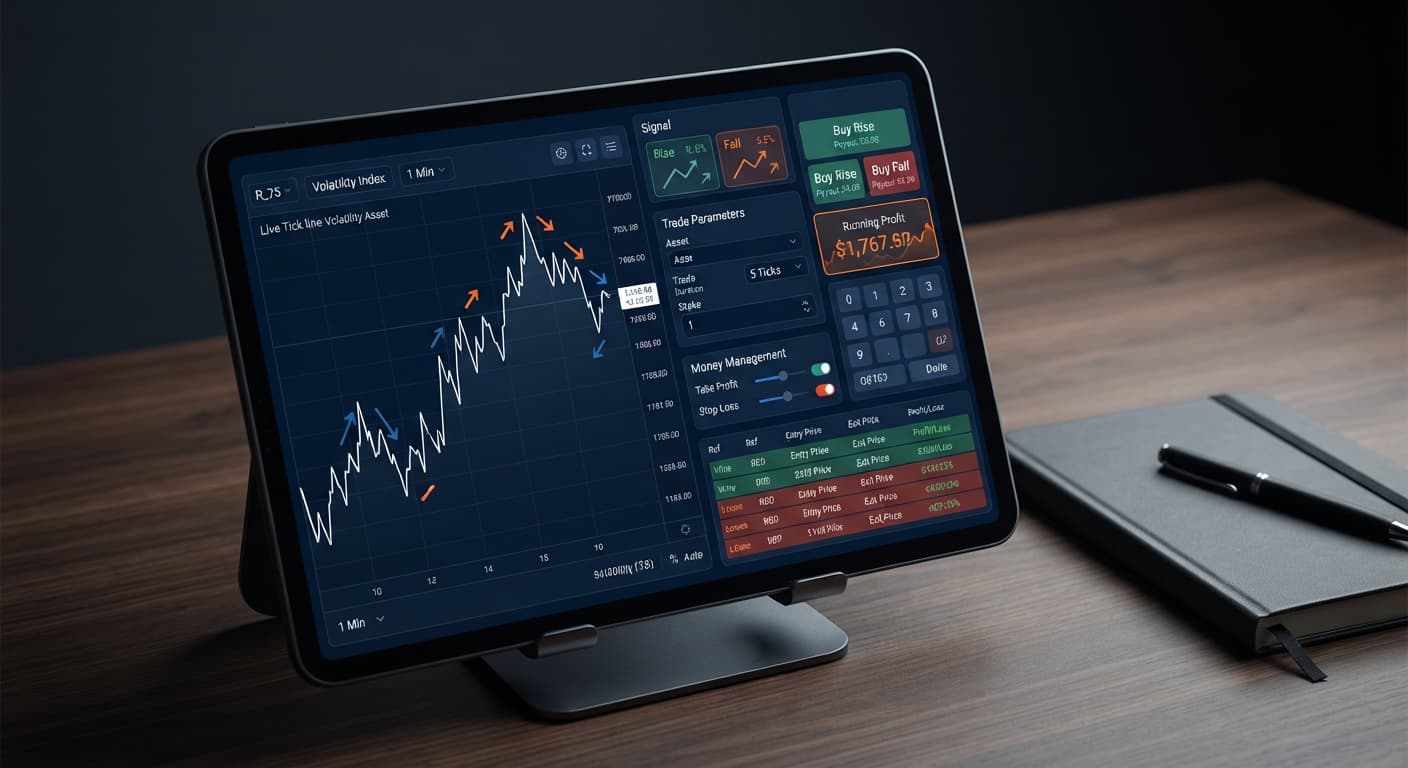
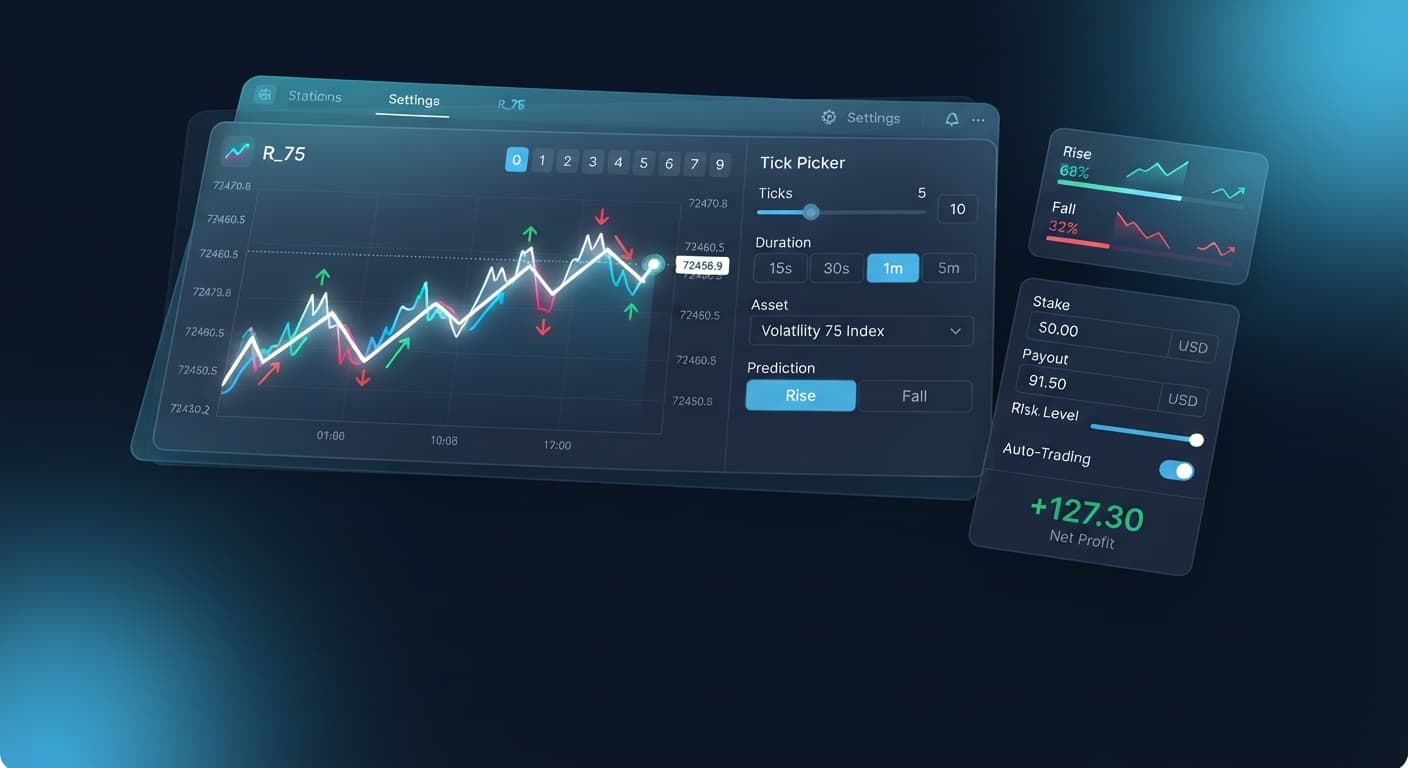
Auto Trading Bots
How to Use Tick Picker for Deriv Rise/Fall Bots
Learn how to use tick picker for automated Rise/Fall trading on BinaryBot.live. Master free deriv bots with tick analysis. Start trading smarter today.
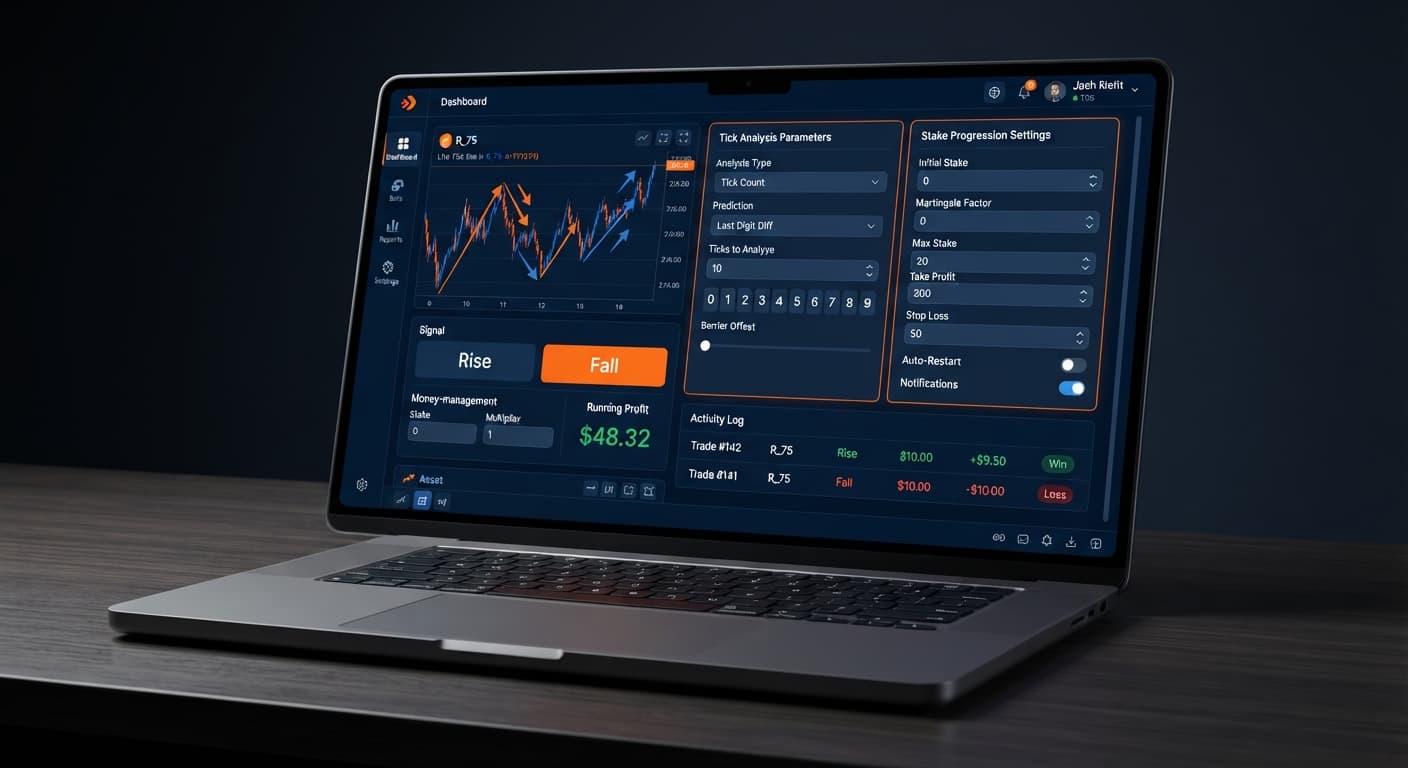
When evaluating tick picker vs dualshot, the decision comes down to whether you prefer signal-based trend analysis with flexible loss-recovery modes or continuous dual-directional market entry. Tick Picker visualizes tick-level price direction to trigger CALL and PUT contracts based on momentum, while DualShot executes dual-sided Rise/Fall positions to capture rapid volatility swings. If you want visual trend validation and managed recovery options like Mesamilano, Tick Picker is the direct choice; if your strategy relies on automated multi-contract coverage without waiting for trend confirmation, DualShot fits better.
Popular choices across free deriv bots often force a choice between single-direction precision and multi-position automation. Tick Picker focuses purely on tick-stream trajectory, giving you clear visibility into live market moves before placing a trade. DualShot strips away manual trend checks to keep contract placement running on both sides of the market. Understanding how these structural differences handle active index conditions prevents blown session balances.
Here's how to pick the right tool for your immediate trading objective:
Choose Tick Picker if:
Choose DualShot if:
Both tools run inside your web browser and connect directly to Deriv over their official API using your personal API token. No funds pass through BinaryBot.live, meaning every contract settlement happens instantly on your own Deriv balance.
While both belong to the top tier of free binary bots built for synthetic index trading, their underlying contract execution models differ completely.
| Dimension | Tick Picker | DualShot |
|---|---|---|
| Primary Execution Model | Directional CALL/PUT signals driven by real-time tick stream trend detection | Simultaneous or rapid dual-direction Rise/Fall automated contract entries |
| Placed Contract Types | CALL, PUT | CALL, PUT |
| Money Management Options | Fixed Stake, Martingale, Mesamilano | Automated fixed or proportional stake progression options |
| Loss Recovery Distribution | Spreads recovery across several trades (Mesamilano) or doubles (Martingale) | Direct stake adjustment based on net dual-contract outcomes |
| Charting & Visual Feedback | Real-time tick chart with active signal indicators | Execution log tracking multi-contract entry points |
| Supported Markets | Volatility indices, 1s volatility indices | Volatility indices, 1s volatility indices |
| Primary Risk Point | Extended trendless consolidation causing false directional signals | Rapid market moves in one direction causing repeated losses on the opposing side |
Deciding between tick picker vs dualshot requires looking at how each bot handles trade selection. Tick Picker waits for tick momentum to align before issuing a signal, making it a natural choice for trend-following strategies. DualShot operates on the assumption that market noise creates tradeable opportunities in both directions, relying on strict recovery rules rather than directional forecasting.
To set up Tick Picker correctly, you adjust four core controls located directly on the interface panel. These settings govern how much capital you commit, how loss recovery behaves, and when the bot disconnects from the API.
| On-Screen Control | Selected Value | Bot Execution Behavior | Ideal Trader Profile |
|---|---|---|---|
stake |
$2.00 | Sets the baseline dollar value placed on every initial CALL or PUT contract | Account balances around $100 looking to keep per-trade risk at 2% |
money management mode |
Mesamilano | Distributes accumulated loss recovery across multiple future trades instead of doubling on the very next tick | Risk-conscious traders who want to avoid the steep drawdown curve of standard stake doubling |
money management mode |
Fixed Stake | Keeps contract size flat at the baseline stake value regardless of trade outcome |
Session testing, strategy verification, and conservative balance preservation |
stop loss |
$15.00 | Automatically stops the bot if total session loss touches or exceeds this limit | Disciplined traders protecting bankrolls against sustained bad market conditions |
target profit |
$10.00 | Terminate trade execution the moment session net profits reach this threshold | Short-session traders targeting quick, realistic profit targets |
I always run money management mode set to Mesamilano paired with a conservative target profit on Volatility 100 Index. Spreading loss recovery across three or four winning trades prevents the severe account balance shocks that occur when Martingale doubles stakes during a bad run.
Neither bot eliminates market risk, and assuming one strategy is immune to losing streaks is a fast path to a zero balance.
Tick Picker generates CALL/PUT trade signals directly from tick-level price trajectory. It's vital to remember that past digit or tick direction does not alter the mathematical probability of the next tick. Deriv synthetic index ticks are completely independent random draws. When Volatility 75 Index enters tight consolidation, tick directions flicker back and forth rapidly. This whip-saw motion creates false trend signals, causing the bot to buy CALL contracts at local tops and PUT contracts at local bottoms.
DualShot faces a completely different risk profile. Because it enters dual-sided positions, a strong, uninterrupted trend in one direction works directly against the opposing contract side. If the index surges upward without dipping, the downward side takes consecutive losses.
If you choose Martingale under money management mode on Tick Picker, the stake doubles far faster than most traders expect. A $2.00 base stake becomes $4.00, $8.00, $16.00, $32.00, and $64.00 in just five consecutive losses. A six-trade losing streak demands a $128.00 stake to recover previous losses, which will instantly wipe small accounts.
Always set stop loss and target profit before starting the bot, not after a session starts going sideways. Test every setup on a Deriv demo account before risking real money.
If you're weighing tick picker vs dualshot for your daily trading, test both systematically on virtual balance before making a live decision. Here's a direct workflow to evaluate performance using our free deriv bot collection.
Select your demo account token and navigate to the interface. Choose Volatility 10 Index from the market selection menu to start with smooth tick dynamics.
Set stake to $1.00, money management mode to Mesamilano, stop loss to $10.00, and target profit to $5.00. Starting with conservative limits gives you room to monitor how the algorithm handles trade recovery.
Start the bot and watch the real-time tick chart. Observe how the system waits for tick alignment before placing a CALL or PUT contract. Note how Mesamilano recalculates contract size after a loss. Once the session hits either your target profit or stop loss, record the total run duration and drawdown.
Switch to DualShot using the exact same demo balance and index market. Run a matching session targeting a $5.00 profit. Compare the trade count, drawdown curve, and win rate against your Tick Picker session.
This systematic test highlights which contract placement model fits your individual risk tolerance. Some traders prefer the directional filtering of Tick Picker, while others like the rapid execution of DualShot. Choosing between tick picker vs dualshot ultimately depends on whether you trust momentum signals or market neutrality during active sessions.
Try it yourself on Tick Picker using a demo balance first.
If you don't have one yet, create a free Deriv account.
Trading involves risk. Past performance does not guarantee future results.
Professional tick analysis tool for Deriv with real-time charts, trend detection and Rise/Fall trading signals, plus Mesamilano and Martingale strategies.
Open Tick Picker →Tick Picker uses real-time tick-stream trend detection to place single CALL or PUT contracts based on momentum. DualShot, on the other hand, automates dual-sided Rise/Fall positions to capture rapid volatility swings without needing trend confirmation.
Yes, Tick Picker supports both Martingale and Mesamilano money management options. Mesamilano is particularly useful because it distributes loss recovery across multiple subsequent trades instead of instantly doubling your stake.
Yes, the bots connect directly to Deriv via your personal API token and no funds pass through BinaryBot.live. Every contract settles instantly on your own Deriv balance.
Tick Picker supports standard Volatility indices and 1s volatility indices on Deriv. It's designed for trading single contracts per cycle with strict control over your entry parameters.
Guides closest to this one.
Learn how to use tick picker for automated Rise/Fall trading on BinaryBot.live. Master free deriv bots with tick analysis. Start trading smarter today.
Compare tick picker vs manual trading on Deriv Rise Fall contracts. Learn how execution speed and emotion control differ when using a free deriv bot. Read now.
Master tick picker stop loss setup on BinaryBot.live. Learn to configure risk controls for automated deriv trading bot rise fall strategies today.