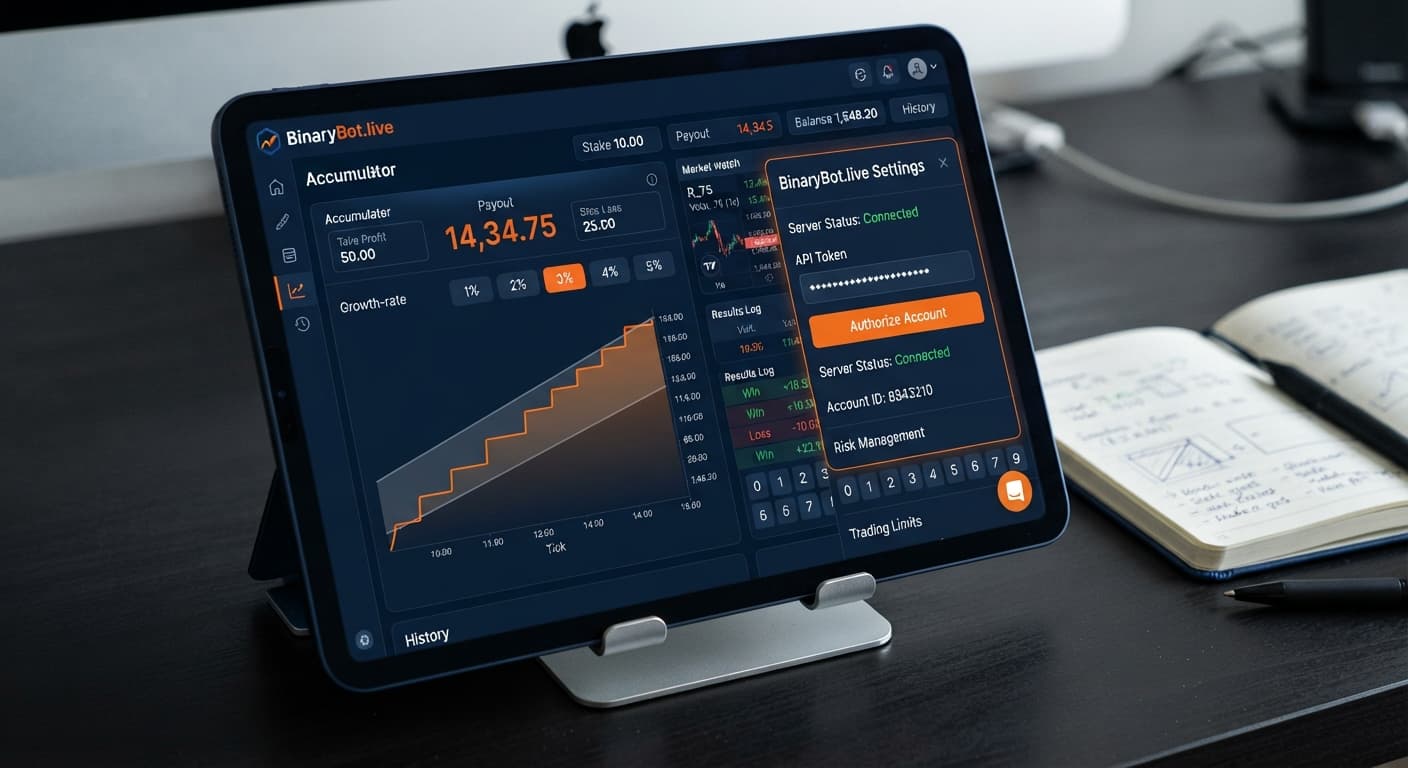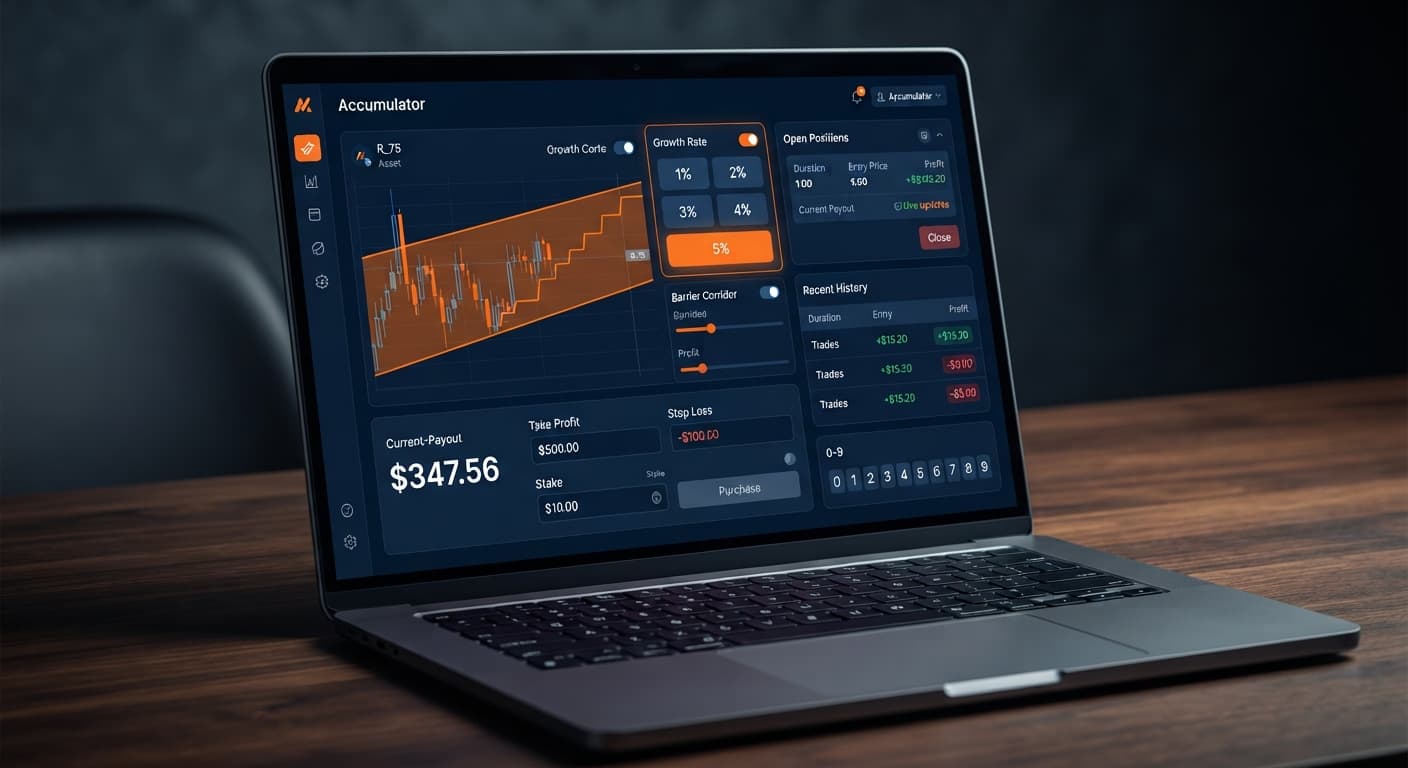
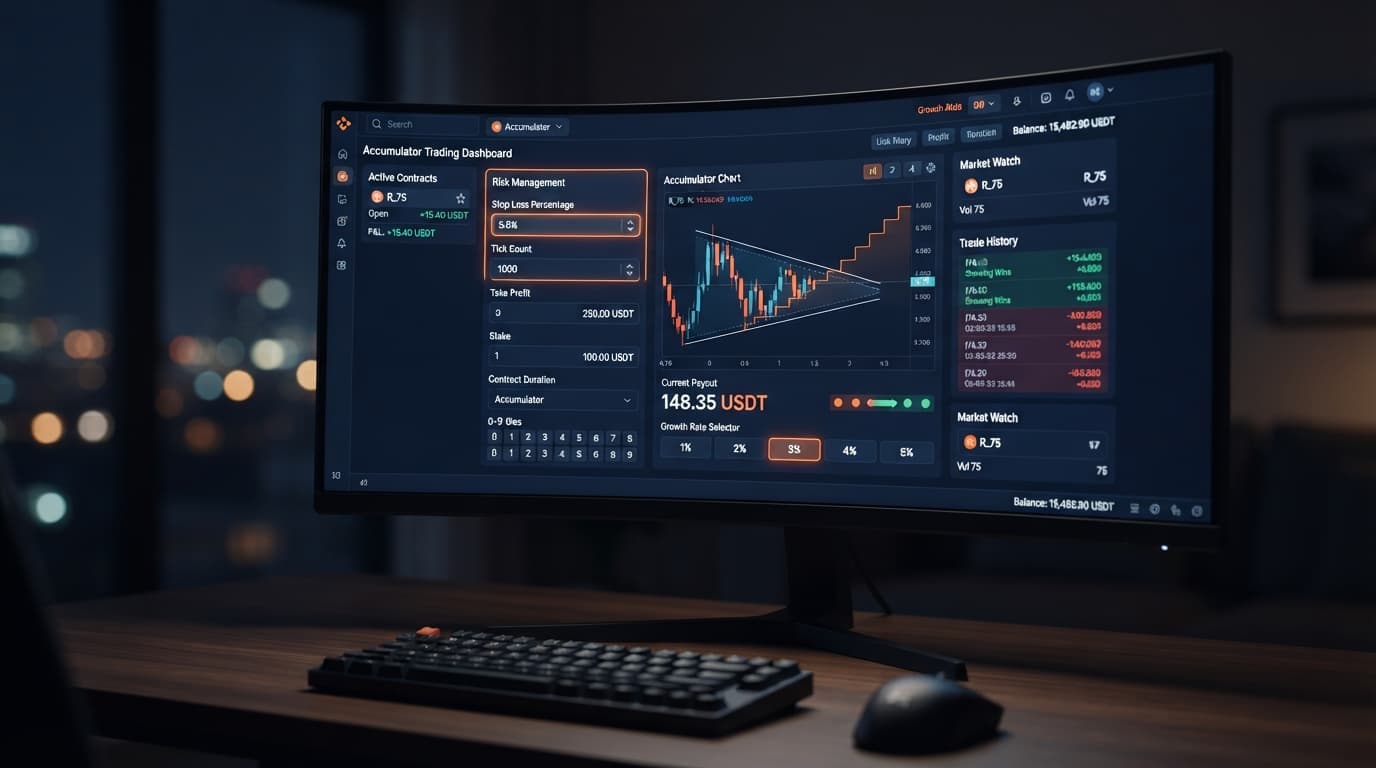
Auto Trading Bots
Accumulator Bot Stop Loss Setup for Deriv Bots
Master your accumulator bot stop loss setup on Deriv volatility indices. Learn step-by-step configuration to manage risk. Try our free platform today.
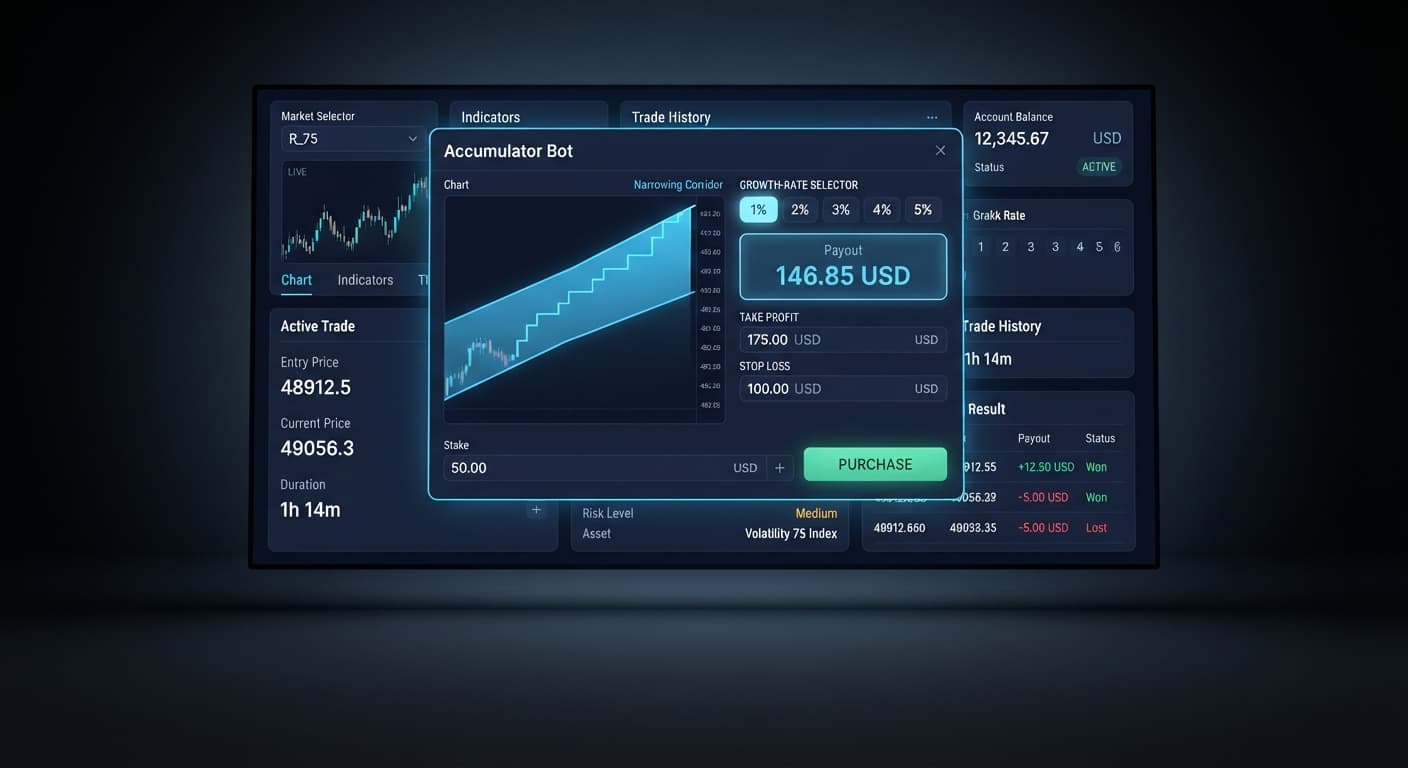
The Volatility 75 Index is the accumulator bot best market if you run low growth rates like 1% or 2% for short tick durations. Its steady two-second tick interval gives price action room to drift without jumping outside narrow barriers. For high-growth strategies above 3%, slower markets like Volatility 10 Index perform better because V75 tick dispersion breaks tight boundaries too easily.
Deriv generates the Volatility 75 Index using an algorithm that maintains a constant 75% annualized volatility. Ticks update exactly every two seconds. When you deploy an automated accumulator on this index, your contract earns continuous profit for every tick that stays within a calculated price corridor.
The width of that corridor depends directly on your selected Growth Rate. Selecting 1% gives you the widest possible range around the spot price. Selecting 5% tightens that range drastically to compensate for the accelerated compounding.
1% Growth Rate:  [-------- Price Barrier Range --------] (Wide)
5% Growth Rate:  [-- Price Barrier Range --]             (Tight)
Because Volatility 75 features aggressive point shifts from tick to tick, high growth rates turn into high-risk setups. A sudden single-tick price jump on V75 will easily clear a 5% barrier and terminate the contract instantly, wiping out the accumulated payout.
To trade ACCU contracts effectively with automated deriv bots, you must treat trade duration as a function of time rather than a random count. Because Volatility 75 ticks land on a fixed two-second clock cycle, you can measure exact contract lifespan down to the second.
| Tick Count | Duration in Seconds | Typical Price Traversal (Points) | Probability of Staying In Range (1% Growth) | Probability of Staying In Range (5% Growth) |
|---|---|---|---|---|
| 5 Ticks | 10 seconds | 15 - 45 pts | High (~92%) | Moderate (~65%) |
| 10 Ticks | 20 seconds | 35 - 90 pts | High (~85%) | Low (~40%) |
| 20 Ticks | 40 seconds | 80 - 180 pts | Moderate (~70%) | Very Low (~15%) |
| 50 Ticks | 100 seconds | 200 - 450 pts | Low (~40%) | Extremely Low (<2%) |
Here is how a standard 20-tick execution sequence unfolds on the clock:
ACCU contract at the current spot price.Growth Rate, your payout compounds five times while price fluctuations remain well within the wide upper and lower bounds.Understanding this clock cycle helps explain why Volatility 75 qualifies as an accumulator bot best market only when you keep contract lifespans under 20 ticks.
Matching your index to the correct settings determines whether your session survives noise spikes. Here is how specific parameters line up on Volatility 75:
| On-Screen Setting | Recommended Value | Expected Market Behavior | Tactical Purpose |
|---|---|---|---|
Growth Rate |
1% or 2% | Maximizes barrier width to absorb V75 price swings | Keeps the contract alive across 10 to 15 ticks |
Growth Rate |
4% or 5% | Extremely narrow barrier range | High risk; single-tick spikes cause frequent knockouts |
take profit |
15% to 30% of stake | Triggers close after ~10–12 consecutive ticks | Secures compounding gains before standard deviation expansion |
target profit |
5% to 10% of session bankroll | Ends session once overall session goal is reached | Prevents over-trading on synthetic volatility |
stop loss |
15% to 20% of session bankroll | Halts the bot after back-to-back contract failures | Protects total capital during high-volatility regime shifts |
If you run popular binary bots on lower volatility indices like Volatility 10 Index, you can sometimes push your compounding settings higher because tick variance is lower. On Volatility 75, sticking to 1% or 2% yields far more consistent runs.
The most common mistake traders make when moving to Volatility 75 from Volatility 10 Index is leaving their settings unchanged. On Volatility 10, a 3% or 4% Growth Rate can survive 15 ticks because the distance between price updates is compressed.
When you apply those same settings to Volatility 75, your setup fails quickly. The absolute point movement per tick on V75 is drastically larger. A single standard-deviation price tick on V75 will exceed a 4% growth barrier easily, terminating the trade in under four seconds.
To trade this market safely:
Growth Rate back to 1% before running the bot on V75.take profit and stop loss limits before pressing start, never mid-trade.A 5% growth rate has a much tighter barrier range than 1%. The faster compounding is paid for with a far higher chance of an early knockout. Adjusting your expectations to accept lower percentage growths over shorter durations is what makes Volatility 75 an effective environment for automated accumulator contracts.
Try it yourself on Accumulator Bot using a demo balance first.
If you don't have one yet, create a free Deriv account.
Trading involves risk. Past performance does not guarantee future results.
Related: Accumulator Bot API Token Setup for Deriv Bots
Related: Step-by-Step Guide: How to Use Accumulator Bot for Deriv Bots
Related: Accumulator Bot Settings: Configure Growth and Stops
Free automated accumulator trading bot for Deriv with take profit, target profit and stop loss controls, plus real-time chart analysis for volatility indices.
Open Accumulator Bot →It works well because its steady two-second tick interval gives price action room to drift without jumping outside narrow barriers when you use low growth rates. However, it's only ideal if you keep your settings to low growth rates like 1% or 2% for short tick durations.
You should use low growth rates like 1% or 2% for short tick durations. Selecting a high growth rate above 3% makes the price range too tight, and a sudden tick jump will easily clear the barrier and instantly terminate your Accumulator Bot contract.
Ticks on the Volatility 75 Index update on a fixed two-second clock cycle. This exact timing lets you measure your contract lifespan down to the second, such as a 10-tick trade lasting 10 seconds.
Slower markets like the Volatility 10 Index perform better for high-growth strategies above 3%. On Volatility 75, tick dispersion breaks tight boundaries too easily when using high growth rates.
Guides closest to this one.
Master your accumulator bot stop loss setup on Deriv volatility indices. Learn step-by-step configuration to manage risk. Try our free platform today.
Complete accumulator bot api token setup guide for binary bots. Learn how to connect your Deriv API token for automated volatility index trading today.
Learn how to use accumulator bot on BinaryBot.live. Follow this step-by-step guide to configure your deriv trading bot and trade volatility indices today.