Auto Trading Bots
Accumulator Bot API Token Setup for Deriv Bots
Complete accumulator bot api token setup guide for binary bots. Learn how to connect your Deriv API token for automated volatility index trading today.
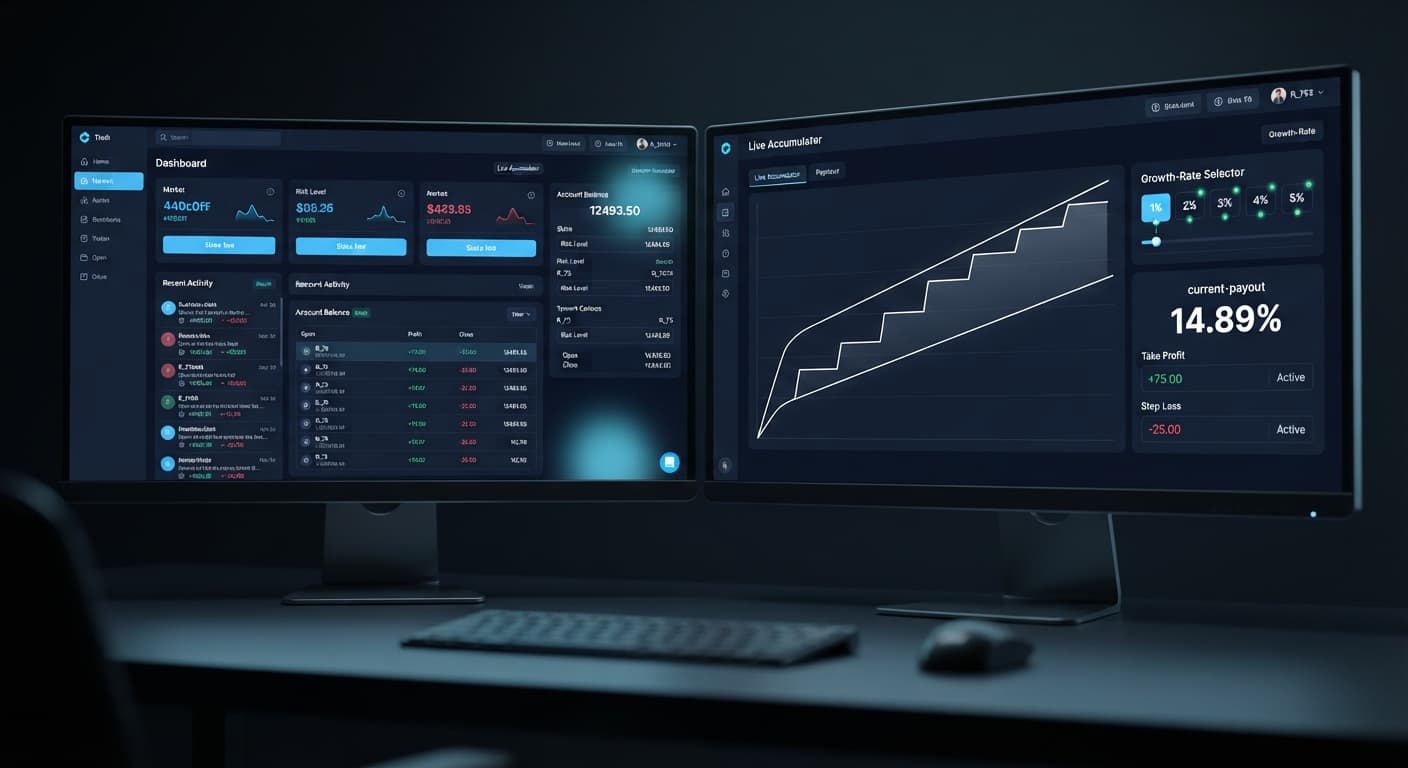
When choosing between an accumulator bot vs autopilot, the winner depends on whether you want tick-by-tick continuous range compounding or hands-off rule-based execution. Accumulator Bot targets exponential payout growth on a single ACCU contract using fixed percentage steps, while AutoPilot runs systematic execution across automated market conditions. If your priority is fast compounding over short tick runs with defined range limits, the accumulator model takes the lead; if you want automated index switching and structured rules across multiple deriv bots setups, AutoPilot is built for that workflow.
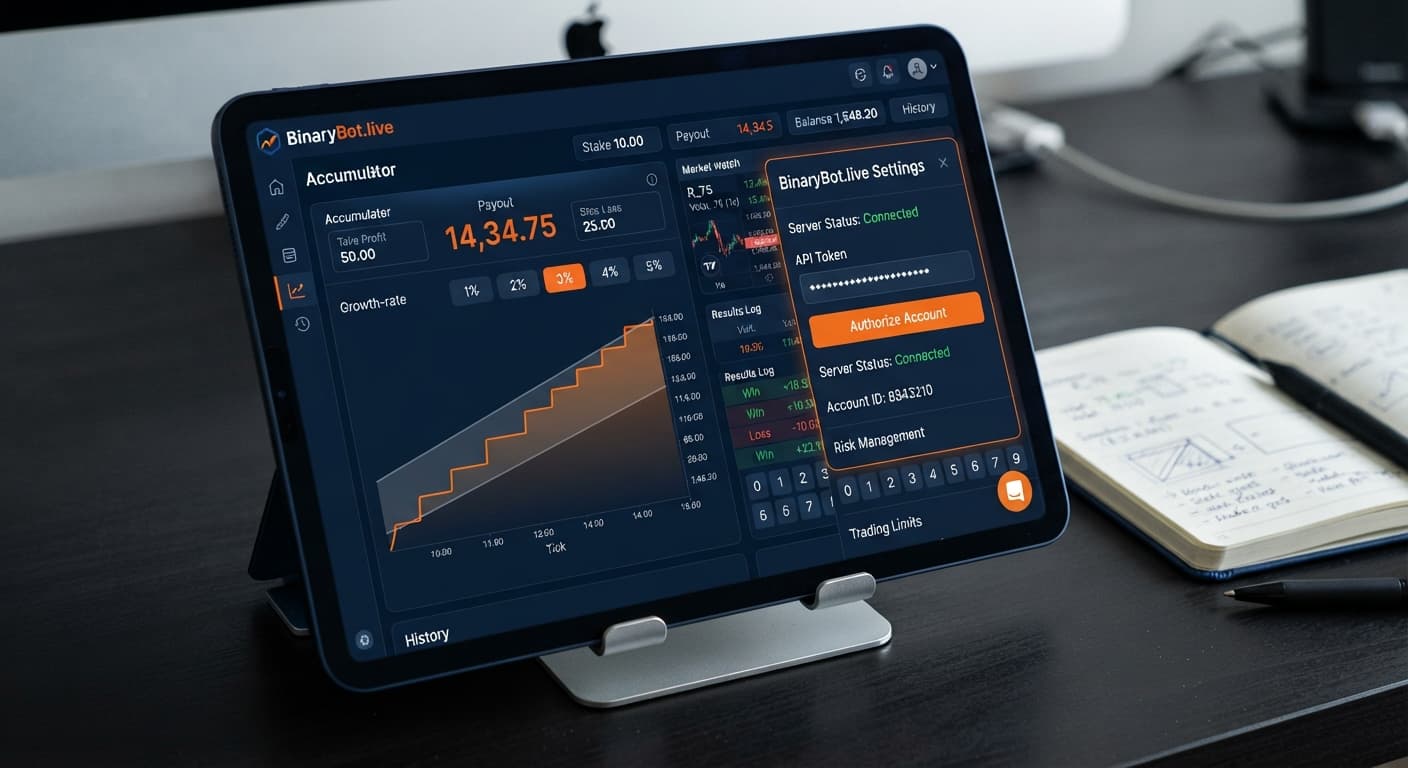
Both options connect straight to Deriv over their official API using your personal API token. No money passes through BinaryBot.live, and every trade executes directly inside your Deriv account. Whether you test strategies on a free virtual balance or trade live markets, understanding how these execution engines differ keeps your capital intact.
Trading synthetic volatility indices requires knowing exactly how your contract handles tick movements. An accumulator contract doesn't wait for a fixed expiry duration like standard options. Instead, ACCU contracts keep your trade open tick after tick as long as the market stays within an active price channel. Every tick that remains inside the channel grows your stake by your chosen percentage.
AutoPilot takes a different route. It acts as an automated management framework, handling entry timing and trade sequences without requiring you to manually execute every order. While AutoPilot coordinates continuous session trading across standard contracts, Accumulator Bot concentrates your risk and return inside a single compounding contract.
It's easy to assume faster tick compounding automatically means higher daily profit. It doesn't. Deriv synthetic indices are independent random draws, meaning past tick patterns or digit counts don't make the next tick any more predictable. The choice comes down to contract mechanics: do you want single-trade exponential compounding or multi-trade automated consistency?
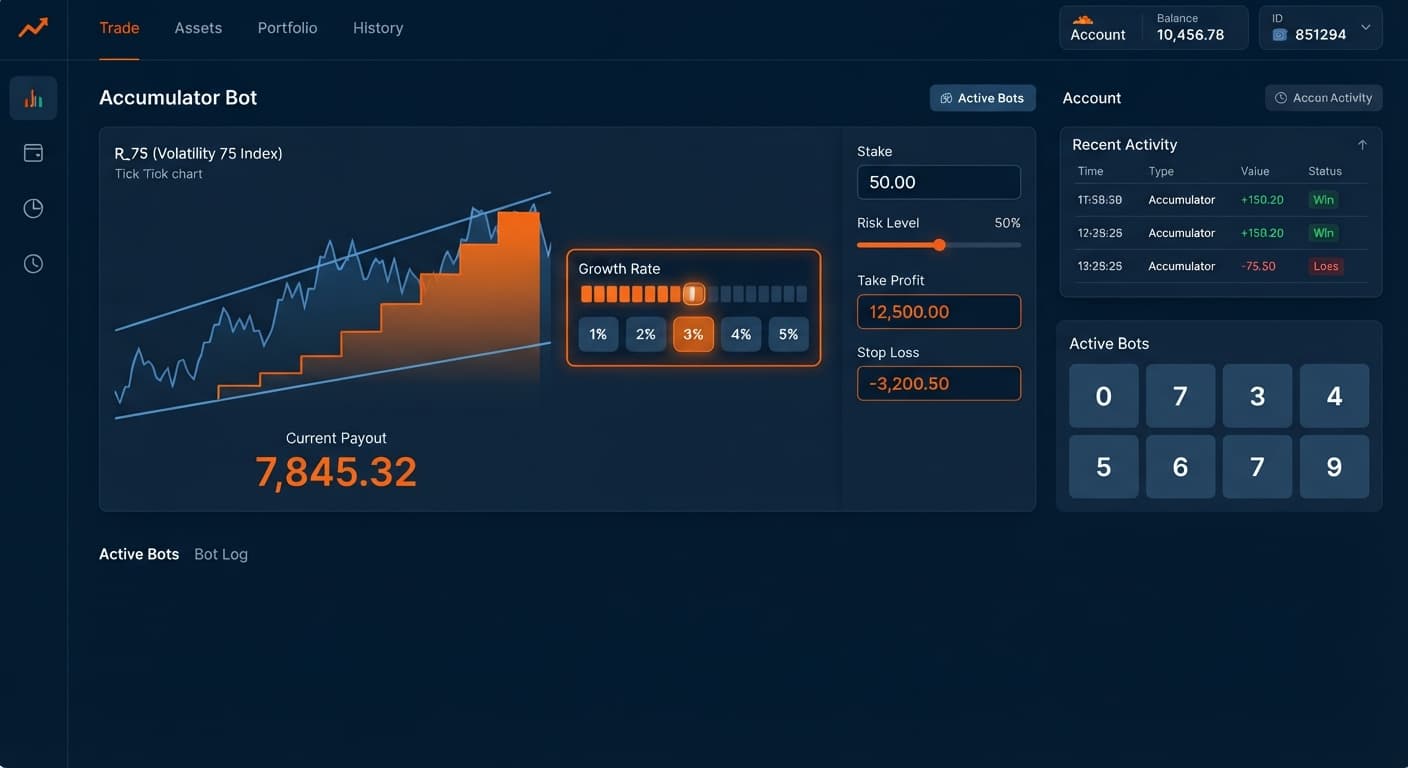
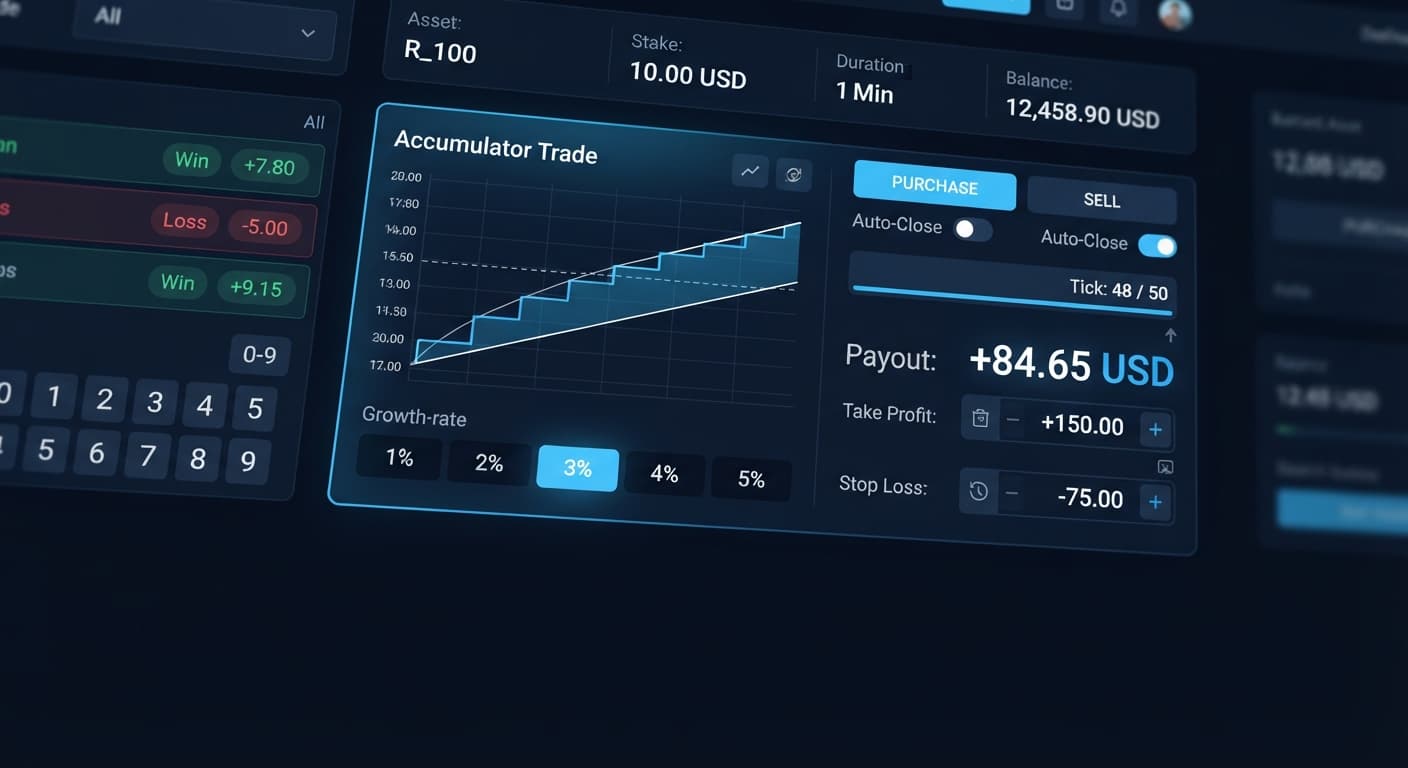
Configuring Accumulator Bot correctly means balancing your compounding speed against channel width. Selecting your Growth Rate changes the math immediately. A higher growth percentage accelerates your payout growth per tick, but Deriv narrows the price channel to offset that higher payout.
Here's how key parameter settings inside the Accumulator Bot interface change trade behavior across synthetic markets.
| Growth Rate Setting | On-Screen Control Values | Channel Barrier Dynamics | Target Trader Profile |
|---|---|---|---|
| Growth Rate: 1% | target profit: 15% / stop loss: 20% | Widest price channel; requires maximum tick deviation to break | Conservative traders seeking longer tick survival |
| Growth Rate: 2% | target profit: 20% / stop loss: 20% | Balanced channel width; solid compromise on Volatility 75 | Steady trend traders working medium tick runs |
| Growth Rate: 3% | target profit: 25% / stop loss: 15% | Moderate channel width; faster payout progression | Active traders targeting quick mid-session growth |
| Growth Rate: 4% | target profit: 30% / stop loss: 15% | Narrow price channel; high sensitivity to sudden spikes | Momentum traders targeting short volatility bursts |
| Growth Rate: 5% | target profit: 35% / stop loss: 10% | Tightest price channel; high chance of early knockout | Scalpers hunting ultra-short 3-to-5 tick runs |
My preferred baseline setting is Growth Rate at 2% paired with a take profit at 20% and stop loss set to 15%. That 2% rate leaves enough channel range on Volatility 75 Index to survive normal tick noise while compounding the position significantly faster than static binary contracts.
Comparing these two choices directly shows how contract structure alters overall session exposure. Many binary bots offer automated trading, but their underlying contract types alter drawdown risk.
| Dimension | Accumulator Bot | AutoPilot |
|---|---|---|
| Primary Contract Type | ACCU (Accumulator contracts) | Standard Rise/Fall, Digits, or Multi-market options |
| Compounding Mechanism | Fixed percentage per tick (1% to 5%) | Stake scaling or fixed position sizing per trade |
| Barrier Dynamic | Live dynamic upper and lower range limits | Fixed strike levels or statistical entry bounds |
| Knockout Conditions | Instant loss if a single tick leaves range | Expiry-based outcome determination |
| Primary Parameters | Growth Rate, take profit, target profit, stop loss | Session limits, contract presets, direction triggers |
| Ideal Market Conditions | Range-bound or steady trend micro-ticks | Multi-condition volatility index shifts |
| Setup Complexity | Single-screen setup; quick parameter adjustments | Preset configuration selection across the free bot library |
| Risk Concentration | Focused within single compounding trade runs | Spread across sequential individual trades |
The core advantage of an accumulator bot vs autopilot workflow is speed of compounding inside tight market conditions. When a synthetic index enters a smooth micro-trend, an ACCU contract at 3% or 4% growth rate can reach a 30% target profit within 8 to 12 ticks. You don't need to win ten separate trades in a row; you just need one trade to stay inside the price channel for a brief window.
That strength is also where the strategy faces severe pressure. A 5% growth rate has a much tighter barrier range than 1%—the faster compounding is paid for with a far higher chance of an early knockout. If price spikes outward by a fraction of a point on tick four, the contract closes immediately and the entire stake for that contract is lost.
AutoPilot avoids single-tick knockouts by spreading risk across multiple distinct contracts. However, running sequential contracts continuously opens your account to session drawdowns if market conditions stay choppy. Automated rule execution cannot bend market probability in your favor. Synthetic index ticks remain independent events regardless of which script handles the execution.
Always set a stop loss and a take profit before starting the bot, not after. Leaving a bot running without hard loss limits active on screen is how minor pullbacks turn into heavy account losses.
You don't need to guess which system fits your trading plan. Pick based on how you prefer to handle trade duration and risk exposure:
Before committing real funds to either approach, test your target parameters thoroughly on a Deriv demo account. Real market speed can surprise you, and watching how range barriers react on a virtual balance is the safest way to refine your strategy.
Try it yourself on Accumulator Bot using a demo balance first.
If you don't have one yet, create a free Deriv account.
Trading involves risk. Past performance does not guarantee future results.
Related: Accumulator Bot API Token Setup for Deriv Bots
Related: Step-by-Step Guide: How to Use Accumulator Bot for Deriv Bots
Related: Accumulator Bot Deriv Bots Guide: Run Your First Bot
Free automated accumulator trading bot for Deriv with take profit, target profit and stop loss controls, plus real-time chart analysis for volatility indices.
Open Accumulator Bot →Accumulator Bot targets exponential payout growth on a single ACCU contract using fixed percentage steps. AutoPilot acts as an automated management framework that handles entry timing and systematic execution across automated market conditions.
Yes, both options connect straight to Deriv over their official API using your personal API token. No money passes through BinaryBot.live, and every trade executes directly inside your Deriv account.
Selecting a higher growth percentage accelerates your payout growth per tick, but Deriv narrows the price channel to offset that higher payout. Conversely, a lower growth rate like 1% gives you the widest price channel and requires maximum tick deviation to break.
No, it doesn't. Deriv synthetic indices are independent random draws, so the choice ultimately comes down to whether you want single-trade exponential compounding or multi-trade automated consistency.
Guides closest to this one.
Complete accumulator bot api token setup guide for binary bots. Learn how to connect your Deriv API token for automated volatility index trading today.
Read this accumulator bot deriv bots guide to configure and run your first free automated trading bot on BinaryBot.live. Start trading today!
Is your accumulator bot not working? Fix Deriv configuration errors, growth-rate limits, and risk control settings on BinaryBot.live today.