Auto Trading Bots
DualShot on Volatility 10: Simultaneous CALL and PUT Setup
Set Risk Level to Low Risk (Safer) when running dualshot on volatility 10 to catch true expansion breaks and avoid losing stakes on flat market micro-ticks.
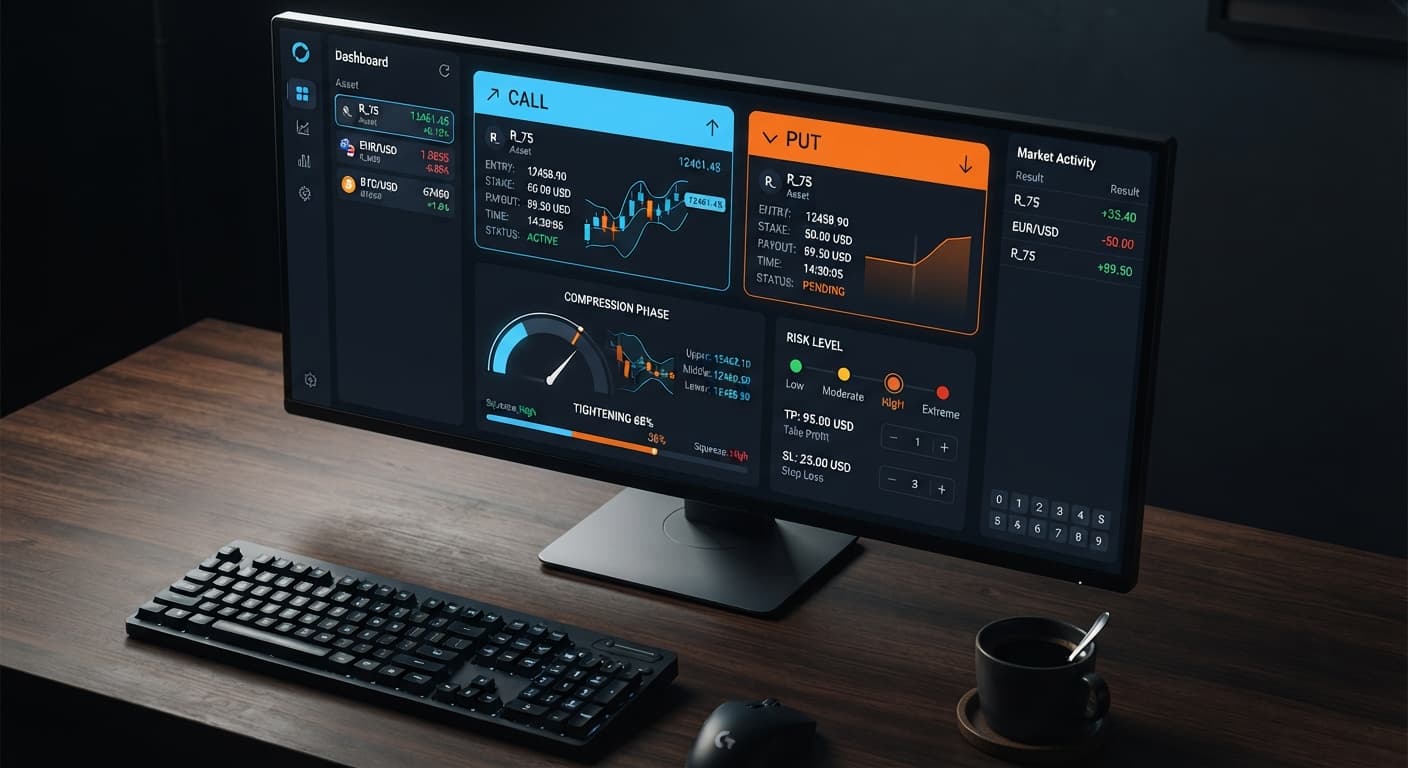
The dualshot best time to trade occurs during tight volatility compression right before a high-velocity market expansion on Deriv synthetic indices. When price consolidates into a narrow tick range, the bot detects the energy squeeze and fires a simultaneous CALL and PUT contract. You profit whenever price breaks out sharply enough in either direction to generate sustained price movement, while a flat, motionless market causes double losses.
When you run automated setups on Deriv, directional bias is usually your biggest threat. Pick CALL and the market drops. Switch to PUT and it reverses back up. Dual execution changes the entry dynamic entirely. Instead of guessing direction, you trade volatility.
The bot connects directly to Deriv over their official API and executes two trades in one click: one CALL contract and one PUT contract on the exact same market tick. Because both directions open at the same instant, your directional exposure is balanced. The net result of the trade depends entirely on how far price travels away from your entry point before expiration, not whether it moves up or down.
If you select a synthetic index like Volatility 75 Index during an active expansion phase, price moves rapidly away from the baseline. One contract goes into profit while the opposing contract expires lost. If the market stays locked in a tight channel, price fails to cover the required barrier distance, leaving you exposed on both legs. That's why timing the entry around market squeezes is the foundation of this strategy when using modern deriv bots.
Trading two contracts simultaneously doubles your upfront exposure. You aren't risking a single stake per click; you're placing two separate trades at once. Understanding the break-even math requires looking closely at contract payouts on Deriv synthetic indices.
A standard Rise/Fall contract on synthetic indices typically offers a payout rate of roughly 95% on winning trades. Suppose you set your base stake to $10.00. Clicking the trigger places a $10.00 CALL contract and a $10.00 PUT contract, putting a total capital outlay of $20.00 on the live account at that single tick.
Here is how the three potential outcomes resolve mathematically:
Because a simple split win/loss yields a minor $0.50 gap on a $20.00 layout due to the 95% house payout multiplier, you can't run this blindly during dead market conditions. The break-even requirement demands timing entries when expansion momentum yields consecutive favorable runs. Ticks on Deriv synthetic indices are generated by cryptographic random algorithms, meaning past tick patterns don't alter the probability of the next tick. The bot's job is simply measuring tick distance metrics to time orders during active movement.
The dualshot best time to trade becomes actionable once you configure the interface correctly on the platform. The software runs straight in your web browser with no local installation required.
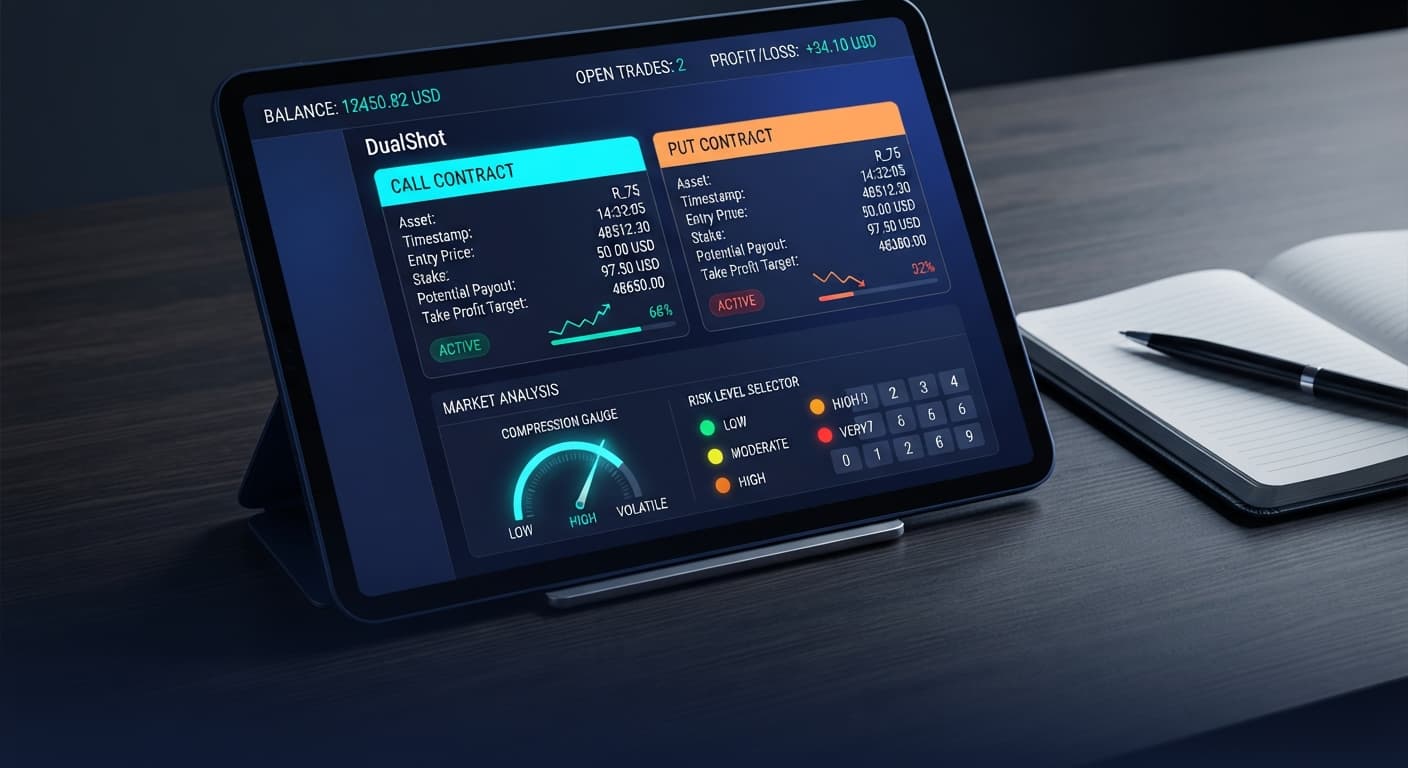
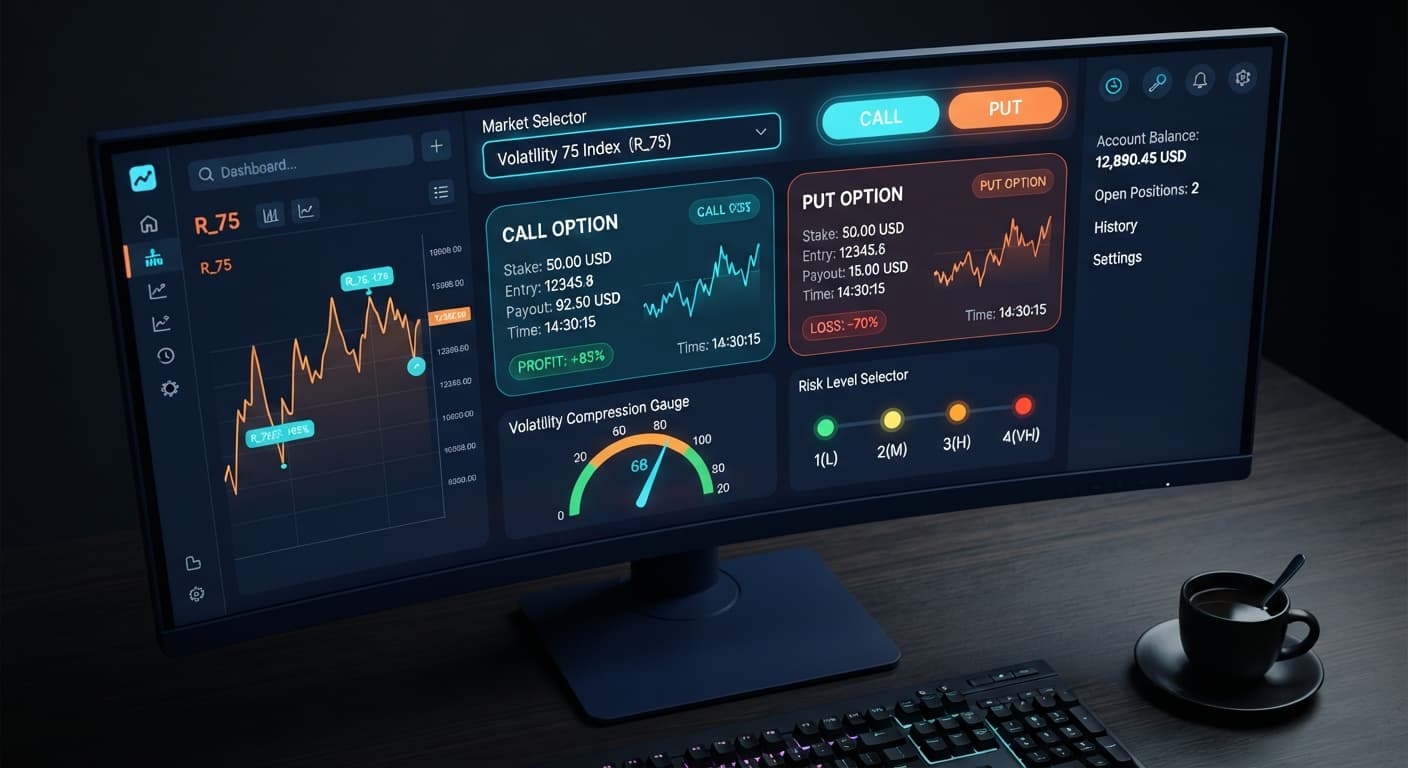
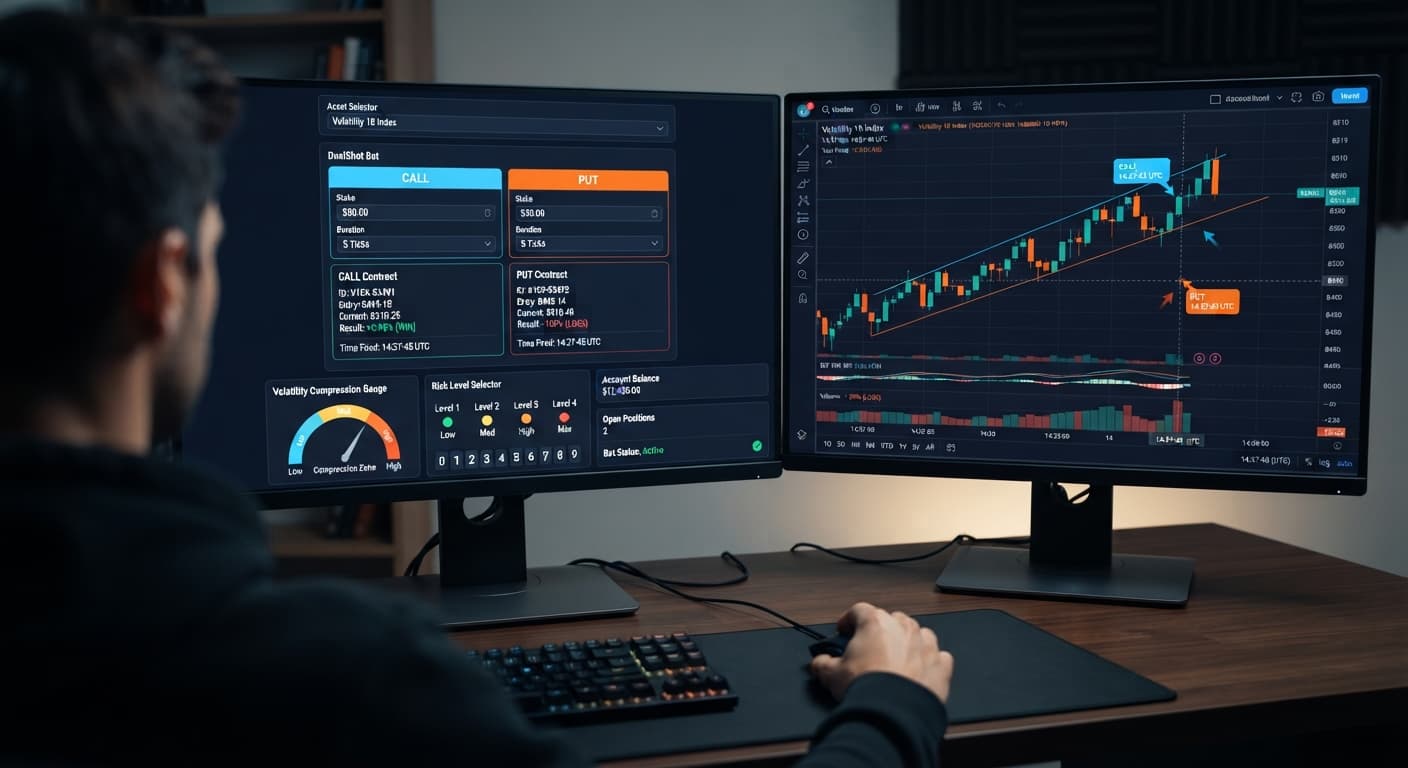
Here are the exact on-screen controls available in the interface:
| On-Screen Control | Setting Options | Practical Function |
|---|---|---|
Stake ($) |
Numeric input (e.g. $1.00, $5.00, $10.00) | Sets individual trade size for EACH contract leg ($5 input = $10 total order risk) |
Risk Level |
Low Risk (Safer) / Medium Risk / High Risk / Very High Risk | Adjusts sensitivity thresholds for compression and breakout detection algorithms |
Follow these steps to deploy the strategy on your trading terminal:
Log into your workspace on BinaryBot.live and paste your official Deriv API token into the connection field. Select your demo account balance first to verify connectivity before placing live trades.
Open the market dropdown menu and pick a high-volatility synthetic index, such as Volatility 75 Index or Volatility 100 Index. These markets display frequent compression and expansion cycles suitable for dual execution.
Locate the Stake ($) control on the interface. Type in your desired entry stake per contract. If you enter $2.00, remember that the bot places both a CALL and a PUT simultaneously, making your total expenditure $4.00 per execution.
Adjust the Risk Level control according to current market movement. Choose Low Risk (Safer) if you want the algorithm to wait for extreme price squeezes, or select Medium Risk or High Risk if you're targeting faster expansion ticks.
Click the execution trigger to let the bot monitor tick variance. When compression criteria line up, the system fires both contracts onto the Deriv platform instantly.
Many traders evaluating popular binary bots prefer this automated engine because it removes emotional hesitation during sudden breakout spikes.
Understanding where this approach breaks down is vital if you want to keep your trading capital intact. The single biggest trap for traders using the dualshot best time to trade method is entering the market during low-volatility chop.
When a synthetic index trades inside an extremely flat horizontal range, price shifts back and forth by tiny fractions of a point. In this environment, compression detection algorithms can mistake slow consolidation for an impending spring-board breakout. If you launch dual trades during a market that refuses to move, both the CALL and PUT contracts can fail if price closes right back where it opened without exceeding required barrier limits.
Losing $20.00 on a double loss takes far longer to recover than taking a single $10.00 directional loss. Firing two trades at once doubles your market exposure on every single trigger. If you hit a run of flat ticks during a quiet period, four consecutive double losses at a $5.00 base stake ($10.00 per execution) wipes out $40.00 quickly.
Remember that synthetic index ticks are independent random draws. A tight compression pattern lasting 20 ticks doesn't mean tick 21 is guaranteed to explode upward or downward. The index has no memory of past ranges. Expecting a breakout just because price stayed flat for two minutes is a fast way to drain your account balance on top-rated binary bots.
To survive long-term when using deriv bots, you need hard mathematical rules that stop you from over-trading when market conditions turn flat.
First, calculate your total session risk based on double exposure. If your total account balance is $200.00, setting a $10.00 base stake means every click commits $20.00, or 10% of your entire bankroll. That's far too aggressive. Keep your Stake ($) setting at 1% to 2% of your available balance per contract. On a $200.00 account, a $2.00 stake per side ($4.00 total exposure per trigger) gives you 50 executions of runway to withstand unexpected flat periods.
Second, establish strict session limits before starting:
Note that DualShot does not feature an automated martingale ladder, stake multiplier, or automatic recovery progression. Every execution relies strictly on the static Stake ($) value you set in the control panel. If you experience losses, don't manually double your stake on the next entry to chase back losses. Doing that during a flat market phase accelerates drawdown exponentially.
Always test your parameters thoroughly on a virtual balance before committing real capital. Testing on a Deriv demo account lets you observe how different Risk Level options perform across various synthetic volatility conditions without putting actual money on the line.
Test the compression settings for yourself on DualShot using a virtual balance before trading live. If you don't have an account yet, create a free Deriv account to start testing. Trading involves risk. Past performance does not guarantee future results.
Deriv best strategy bot with advanced analysis tools — executes 2 simultaneous trades in one click, firing CALL and PUT contracts at the same time with real-time volatility detection.
Open DualShot →The best time is during tight volatility compression right before a high-velocity market expansion on synthetic indices. You'll want to time your entries around these market squeezes so price breaks out sharply enough to cover the required distance.
The bot connects directly to Deriv via their API and executes a CALL contract and a PUT contract simultaneously on the exact same market tick. This balances your directional exposure so you're trading market volatility instead of guessing whether the price will go up or down.
If the market stays locked in a tight channel and fails to move past the barrier distance, both opposing contracts will expire as losses. This results in a 100% loss of your total capital outlay for that trade.
Yes, you can still experience a small net loss even if one leg wins due to the 95% standard payout rate on Deriv synthetic indices. For example, on a $20 total outlay where one contract wins and one loses, you'll see a net session impact of minus fifty cents.
Guides closest to this one.
Set Risk Level to Low Risk (Safer) when running dualshot on volatility 10 to catch true expansion breaks and avoid losing stakes on flat market micro-ticks.
Configure dualshot take profit settings on BinaryBot.live. Learn how to manage risk for automated deriv simultaneous CALL and PUT trades. Try our free bot.
Volatility 75 stands as the dualshot best market on Deriv for simultaneous CALL and PUT execution due to its fast price expansions and synthetic ticks.