Auto Trading Bots
DualShot Settings: Configure BinaryBot.live Deriv Bots
Learn how to configure dualshot settings on BinaryBot.live for automated trading bot strategies. Set up your free deriv bot today. Start now!
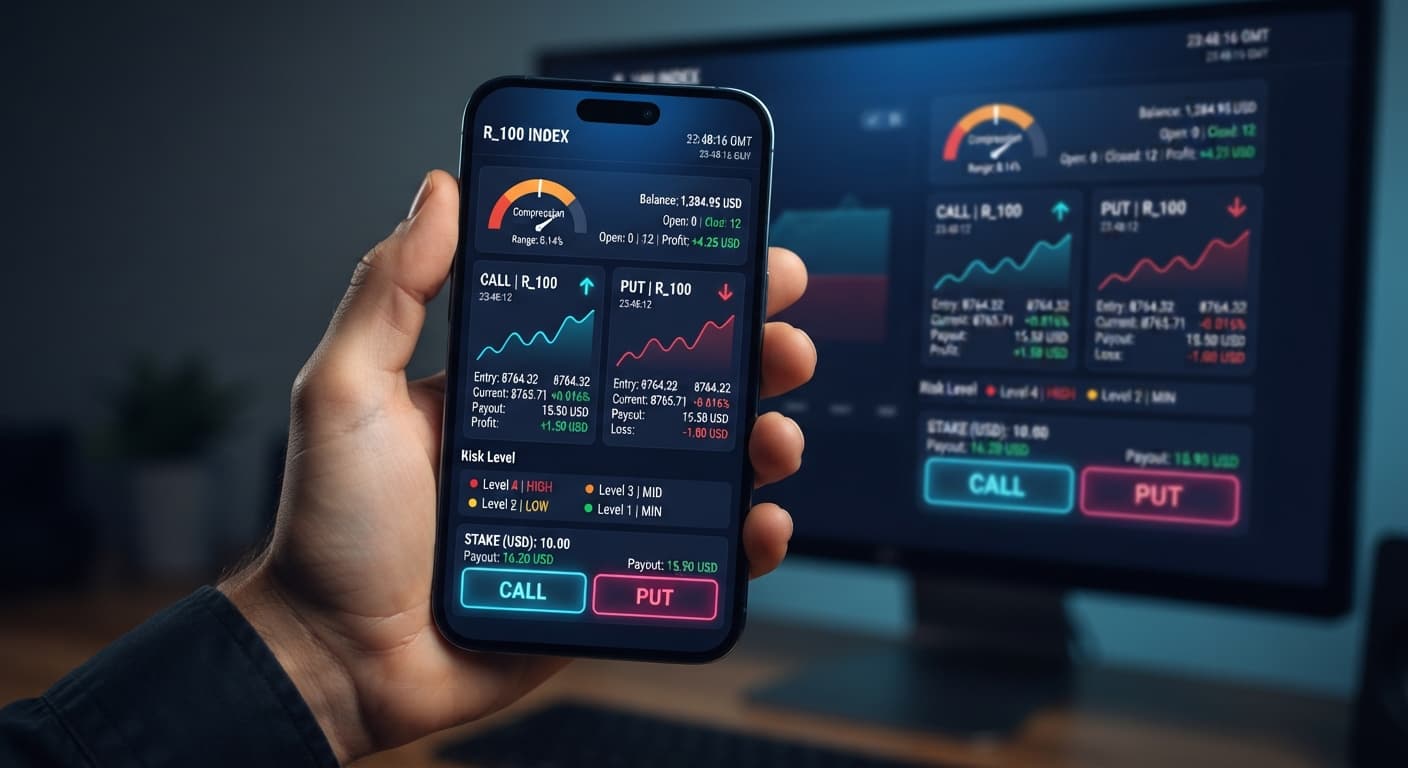
When deciding between dualshot vs manual trading, the primary difference comes down to execution speed and market neutrality: DualShot automatically fires simultaneous CALL and PUT contracts during volatility expansions to catch immediate directional breakouts, whereas manual trading forces you to pick a single direction and execute trades one by one with inevitable manual lag. If you want to profit from sharp volatility spikes without guessing direction, DualShot automates the two-sided entry; if you prefer analyzing market structure and taking directional setups, manual execution fits better.
Both methods have distinct operational trade-offs on Deriv synthetic indices. Understanding how simultaneous execution alters your risk profile is essential before risking live capital.
When you place trades manually on the standard Deriv interface, you choose a single market bias. You analyze the chart, decide whether price will rise or fall, and click either CALL or PUT. If the market explodes upward, your CALL wins. If it reverses suddenly, you take a full loss on that stake.
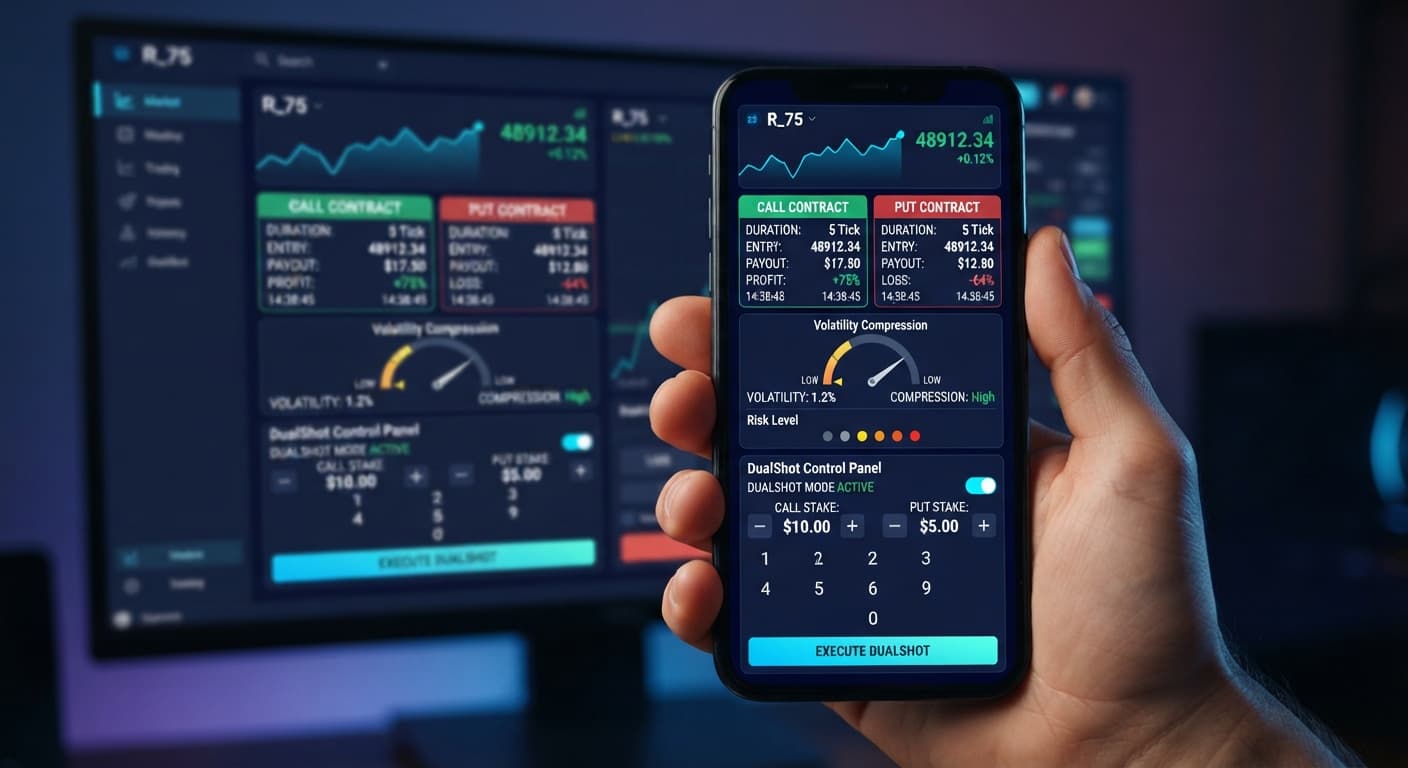
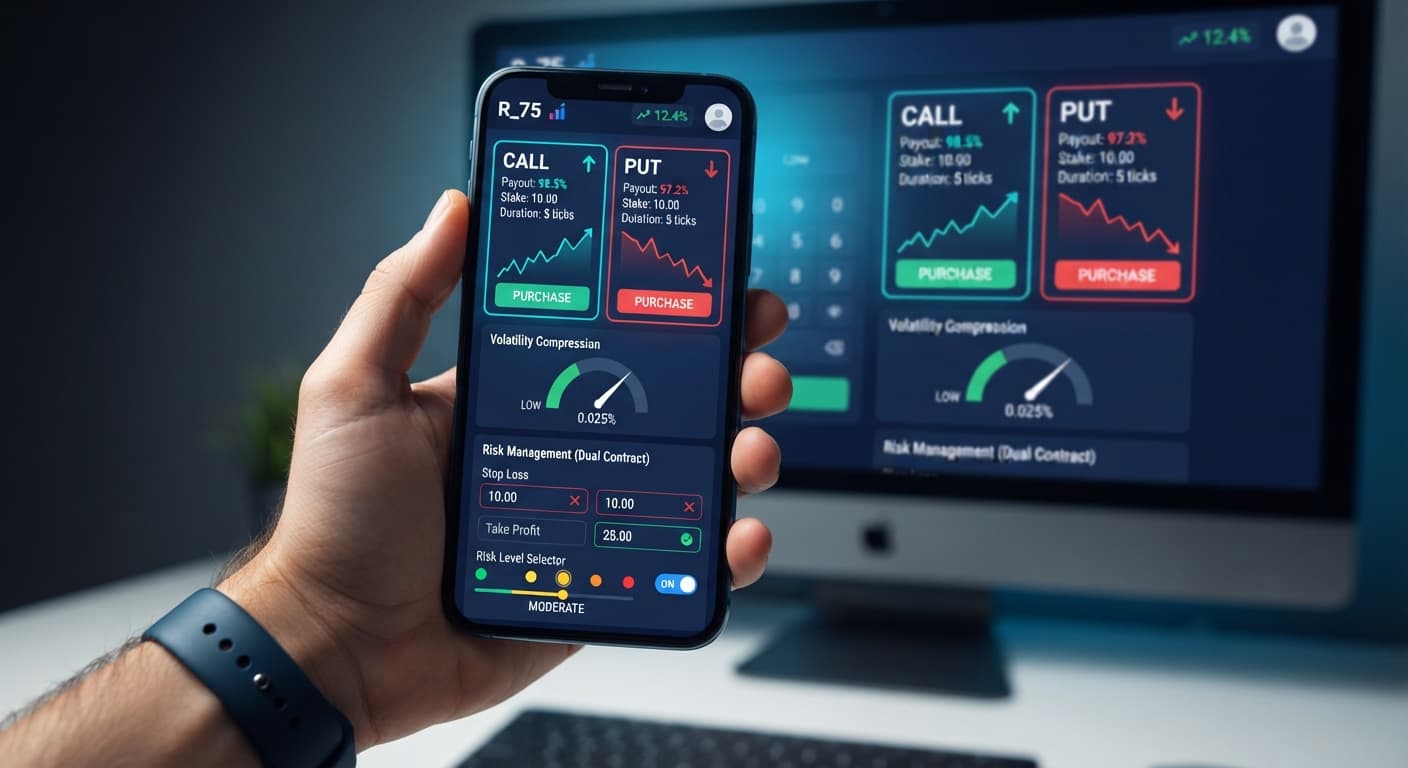
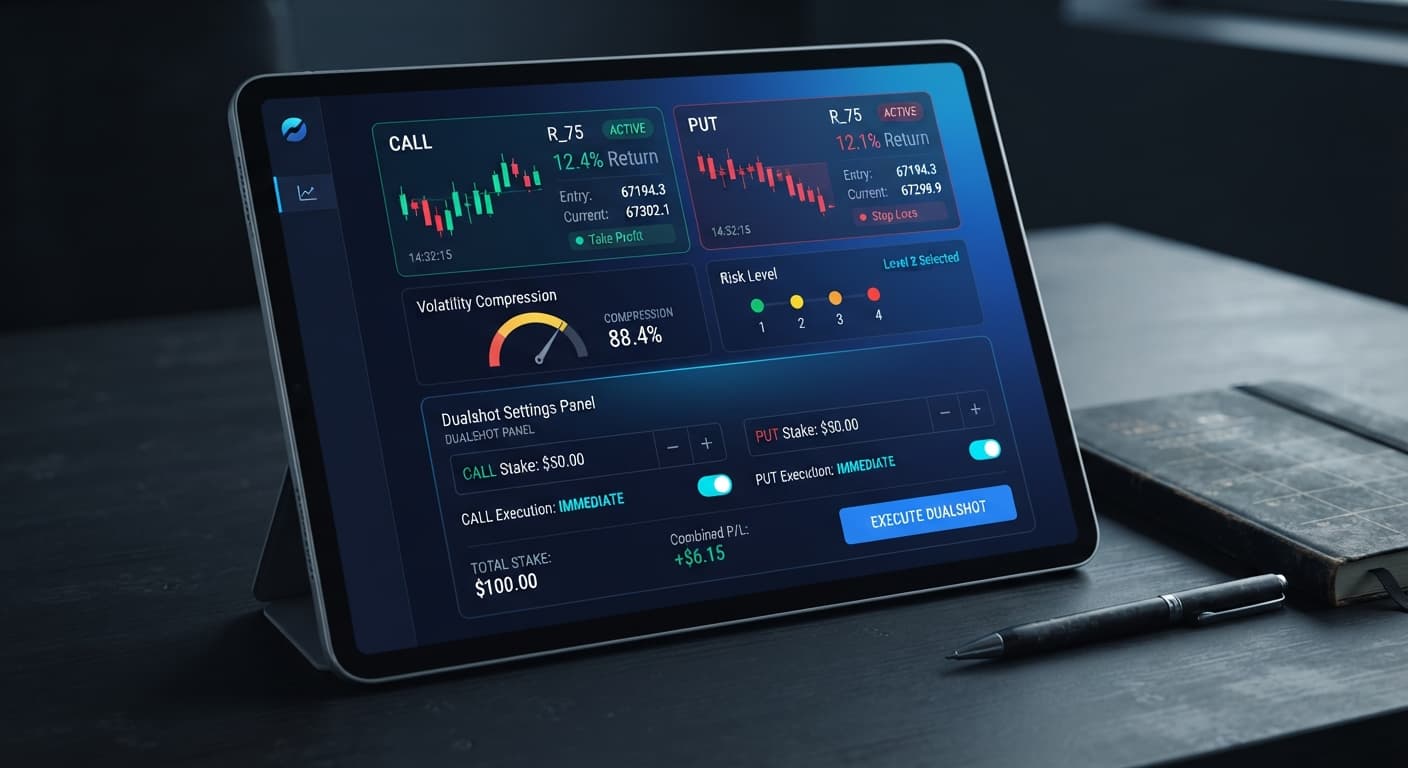
DualShot changes the entry mechanics entirely. Instead of picking a direction, the bot monitors volatility compression—periods where market tick range narrows tightly—and detects the immediate moment of breakout expansion. In a single click, it sends two contracts to Deriv at the exact same millisecond: one CALL and one PUT.
Manual Entry:   [ Market Chart ] ---> Click CALL or PUT ---> 1 Active Contract
DualShot Entry: [ Compression ] ---> Auto-Fire CALL + PUT ---> 2 Active Contracts
Executing a dual entry manually is virtually impossible. By the time you click CALL, adjust your cursor, and click PUT, several market ticks have passed. On volatile synthetic indices like Volatility 75 or Volatility 100, a three-tick delay completely changes your barrier entry points.
Because both positions open together, direction becomes secondary to move distance. However, firing two contracts simultaneously instantly doubles your stake exposure on that trade cycle. If you use free deriv bots, understanding this entry speed advantage—and its cost—is the first step to staying profitable.
Many traders assume that opening both sides of a trade guarantees a profit. That is mathematically incorrect. Deriv contracts include friction through payout rates, meaning you must calculate exact break-even requirements before running simultaneous orders.
Standard Deriv CALL and PUT contracts typically offer payouts around 95% on synthetic indices. Let's walk through the exact numbers for both manual single-direction trades and automated dual trades using a standard $10 base stake.
To break even over 100 manual trades, you need to win at least 52 of them.
If both contracts expire with one in the money and one out of the money under standard equal durations, you lose $0.50 per cycle (a -2.5% drag on total outlay).
Single Manual Trade:  [$10 Stake] ---> Win: +$9.50 | Loss: -$10.00  (Break-even: 51.28%)
DualShot Dual Entry:  [$20 Outlay] --> 1 Win / 1 Loss: -$0.50 Net   (Requires Expansion)
Why use dual execution if the static payoff yields -$0.50 on a flat tie? Because DualShot does not trade flat markets. It relies on its internal detection engine to catch volatility compression before expansion occurs. When synthetic indices break out sharply, price expansion allows specific trade timing or tick offset advantages where market movement overcomes standard static decay.
If you run dual execution during flat, range-bound price action, that -$0.50 friction per trade will steadily drain your account balance. This is why testing your timing against real volatility cycles on binary bots is necessary.
Comparing these two trading styles across key operational parameters highlights where automated simultaneous execution excels and where manual control remains superior.
| Dimension | DualShot Execution | Manual Execution |
|---|---|---|
| Primary Query Focus | Automated dualshot vs manual trading | Manual single-leg analysis |
| Contracts Placed Per Cycle | 2 contracts (CALL + PUT simultaneously) | 1 contract (CALL or PUT) |
| Execution Latency | Sub-millisecond parallel API transmission | 1 to 3 seconds manual reaction lag |
| Directional Market Bias | Delta-neutral (relies on move size) | Directional (requires correct price movement) |
| Outlay Per Trade Signal | Double (2 x base stake) | Single (1 x base stake) |
| Market Condition Sensitivity | Prefers high volatility & compression breakouts | Prefers established trend or range support |
| Execution Controls Available | Stake ($), Risk Level settings | Manual button clicks on trading interface |
| User Workload During Session | Automated entry timing after start | Continuous visual chart monitoring |
Traders choose between these methods depending on their personal execution style, risk tolerance, and session goals. Both strategies have clear strengths, but both come with distinct failure points that can hurt an unmanaged account.
The main argument for using DualShot is removing human hesitation and directional guessing. When synthetic index charts compress into tight ranges, picking whether the breakout will explode up or down is often a 50/50 toss-up. DualShot removes the pick entirely.
Key advantages include:
🟢 Low Risk (Safer), 🟡 Medium Risk, 🟠 High Risk, and 🔴 Very High Risk).Where DualShot is weakest: Flat, low-volatility markets. If price drifts sideways without strong movement, the combined payout friction ($0.50 loss on a $20 combined stake) accumulates. Furthermore, because two contracts open at once, a sudden spike that snaps back instantly can leave both contracts expiring out of the money, doubling your loss on a single cycle.
Manual trading remains the preferred choice for technical analysts who trade price action, support and resistance zones, or specific chart patterns.
Key advantages include:
Where manual trading is weakest: Execution lag. Human fingers cannot execute two opposing orders at the exact same tick. In fast-moving markets, manual traders often suffer severe slippage, entering trades right as the breakout movement finishes.
Making the right choice between dualshot vs manual trading depends on how you analyze market movement and manage your account balance.
Regardless of which path you select, money management discipline determines your long-term success. Always set strict risk parameters before starting any automated session. Set a firm stop loss and take profit target on your account before clicking start—never try to manage risk manually mid-session during high-volatility spikes.
Test your execution settings, stake size, and risk levels thoroughly on a virtual demo account first. Verify how the dual entries perform during different market conditions before placing real capital on live synthetic indices.
Try out dual execution strategies on the free DualShot tool using a virtual balance.
If you don't have a trading profile yet, open a free Deriv account to connect your API token.
Trading involves risk. Past performance does not guarantee future results.
Related: DualShot Settings: Configure BinaryBot.live Deriv Bots
Related: DualShot Not Working: Fix Deriv Bots Simultaneous Trades
Related: DualShot Demo Account Setup for Deriv Bots: Simultaneous Trades
Deriv best strategy bot with advanced analysis tools — executes 2 simultaneous trades in one click, firing CALL and PUT contracts at the same time with real-time volatility detection.
Open DualShot →DualShot automatically fires simultaneous CALL and PUT contracts during volatility expansions to catch breakouts without guessing direction. Manual trading forces you to pick a single direction and execute trades one by one, which introduces manual lag.
No, executing a dual entry manually is virtually impossible because by the time you click one option and move to the other, several market ticks pass. On volatile synthetic indices, that delay completely changes your barrier entry points.
No, opening both sides doesn't guarantee a profit because Deriv contract payout rates create a mathematical drag. If one leg wins and one loses under standard equal durations, you actually take a small net loss on the trade cycle due to this friction.
You need a break-even win rate of 51.28% over 100 trades when using standard single-direction trades with a 95% payout rate. This means you must win at least 52 of your trades just to break even.
Guides closest to this one.
Learn how to configure dualshot settings on BinaryBot.live for automated trading bot strategies. Set up your free deriv bot today. Start now!
Is your dualshot not working on BinaryBot.live? Fix simultaneous CALL and PUT Deriv trades, risk settings, and dual contract trading errors today.
Master your dualshot stop loss setup on BinaryBot.live. Learn how to configure risk controls for this deriv trading bot before launching.