Auto Trading Bots
Solid Trading Bot Deriv Bots Guide: Configure Settings
Read the solid trading bot deriv bots guide to configure trade modes, patterns, and risk limits for automated Deriv trading. Start testing today.
If you're asking is solid trading bot safe, the short answer is no automated trading script is inherently safe, but its actual risk depends entirely on how you configure its parameters. On a Digit Differs strategy, you win roughly 90% of individual contracts because you're predicting the last digit won't match a target. However, because the payout on a DIGITDIFF contract is only around 9% to 10%, a single loss wipes out ten consecutive wins. Determining if a solid trading bot safe configuration exists comes down to whether you enforce strict risk boundaries before starting an automated run.
Traders often look for automated scripts because they see long strings of green ticks in execution logs. With standard binary bots, execution is fast, and seeing nine winning ticks in a row creates a false sense of security. You might think that because a specific digit hasn't appeared in ten ticks, it's overdue to hit, or conversely, that it won't appear twice in a short window.
That belief is a mathematical trap. Synthetic indices generated by Deriv use cryptographic random number generators. Every single tick is an independent draw from 0 to 9. The probability of any specific digit landing on the next tick is always exactly 10%, regardless of what happened on the last five, fifty, or five hundred ticks. Past digit frequency does not change the probability of the next tick.
When running deriv bots set to DIGITDIFF contracts, your risk-reward profile is skewed against you. A $10 stake returns roughly $0.90 in profit on a winning tick. If the target digit lands, you lose the entire $10 stake. That means you need an 11-to-1 win-to-loss ratio just to break even over time. Without strict equity controls set beforehand, a brief sequence of losing ticks will empty your balance faster than you can manually stop the script.
To evaluate if the solid trading bot safe question applies to your trading session, you have to look at what happens on your screen during two distinct market conditions.
In a calm session on a standard synthetic asset, ticks arrive predictably every two seconds. The last digit cycles across 0 through 9 with normal variance. The trade log on screen fills with small profit credits of $0.90 or $1.80. Over twenty minutes, the execution engine might log 40 trades, yielding 36 wins and 4 losses. In this scenario, your balance grows steadily, and the script feels completely stable.
Now consider a clustered session. Random distribution doesn't mean equal distribution in short sample sizes. It's entirely normal for a random draw to output the digit 4 three times within six ticks. If your target digit hits on tick 1, you lose your stake. If the bot executes another trade immediately on tick 3 and digit 4 hits again, you take a second full loss. In under ten seconds, two bad ticks destroy eighteen wins worth of accumulated growth.
This is why trader behavior matters more than the code. The tool connects straight to the official Deriv API to execute trades without emotion. If you haven't assigned realistic limits on screen, the script will keep buying contracts directly through your account until your session bankroll is depleted.
Not all synthetic assets behave identically when evaluated for digit frequency and execution timing. When choosing where to deploy deriv bots, you need to evaluate tick speed, tick intervals, and structural price mechanics.
Below is a comparison of three distinct markets available on the platform, illustrating how market selection changes your overall strategy performance:
| Market Index | Tick Interval | Price Movement Characteristic | Digit Distribution Behavior | Preferred Tick Duration |
|---|---|---|---|---|
| Volatility 10 Index | 2 Seconds | Smooth, low volatility variance | Uniform distribution across 0-9 | 1 Tick |
| Volatility 75 Index | 2 Seconds | Wide price swings, fast movement | Rapid digit shifts across price points | 1 to 2 Ticks |
| Jump 25 Index | 2 Seconds | Periodic volatility jumps | High digit variance during price jumps | 3 Ticks |
For a Digit Differs approach, Volatility 10 Index remains the standard choice for most traders using binary bots. Its slower price variance means price steps move incrementally, providing predictable API request cycles. Conversely, Jump indices introduce sudden price jumps that can trigger cluster repeats during volatility spikes. Running a digit strategy on Jump 100 Index or Volatility 100 (1s) Index increases execution frequency, but exposes your balance to rapid sequential losses if a digit clusters during high-frequency cycles.
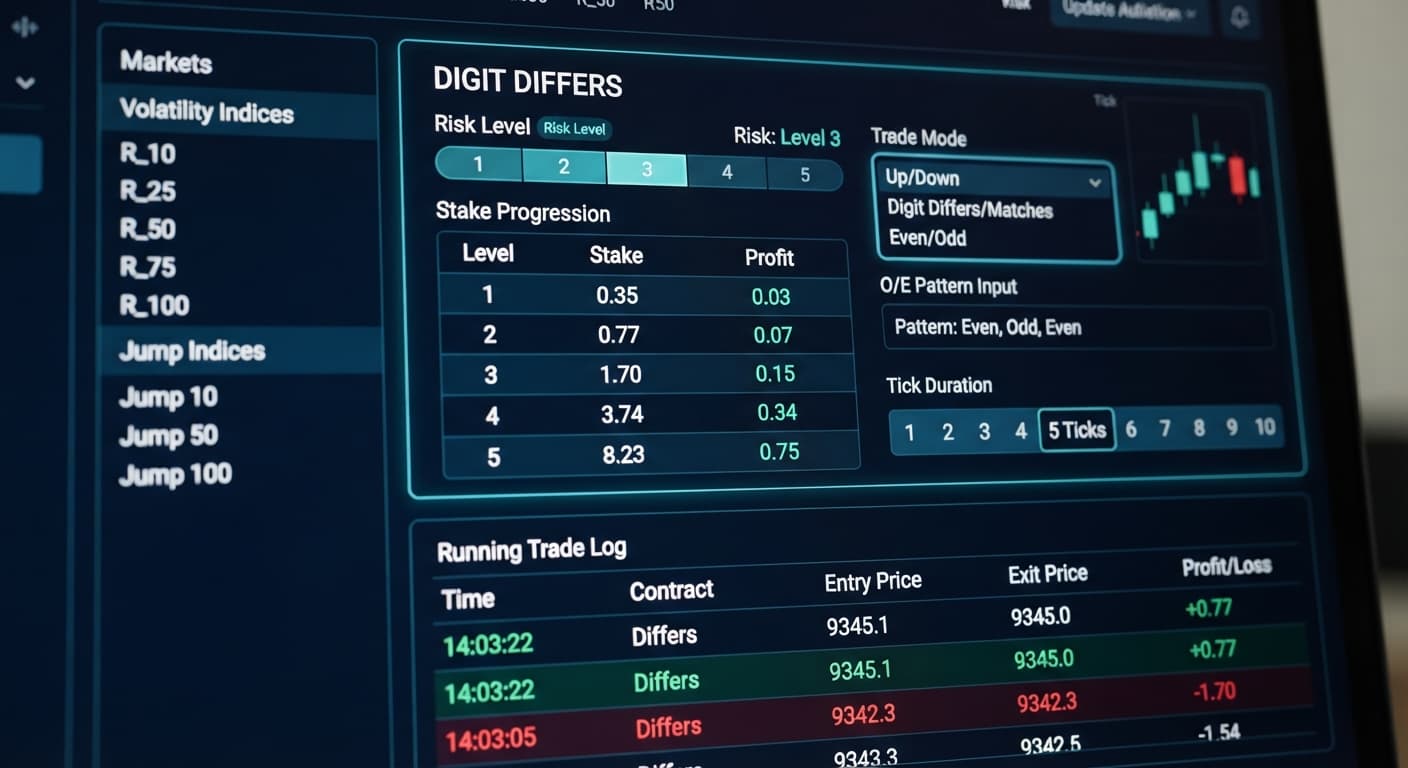
If you decide to run this setup, you must configure the on-screen settings precisely. Here is the exact setup process on the platform interface.
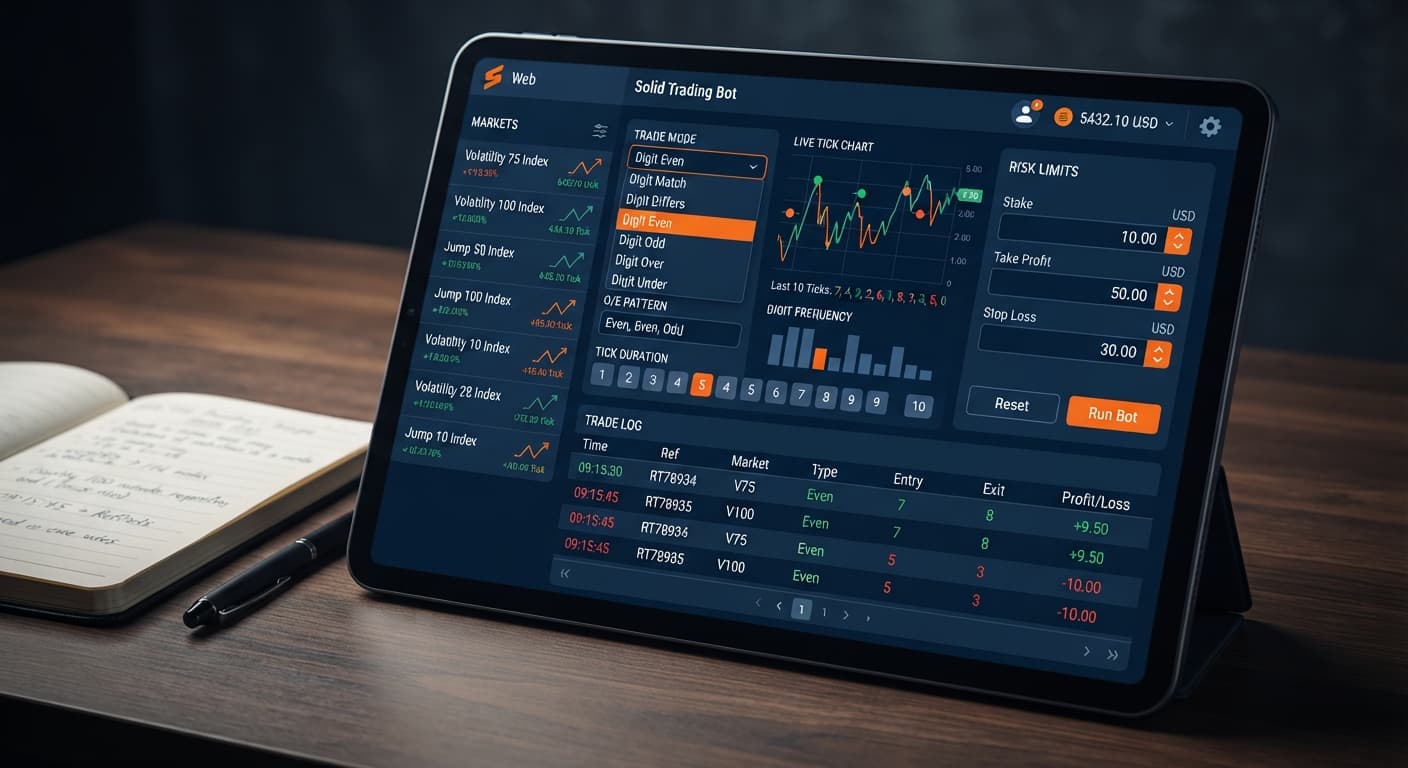
Open the platform interface and click the Market Index field. Choose Volatility 10 Index from the dropdown menu. This sets your underlying asset to a lower-volatility synthetic stream.
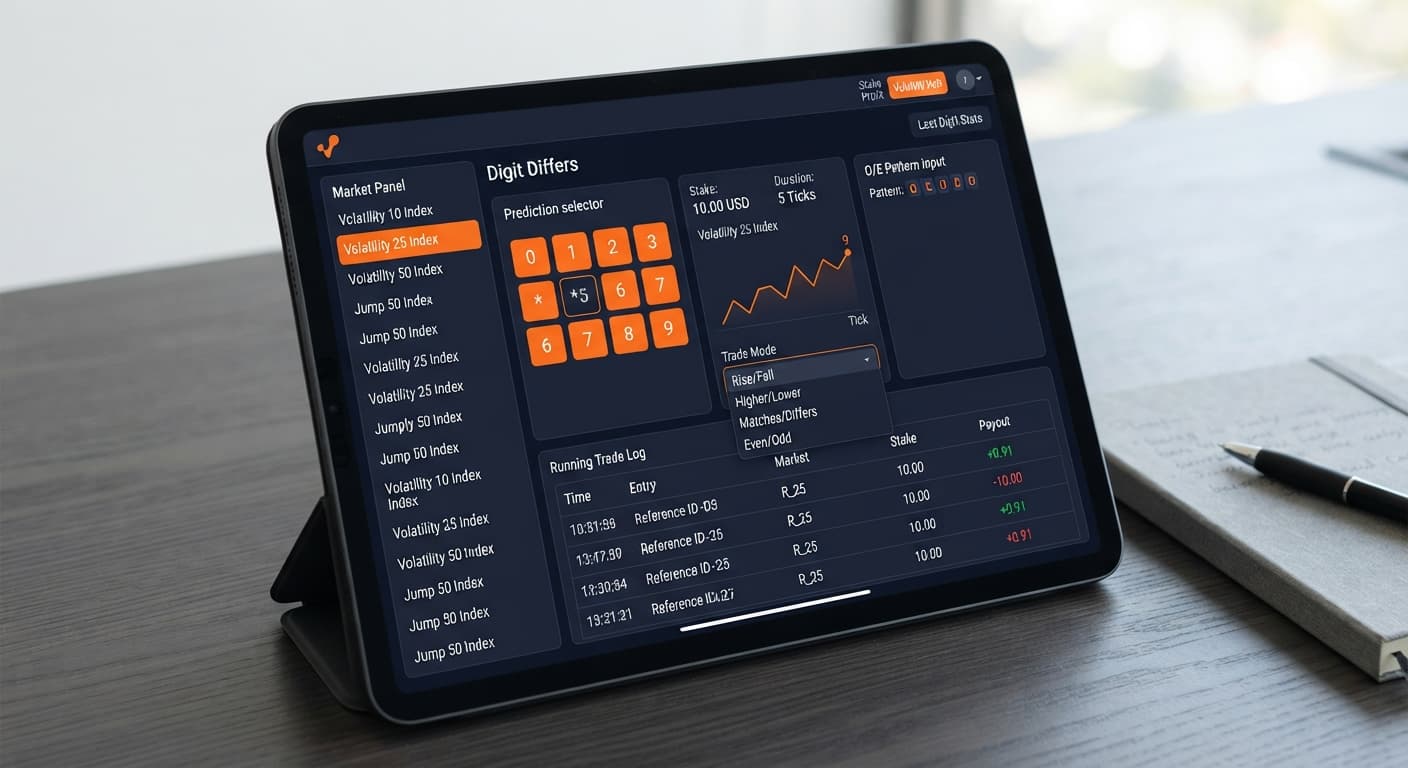
Locate the Trade Mode menu. Select Digit Differs. This instructs the engine to place DIGITDIFF contracts through your account API token.
In the Pattern (O=Odd, E=Even) box, enter a filtering sequence such as O,E. This tells the bot to wait until an Odd digit followed by an Even digit appears before sending an order, preventing the bot from trading continuously on every single tick.
In the Start Stake ($) box, enter a conservative baseline amount, such as 1.00. Next, go to the Tick Duration — 1 to 10 ticks field and set it to 1. A 1-tick duration ensures your contract resolves on the immediate next price tick.
Enter your maximum acceptable drawdown in the Stop Loss ($) field—for instance, 10.00 on a 100.00 balance. In the Target Profit ($) box, set a realistic gain goal, such as 3.00. Once either threshold is hit, the platform automatically halts trading requests.
Understanding whether the solid trading bot safe threshold works for you comes down to your personal approach to risk and bankroll preservation.
This setup suits systematic traders who treat digit algorithms as analytical tools rather than income engines. If you understand that synthetic digit outputs are strictly independent random draws, you can use brief trading sessions to capture small targets while strictly enforcing your Stop Loss ($). You'll accept that small, frequent losses are part of the process and won't attempt to recover funds by manual intervention during a bad sequence.
You should leave this strategy alone if you expect consistent passive gains without risk. If taking a full stake loss ruins your trading discipline or leads you to increase stakes without a plan, high-probability digit contracts will cause significant drawdown. Traders looking for risk-free automation or guaranteed outcomes shouldn't trade automated synthetic contracts with real capital.
Test these exact settings on Solid Trading Bot using a virtual demo balance before risking real capital. If you don't have an account yet, create a free Deriv account to begin testing tools.
Trading involves risk. Past performance does not guarantee future results.
Advanced automated digit trading bot for Deriv with 9 trading strategies including Digit Differs, Odd/Even, Over/Under, Rise/Fall and Higher/Lower.
Open Solid Trading Bot →No automated trading script is inherently safe, and the Solid Trading Bot's risk depends entirely on how you configure its parameters. Because it executes trades automatically through the Deriv API without emotion, it will keep buying contracts until your bankroll is depleted if you don't set strict equity controls.
You win roughly 90% of individual contracts by predicting that the last digit won't match a target digit. However, because the payout on a DIGITDIFF contract is only around 9% to 10%, a single loss wipes out ten consecutive wins.
No, that's a mathematical trap and a false sense of security. Every tick generated by Deriv's synthetic indices is an independent draw from 0 to 9, meaning the probability of any digit landing is always exactly 10% regardless of past history.
You need an 11-to-1 win-to-loss ratio just to break even because a winning tick returns a tiny profit while a single loss takes your entire stake. During short market clusters where your target digit hits more than once, just a couple of bad ticks can instantly destroy dozens of wins worth of accumulated growth.
Guides closest to this one.
Read the solid trading bot deriv bots guide to configure trade modes, patterns, and risk limits for automated Deriv trading. Start testing today.
Solid trading bot vs sniper bot v3: choose Solid for Jump index support and pattern filters, or Sniper Bot V3 for rapid digit entries.
Build a solid trading bot on volatility 25 using Deriv digit differs. Follow this step-by-step setup guide for free binary bots. Start testing today.