
By Country
Deriv Bots Kenya: Automate Digit Strategies Instantly
Discover deriv bots kenya automation for DIGITODD and DIGITEVEN strategies using M-Pesa funded Deriv accounts on BinaryBot.live. Start trading today.
M-Pesa makes funding a Deriv account fast in Kenya. You send Kenyan Shillings, your balance updates in seconds, and you're ready to trade. Speed of deposit won't save a bad bot setup, though.
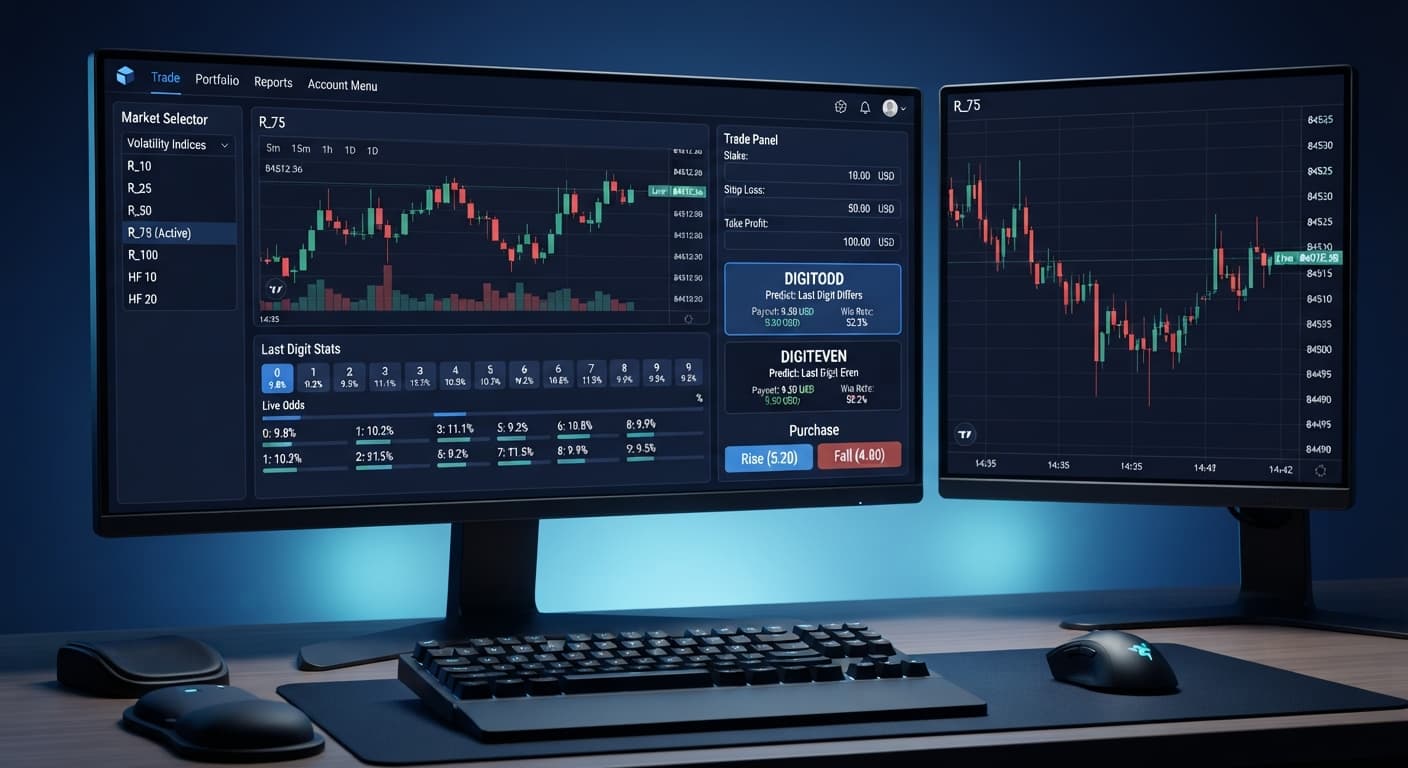
BinaryBot.live runs straight in your web browser. You don't download executable files or give account credentials to a third party. The platform connects directly to Deriv over their official API using your personal API token. Every trade occurs directly inside your own Deriv account.
Synthetic indices simulate market volatility without relying on real-world financial events. Central bank interest rate decisions, non-farm payroll reports, and stock market crashes have zero impact on these price ticks. Deriv generates these numbers using a cryptographic random number generator, audited independently for transparency.
The number attached to a Volatility Index specifies its constant volatility level. Volatility 10 Index maintains 10% annualized volatility, leading to smooth price movements. Volatility 75 Index maintains 75% volatility, producing sharp price swings. Volatility 100 Index represents maximum price movement speed.
The last digit of a synthetic index tick is mathematically independent from the digit before it. A string of five consecutive even numbers does not make an odd number more likely on the next tick. The system has no memory. If you build a trading plan assuming a digit pattern owes you a reversal, you will drain your balance quickly.
Standard Volatility Indices generate a tick every two seconds. The 1s variants, like Volatility 10 (1s) Index or Volatility 75 (1s) Index, produce a new price point every single second.
Tick speed directly controls execution frequency. On Volatility 75 Index, a 1-tick contract completes in two seconds. On Volatility 75 (1s) Index, that same contract completes in one second.
Running digit bots on 1s indices increases trade density. High frequency exposes your balance to rapid drawdown if your trade management relies on aggressive stake progression. If you start an automated session on Volatility 100 (1s) Index with a martingale recovery system, five consecutive losses take five seconds.
Different digit contract types require distinct risk configurations. BinaryBot.live supports six specific contract types: DIGITEVEN, DIGITODD, DIGITOVER, DIGITUNDER, DIGITMATCH, and DIGITDIFF.
Traders using deriv bots kenya frequently select DIGITEVEN and DIGITODD for balanced payout structures. The probability for an even or odd last digit is 50%, with payouts sitting near 95% depending on market conditions.
For higher win rates, DIGITOVER and DIGITUNDER offer flexible entry barriers. Setting DIGITOVER to 2 gives a statistical win probability of 70% per tick (digits 3, 4, 5, 6, 7, 8, and 9 win), but yields a lower payout return near 38%. Setting DIGITUNDER to 7 offers similar odds.
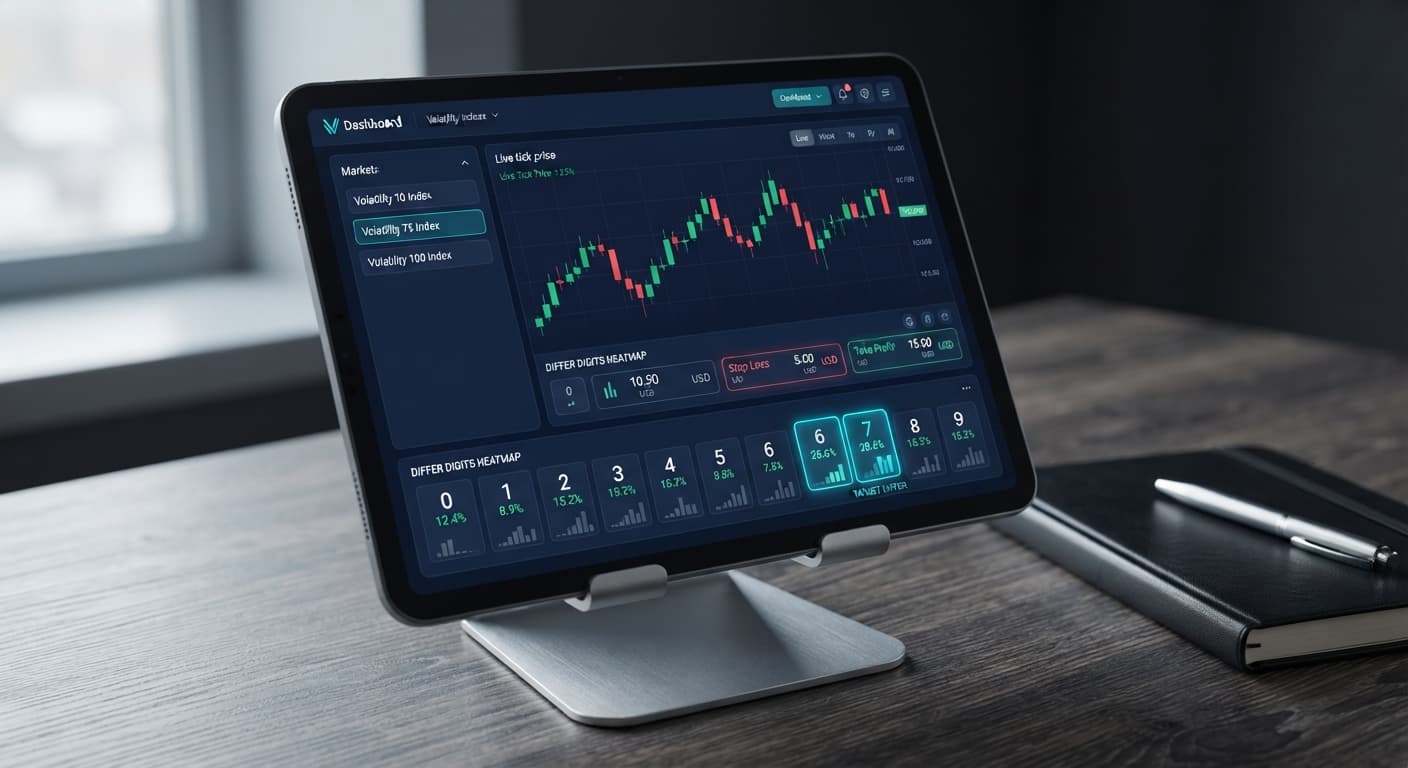
DIGITDIFF pays a small return—roughly 9% to 10% per trade—because you win on 9 out of 10 possible digit outcomes. A 90% win rate looks safe until you realize one single loss wipes out nine winning trades.
Automated traders encounter these exact mathematical limits globally, whether running deriv bots india, deriv bots south africa, or deriv bot brasil. The underlying probability engine operates identically everywhere.
Hardcoding strict profit targets and loss limits into your bot configuration prevents emotional decisions during drawdowns. Never start an automated session without setting defined parameters.
| Contract Type | Barrier / Target | Stat Win Rate | Approx Payout | Martingale Multiplier |
|---|---|---|---|---|
| DIGITEVEN | N/A | 50% | ~95% | 2.1x |
| DIGITODD | N/A | 50% | ~95% | 2.1x |
| DIGITOVER | Barrier 2 | 70% | ~38% | 3.6x |
| DIGITUNDER | Barrier 7 | 70% | ~38% | 3.6x |
| DIGITDIFF | Target 5 | 90% | ~9.8% | 11.2x |
Look at what happens to your account balance during a martingale sequence on DIGITEVEN contracts with a 2.1x multiplier. Assume an initial stake of $1.00 USD (around KES 130).
If your M-Pesa deposit was KES 5,000 (roughly $38 USD), your account wipes out entirely on the fifth consecutive loss. On a 1s index, those five losses happen in five seconds.
To protect your capital, apply these operational controls:
Test your settings on a virtual balance first. Practice running configurations on a Deriv demo account before trading with real funds. This guide is for educational purposes and is not financial advice.
Try running your strategies on the free Deriv bot library using a demo balance first. If you need an account, create a free Deriv account to begin. Trading involves risk. Past performance does not guarantee future results.
Related: Step-by-Step Guide to Configuring AutoPilot for Deriv
Related: Configuring Sniper Bot V3 Virtual Trades: Beginner Guide
Related: Step-by-Step Guide: Reading Live Ticks with LDP Analyzer
Related: Configuring Digit Differ Strategy Using deriv bots india
Related: Binary Bots India: Run Free Digit Analysis on BinaryBot
Related: Deriv Bots Kenya: Automate Digit Strategies Instantly
Country-specific guidance for Deriv traders — local payment rails, regulator context and the bots that suit each market.
See Bots for Your Country →Yes, M-Pesa allows you to send Kenyan Shillings and update your balance in seconds so you're ready to trade. Speed of deposit won't save a bad bot setup, though.
It's safe because it runs straight in your web browser without requiring you to download files or share your account credentials with a third party. The platform connects directly to Deriv over their official API using your personal API token.
Standard Volatility Indices generate a tick every two seconds, while 1s variants produce a new price point every single second. This higher tick speed directly increases trade density and execution frequency.
No, the last digit of a synthetic index tick is mathematically independent from the digit before it and the system has no memory. Assuming a digit pattern owes you a reversal will quickly drain your balance.
Guides closest to this one.
Discover deriv bots kenya automation for DIGITODD and DIGITEVEN strategies using M-Pesa funded Deriv accounts on BinaryBot.live. Start trading today.
Learn how beginners use Deriv Bots South Africa with browser tools and ZAR accounts. Start trading digits with zero downloads. Read the guide today.
Learn how traders using binary bots kenya test DIGITOVER and DIGITUNDER strategies with free analysers before funding via M-Pesa. Start today!