Auto Trading Bots
Sniper Bot V3 API Token Setup for Deriv Bots
Master your sniper bot v3 api token setup for binary bots. Learn how to connect Deriv safely and launch your automated trading bot today.
If you're looking for a clear guide to sniper bot v3 for beginners, the fastest way to get started is to connect your Deriv API token, select a Volatility index market, configure your paper-trading triggers, and test execution on a demo account. The bot automates contract orders directly through your account based on precise rules you set, letting you test digit or rise/fall trades without risking real money on every single tick. In this guide, we'll break down how the tool's virtual filter operates, calculate the real mathematical break-even hit rates for digit options, walk through your first test setup step-by-step, and show you exactly when to pause a session.
Setting up automated strategies on Deriv can feel intimidating if you haven't done it before. Many standard deriv bots place real orders immediately on every trigger, which means early losses hit your balance directly. Understanding how to use virtual execution to absorb initial losses on paper before committing live funds is the single most valuable skill you can build.
When you run Sniper Bot V3, it acts as an automated bridge between your strategic parameters and your account. You define the underlying market—such as Volatility 100 Index or Volatility 10 (1s) Index—and select the contract type, such as DIGITEVEN, DIGITODD, CALL, or PUT. The bot continuously monitors tick data coming from Deriv's market feed and triggers orders whenever your visual parameters align.
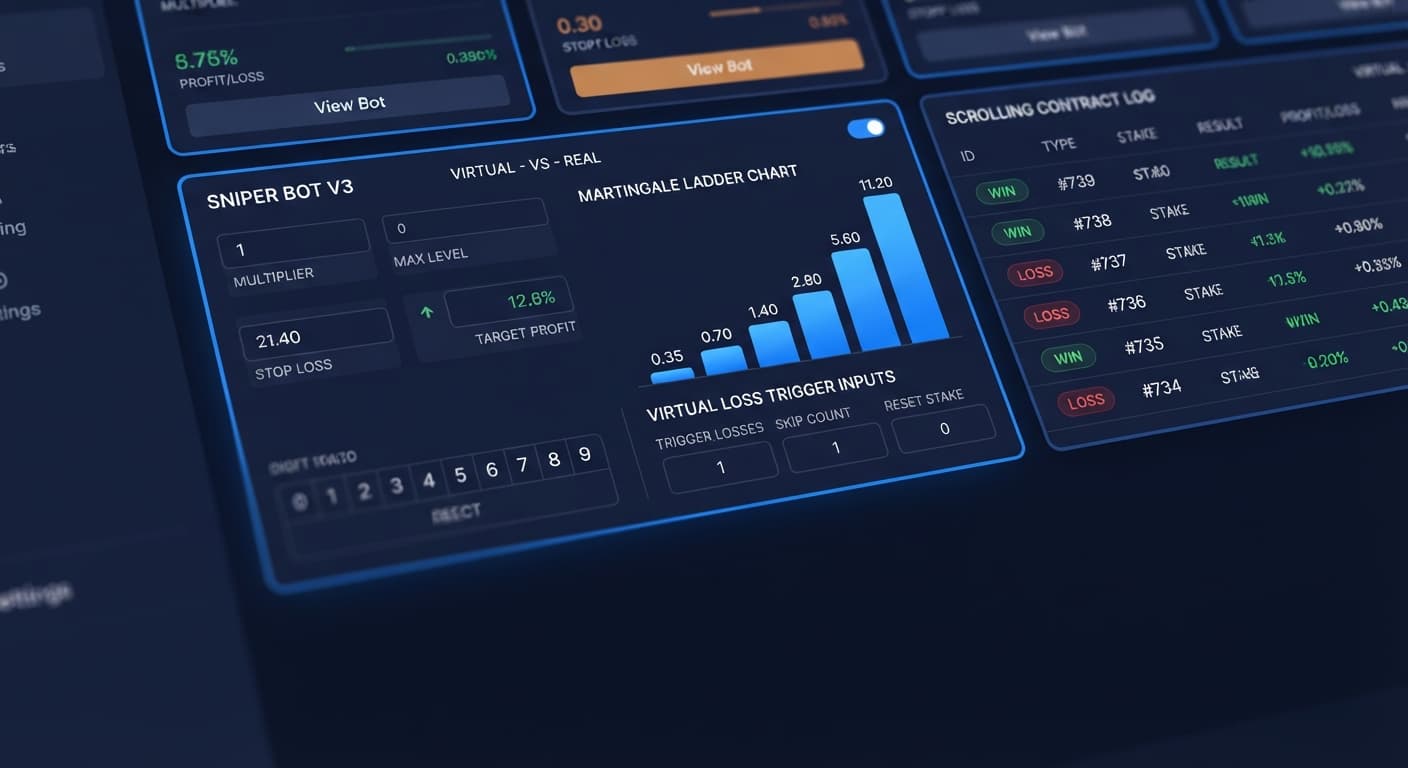
What makes this system unique is its paper-trading engine. Instead of firing live orders immediately, you can assign a demo token to the VIRTUAL TOKEN field and specify a value for VIRTUAL LOSS (in a row). If you set this value to 3, the bot tracks synthetic contracts in the background using your demo balance. It watches for three consecutive losses on paper before it places a single real stake using your live API token.
It's equally vital to understand what the software does not do. The bot doesn't analyze secret market trends, it doesn't manipulate tick timing, and it cannot alter contract outcomes. Synthetic indices rely on random number generators where each tick is completely independent of the last. The bot simply executes your chosen money management logic—such as Fixed Stake or Martingale—with strict adherence to your configured parameters.
Before running any script on binary bots, you need to know the mathematical reality of the payout ratios. No strategy changes the underlying odds of a fair synthetic tick, so long-term results depend on whether your hit rate exceeds the broker's built-in mathematical barrier.
Let's look at a concrete example using the DIGITEVEN contract on a Volatility index.
A standard last-digit draw has ten possible outcomes (0 through 9). Five of these digits are even (0, 2, 4, 6, 8) and five are odd (1, 3, 5, 7, 9). That gives a DIGITEVEN contract a true theoretical probability of exactly 50.00%.
However, Deriv doesn't pay out 100% net profit on a winning DIGITEVEN contract. A typical net payout on this contract is 95.00%. That means if you place a $10.00 stake, a winning contract returns your original $10.00 stake plus $9.50 in net profit, for a total payout of $19.50.
To calculate the break-even hit rate required to survive over time, divide your initial stake by the total return:
$$\text{Break-Even Win Rate} = \frac{\text{Stake}}{\text{Total Return}} = \frac{$10.00}{$19.50} \approx 51.28%$$
Here's how the numbers stack up side by side:
| Contract Type | Underlying Market Probability | Typical Net Payout | Total Return on $10 Stake | Required Break-Even Win Rate |
|---|---|---|---|---|
| DIGITEVEN / DIGITODD | 50.00% | 95.00% | $19.50 | 51.28% |
| DIGITDIFF (Not matching 1 digit) | 90.00% | 9.90% | $10.99 | 90.99% |
| CALL / PUT (Standard Rise/Fall) | 50.00% | 95.00% | $19.50 | 51.28% |
Now compare the DIGITDIFF contract. A DIGITDIFF contract wins if the final digit does not match your target digit. Since 9 out of 10 digits win, your raw probability of winning any single contract is 90.00%.
Because the win rate is naturally high, the broker sets the net payout low—typically around 9.90%. A $10.00 stake yields $0.99 in net profit, giving a total return of $10.99.
Calculate the break-even requirement for DIGITDIFF:
$$\text{Break-Even Win Rate} = \frac{$10.00}{$10.99} \approx 90.99%$$
Since your probability of winning is 90.00% and the required break-even win rate is 90.99%, the broker holds a 0.99% mathematical edge. Past digit streaks don't change this probability; digit 7 appearing three times in a row doesn't make digit 7 any less likely on the next tick. Using VIRTUAL LOSS (in a row) allows you to wait out paper loss sequences, but it doesn't change the underlying math of the contract once a live trade triggers.
Follow these precise steps to set up sniper bot v3 for beginners safely using virtual parameters.
Navigate to the interface to begin setup. Open your Deriv account security tab, generate a Read/Trade API token for your demo account, and input it into the bot settings. If you want to use virtual filtering, generate a second token from your demo balance and paste it into the VIRTUAL TOKEN box.
Select your target instrument from the market dropdown list, such as Volatility 100 Index. Under the MODE setting, choose your preferred capital allocation system. For your initial test run on demo, select Martingale or Fixed Stake.
Set your contract type (for example, DIGITEVEN). Next, locate the VIRTUAL LOSS (in a row) control and set it to 3. This forces the software to process paper trades until three consecutive virtual losses occur on your demo account before sending a live contract. Under BACK TO VIRTUAL, select IF REAL WIN so that as soon as a live trade wins, the bot immediately drops back to monitoring paper trades.
Specify your base contract size in the UNIT field (e.g., 0.35 for a $0.35 base stake). Set your MULTIPLIER (typically 2.0 for standard stake doubling on martingale modes) and cap your maximum progression using MAX LEVEL set to 4. Define your session boundaries by entering a STOP LOSS of 10.00 and a TARGET PROFIT of 5.00.
Review all control values on screen before clicking start. Check that your account toggle points to virtual funds, then activate the session. Watch the log window to confirm that paper trades register first, and verify that the bot only executes a contract when your exact virtual loss conditions are met.
If you want to explore other automated tools built for specific digit strategies, you can also analyze digit distribution histories using the LDP Analyzer Pro dashboard or test multi-strategy execution with Solid Trading Bot.
Automated trading requires strict session rules. The biggest mistake new traders make with binary bots is letting a bot run indefinitely without supervision.
You should stop execution and return to paper trading whenever any of these conditions occur:
BOT STOP AFTER triggers, shut down the session.DELAY AFTER WIN or DELAY AFTER LOSE might misfire. Pause the bot until execution stabilizes.MODE, MULTIPLIER, or WHEN MAX LEVEL settings while a live session is actively running. Stop the bot completely, switch back to virtual testing, and observe at least 50 paper trades before applying changes to real stakes.By keeping your test runs grounded in mathematical reality and relying on virtual filters, you can evaluate strategies systematically without putting your account through unnecessary drawdown.
Try it yourself on Sniper Bot V3 using a demo balance first.
If you don't have one yet, create a free Deriv account.
Trading involves risk. Past performance does not guarantee future results.
Related: Sniper Bot V3 Stop Loss Setup for Deriv Bots
Related: Sniper Bot V3 Demo Account Setup for Deriv Bots
Related: Sniper Bot V3 India: Run Deriv Bots Free, Zero Setup
Advanced automated trading bot for Deriv with Rise/Fall, Higher/Lower, Touch/No Touch and Digit strategies, plus martingale, anti-martingale, Fibonacci and D'Alembert money management.
Open Sniper Bot V3 →You can get started by connecting your Deriv API token, choosing a Volatility index market, and setting up your paper-trading triggers to test on a demo account. The bot automates your contract orders based on rules you define, allowing you to test strategies without risking real money on every tick.
The virtual execution filter acts as a paper-trading engine that tracks synthetic contracts in the background using a demo token. You can configure a virtual loss streak, like three in a row, so the bot absorbs initial losses on paper before placing a real stake with your live token.
No, the bot doesn't analyze secret trends, manipulate tick timing, or alter contract outcomes since synthetic indices rely on independent random ticks. It simply executes your chosen money management logic, like fixed stakes or Martingale, according to the parameters you set.
A standard last-digit draw has a true theoretical probability of 50% for even digits, but a typical net payout on a winning DIGITEVEN contract is around 95%. Long-term results depend on whether your hit rate exceeds this built-in mathematical barrier set by the broker.
Guides closest to this one.
Master your sniper bot v3 api token setup for binary bots. Learn how to connect Deriv safely and launch your automated trading bot today.
Master the sniper bot v3 stop loss setup for Deriv bots. Learn to configure risk limits and target profit safely on our free automated trading bot.
Master your sniper bot v3 demo account setup on BinaryBot.live. Learn how to configure and test this automated trading bot risk-free today.