
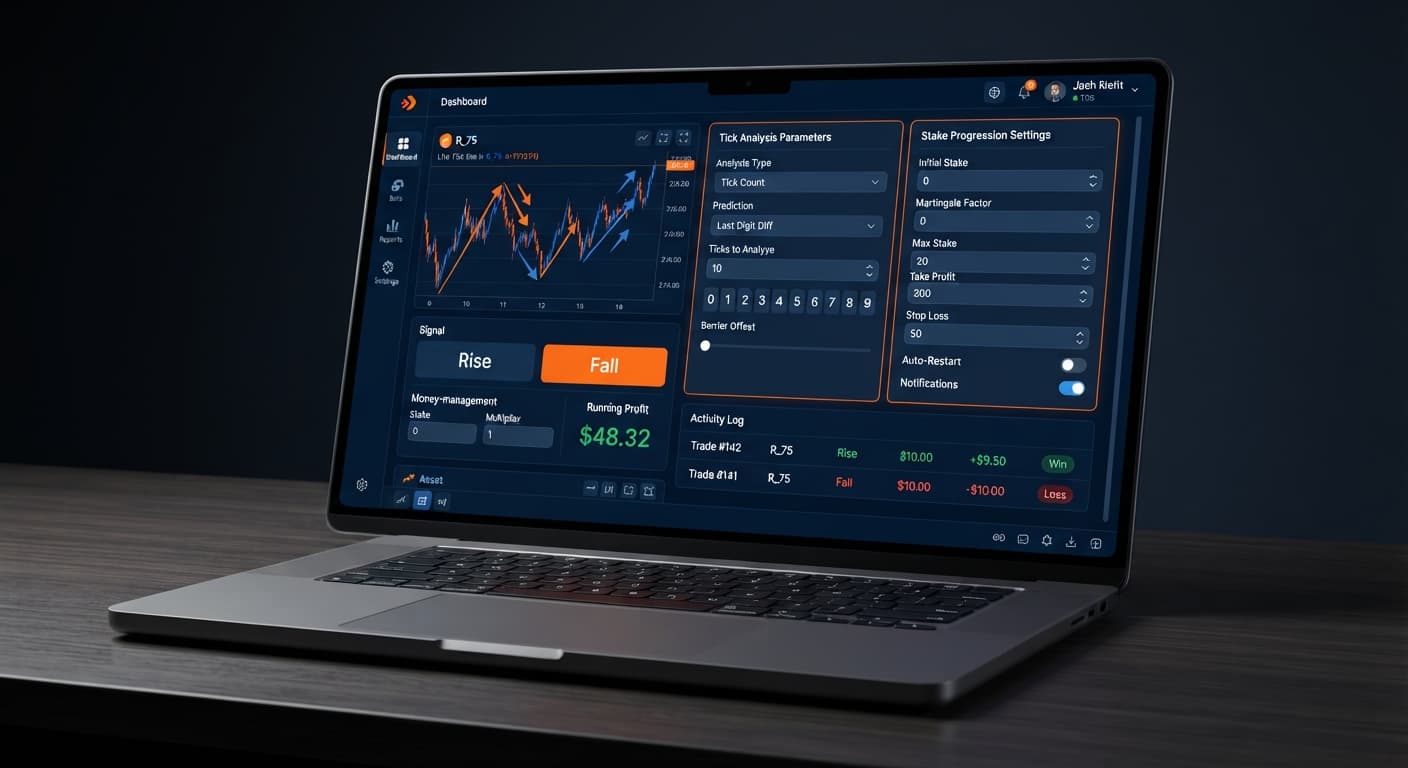
Auto Trading Bots
Tick Picker vs Dualshot: Deriv Bots for Rise/Fall
Compare Tick Picker vs Dualshot for automated trading on BinaryBot.live. Learn how fixed stake and recovery progression impact your strategy. Test free now.
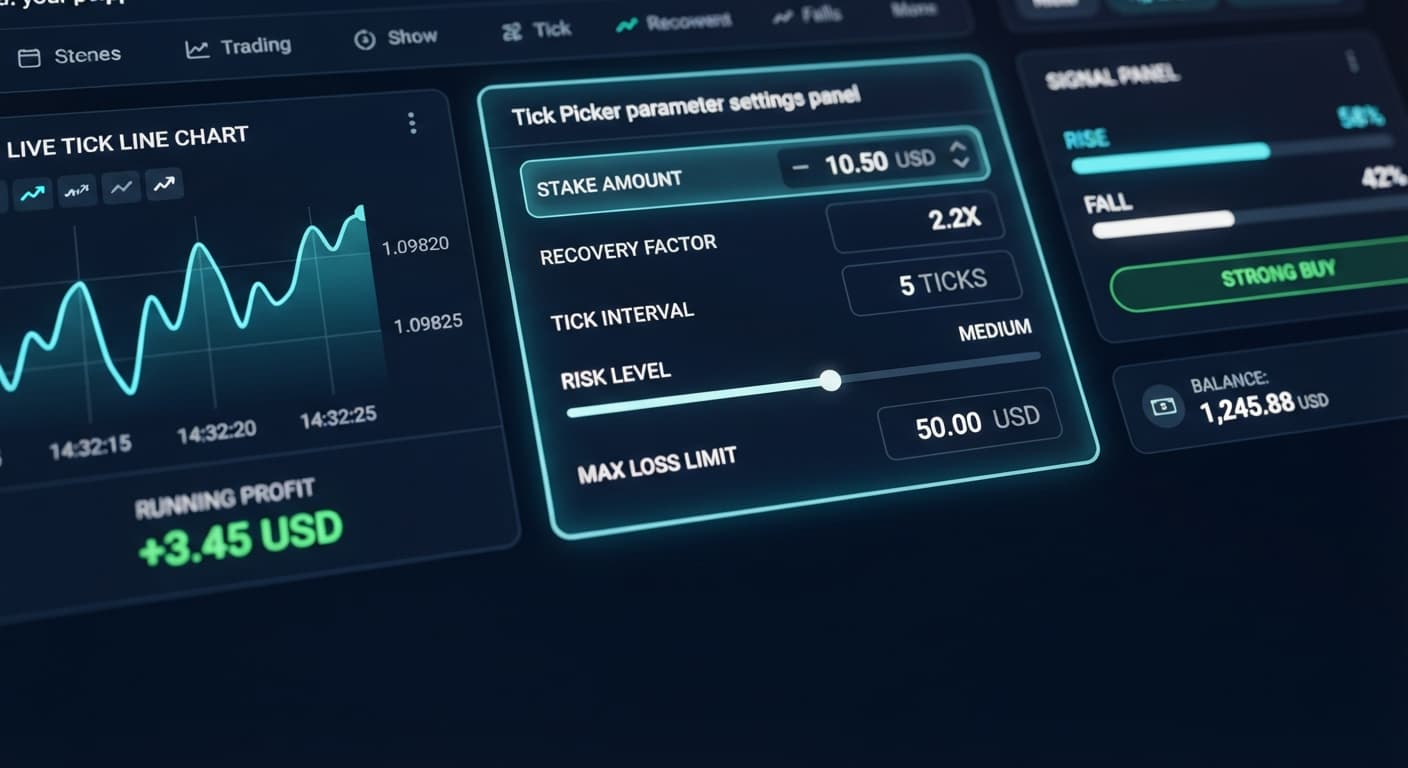
Building a sustainable tick picker small account strategy requires controlling your risk exposure on every single tick. To keep a small Deriv account safe—such as $50 or $100—you cannot rely on aggressive stake doubling. The key is selecting a execution pattern in Tick Picker that splits drawdown recovery over several trades rather than risking your entire bankroll on a single recovery entry.
When you run automated trading software on synthetic markets, money management dictates whether your account survives a market shift. The algorithm evaluates live tick direction to execute CALL and PUT trades. While market momentum provides entry signals, your defensive parameters dictate how long your account stays operational during an adverse run.
Before launching any automated run, you need to adjust your operational parameters directly inside the main control panel. The web application interfaces directly with Deriv through your API token, executing contracts on your account without storing your funds.
You'll find four primary inputs on the configuration board:
Adjusting these fields before hitting the start button is essential. Setting risk parameters after launching the bot is a quick way to lose control of a session.
Selecting the right execution style determines how your capital responds when a trade closes out of the money. Synthetic index ticks are completely independent random draws; previous tick patterns do not alter the statistical odds of the next tick. Because probability remains fixed, your money management strategy must handle bad streaks without blowing up your account.
The platform offers three execution systems:
| Mode | Position Sizing After a Loss | Account Risk Profile | Recommended Account Size |
|---|---|---|---|
| Fixed Stake | Maintains the exact same amount for every contract | Lowest risk; stable equity curve | Any account balance ($10+) |
| Martingale | Doubles the previous stake immediately | Extremely high risk; rapid drawdown | Large accounts ($1,000+) |
| Mesamilano | Spreads recovery across a sequence of minor increases | Moderate risk; structured loss mitigation | Small to mid-sized balances ($50+) |
Fixed Stake keeps your risk static. If you trade $1 per contract, every trade remains $1 regardless of whether you win or lose. This approach is the safest choice for micro balances, though recovering from a loss streak takes longer because payouts match your base stake.
Martingale doubles the position after every loss. While a single win recovers all previous losses plus the original profit, the exponential curve quickly demands capital that small accounts simply don't have.
Mesamilano serves as a middle ground for a tick picker small account strategy. Instead of forcing a 2x stake increase on the immediate next contract, Mesamilano breaks the cumulative loss into fractional steps across subsequent entries. This approach softens the drawdown curve, giving your balance room to recover without spiking your margin requirements.
Traders who prefer analyzing underlying digit stats across different binary bots often use tools like LDP Analyzer to check digit patterns before deploying execution bots. However, inside this tool, execution strictly follows tick momentum using standard CALL and PUT options.
Setting up a solid tick picker small account strategy requires precise input parameters. Follow these concrete steps to configure your session on a $50 account balance.
Set the stake field to $1.00. For small balances, your base position should never exceed 2% of your overall capital. Keeping your entry size small gives you enough breathing room to navigate natural market oscillations on synthetic indices.
Click the dropdown for money management mode and select either Fixed Stake or Mesamilano. If your balance is under $50, select Fixed Stake. If you have between $50 and $100 and want structured recovery, select Mesamilano. Avoid selecting Martingale on accounts of this size.
Set your stop loss to $10.00 and your target profit to $5.00. Halting the bot after a $10 drop caps your session loss at 20% of your account balance. Setting a $5 target lets you exit the session as soon as you achieve a 10% gain, preventing you from over-trading.
Select a market from the available Volatility indices or 1s volatility indices. Indices like Volatility 10 Index or Volatility 25 (1s) Index often exhibit consistent tick movements compared to higher-volatility assets, making them popular choices for deriv bots.
Always switch your account toggle to a Deriv demo account before turning the bot on with real funds. Run the system through at least 20 to 30 trades on virtual money to confirm that the stake transitions match your expectations.
To understand why traditional doubling destroys small accounts, let's look at the math behind a losing sequence. Assume you start with a $50 balance trading Volatility 75 Index with a starting stake of $1.00.
Here is what happens to your balance during a six-trade losing streak using Martingale versus Fixed Stake:
Martingale Sequence ($1 Base Stake):
Trade 1: Stake $1.00  | Loss | Running Balance: $49.00
Trade 2: Stake $2.00  | Loss | Running Balance: $47.00
Trade 3: Stake $4.00  | Loss | Running Balance: $43.00
Trade 4: Stake $8.00  | Loss | Running Balance: $35.00
Trade 5: Stake $16.00 | Loss | Running Balance: $19.00
Trade 6: Stake required: $32.00 | FAILS (Insufficient Funds: $19.00 remaining)
By the fifth consecutive loss, you have lost $31.00 of your $50.00 balance. To place the sixth trade, the algorithm needs a $32.00 stake, but your account only has $19.00 left. The system halts, leaving you with a 62% account loss that you cannot recover through the bot.
Now consider the same six-trade losing streak using Fixed Stake:
Fixed Stake Sequence ($1 Base Stake):
Trade 1: Stake $1.00 | Loss | Running Balance: $49.00
Trade 2: Stake $1.00 | Loss | Running Balance: $48.00
Trade 3: Stake $1.00 | Loss | Running Balance: $47.00
Trade 4: Stake $1.00 | Loss | Running Balance: $46.00
Trade 5: Stake $1.00 | Loss | Running Balance: $45.00
Trade 6: Stake $1.00 | Loss | Running Balance: $44.00
After six consecutive losses on Fixed Stake, your balance sits at $44.00. You have lost just $6.00 (12% of your account), leaving your balance intact so you can continue trading or stop the session safely without blowing your capital.
When using Mesamilano, the stake steps up incrementally—for instance, moving from $1.00 to $1.30, then $1.70, then $2.20 across losses. This structure keeps your required capital well within your balance limits, making it a far safer alternative than standard doubling for a tick picker small account strategy.
Automated trading tools process data efficiently, but they cannot eliminate financial risk. Always monitor your active sessions, keep your risk limits tight, and never risk money you cannot afford to lose.
Test these execution parameters yourself on Tick Picker using a demo account balance before risking real capital.
If you don't have a trading account yet, create a free Deriv account to begin testing.
Trading involves risk. Past performance does not guarantee future results.
Related: Tick Picker vs Dualshot: Deriv Bots for Rise/Fall
Related: Tick Picker Stop Loss Setup for Deriv Bots
Related: Tick Picker vs Digit Pad: Deriv Bots Compared
Related: Multi Shot for Beginners: Zero-Knowledge Setup Guide
Professional tick analysis tool for Deriv with real-time charts, trend detection and Rise/Fall trading signals, plus Mesamilano and Martingale strategies.
Open Tick Picker →Yes, you can run Tick Picker on a small $50 or $100 account if you control your risk exposure and avoid aggressive stake doubling. Using a moderate progression like Mesamilano helps split drawdown recovery over several trades instead of risking your whole balance at once.
Mesamilano is a progression mode that spreads your loss recovery across a sequence of minor position increases rather than doubling your stake immediately. It serves as a moderate risk middle ground between Fixed Stake and Martingale for accounts of $50 or more.
You'll find the stop loss and target profit fields directly inside the main configuration board on the Tick Picker control panel. It's essential to adjust these defensive inputs before you hit the start button to keep your trading session under control.
No, Martingale is extremely high risk and demands exponential capital that small accounts simply don't have. It immediately doubles your previous stake after a loss, which can cause rapid drawdown and blow up a micro account.
Guides closest to this one.
Compare Tick Picker vs Dualshot for automated trading on BinaryBot.live. Learn how fixed stake and recovery progression impact your strategy. Test free now.
Master tick picker stop loss setup on BinaryBot.live. Learn to configure risk controls for automated deriv trading bot rise fall strategies today.
Compare tick picker vs digit pad strategies on BinaryBot.live. Learn how to use tick chart analysis and digit distribution in your free deriv bot setup.