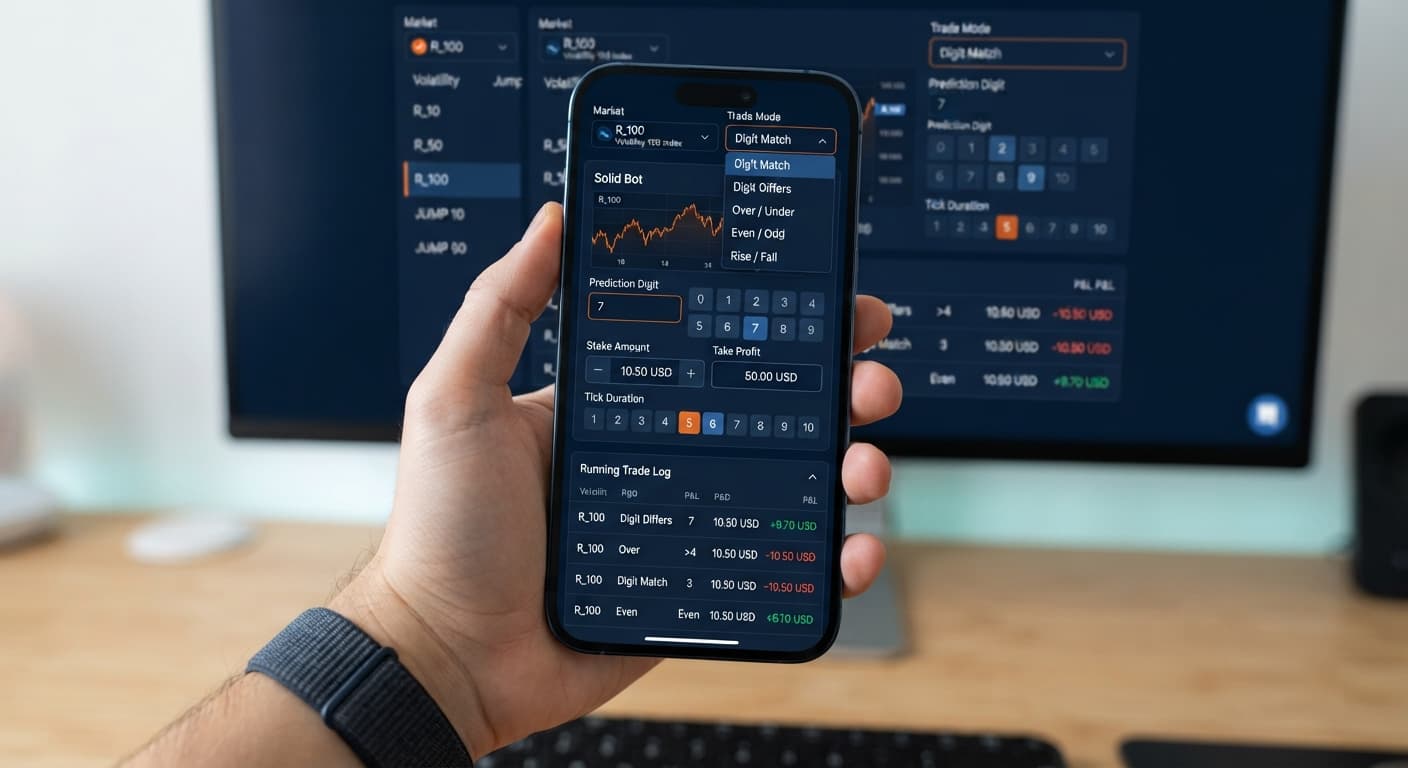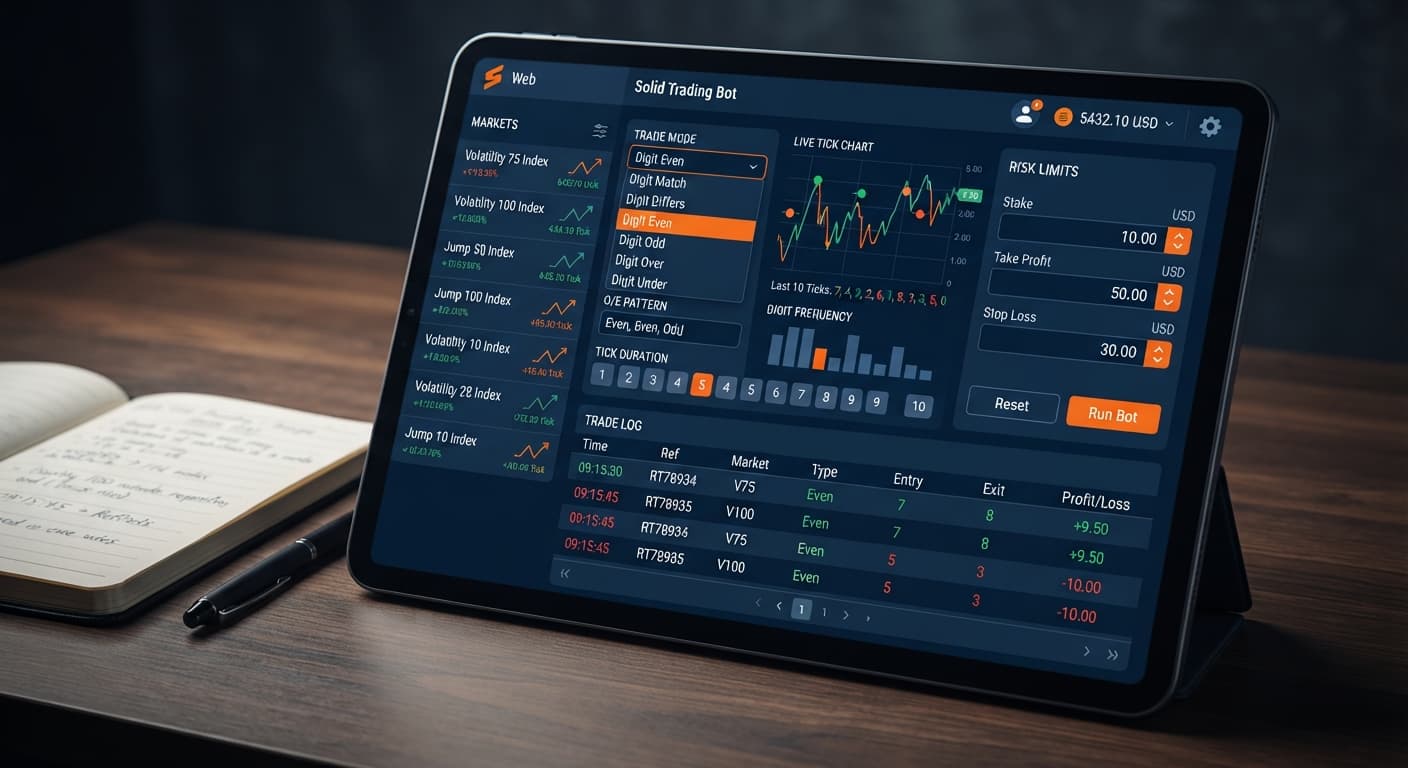
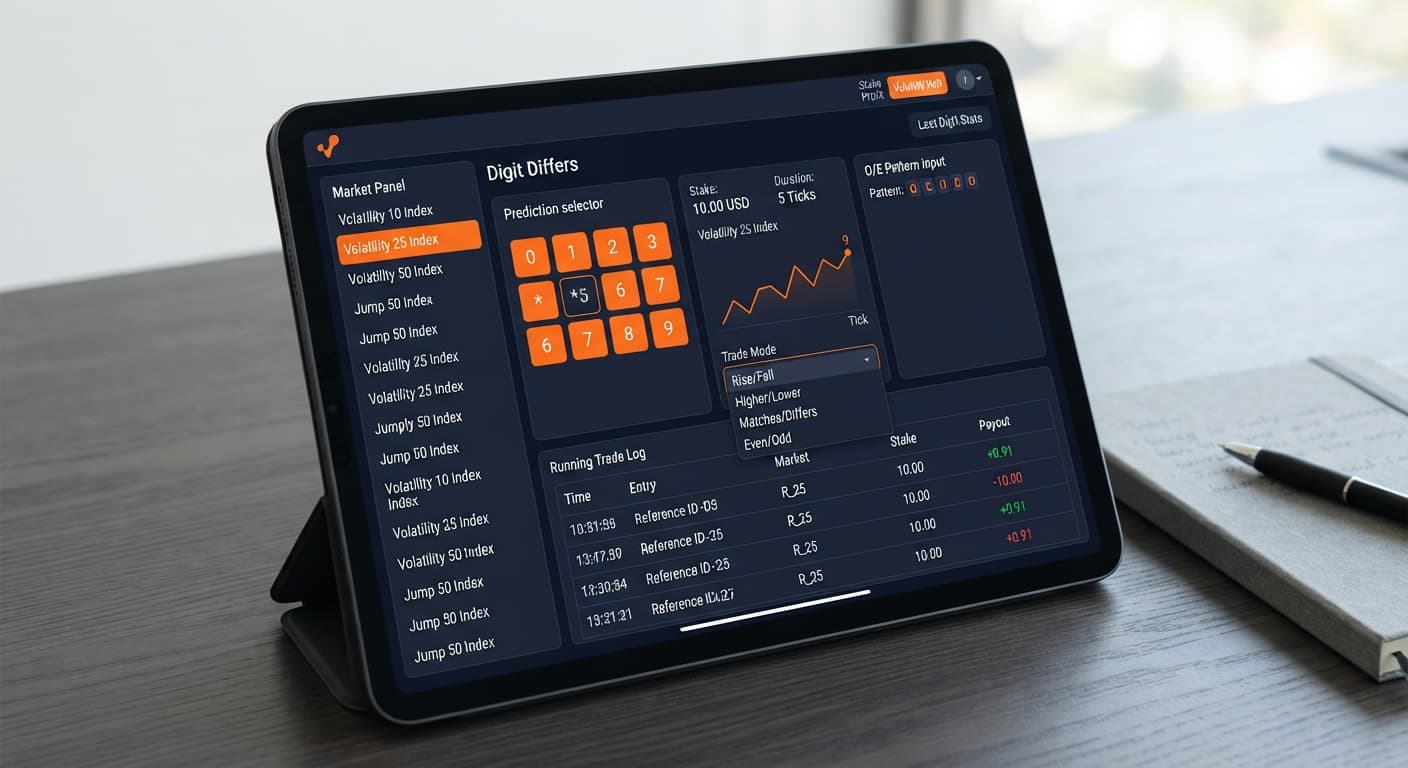
Auto Trading Bots
Build a Solid Trading Bot on Volatility 25 for Deriv
Build a solid trading bot on volatility 25 using Deriv digit differs. Follow this step-by-step setup guide for free binary bots. Start testing today.
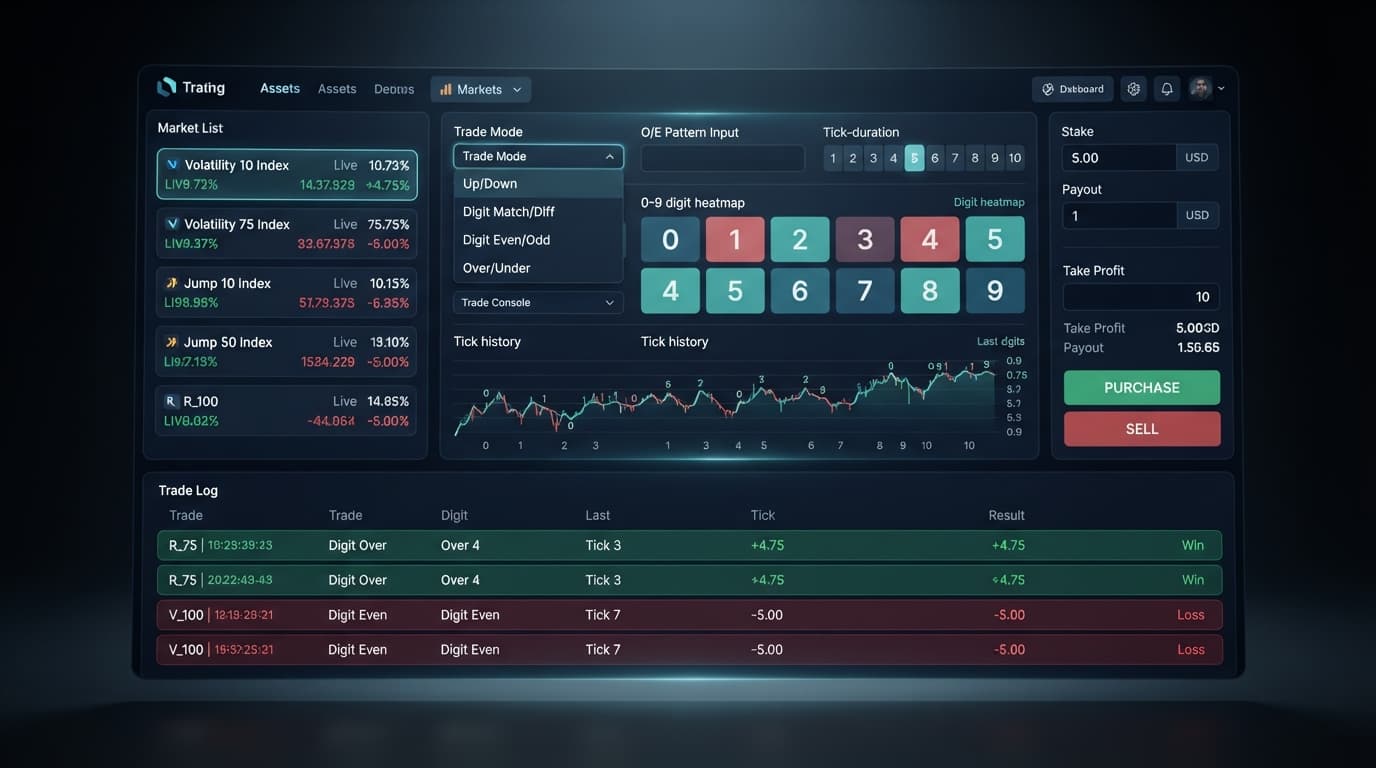
Choosing between solid trading bot vs manual trading comes down to execution speed and strict adherence to rules. Using an automated setup eliminates execution delay when tracking complex digit sequences, while manual trading gives you complete control over entry timing when market conditions shift. For systematic digit strategies on Deriv, using an automated trading bot handles rapid pattern scanning far better than any human clicker could manage.
Manual execution on synthetic indices often leads to late entries. When you watch a tick stream, your eyes need time to register a digit pattern, decide on a contract, and click the trade button. That lag usually costs you a tick or two. Automated setups connect directly to Deriv over their official API to analyze ticks and send trade commands instantly without hesitation.
When evaluating solid trading bot vs manual trading, comparing how each approach handles real-time data across Deriv's asset list highlights key operational differences.
| Feature / Dimension | Solid Trading Bot | Manual Trading |
|---|---|---|
| Execution Latency | Near-instant API entry upon trigger | 200ms to 800ms human reaction delay |
| Pattern Sequence Tracking | Automated sequence filtering via Pattern (O=Odd, E=Even) | Visual counting subject to miscounts |
| Asset Compatibility | Volatility 10-100 (including 1s) and Jump 10-100 Indices | Single market focus; multi-charting fatigue |
| Trade Modes Supported | Digit Differs, Digit EVEN, Digit ODD, Digit Over, Digit Under, Only Rise, Only Fall | Manual contract switching across menu tabs |
| Duration Settings | Exact Tick Duration — 1 to 10 ticks | Manual slider adjustments before each order |
| Risk Boundary Controls | Automated Target Profit ($) and Stop Loss ($) enforcement | Manual discipline required to stop trading |
| Emotional Interference | Zero influence from previous loss or win | High vulnerability to revenge trading |
Automated web interfaces act as free deriv bot tools that let you deploy pre-built logic without writing code. While manual traders struggle to switch between Jump 75 Index and Volatility 100 (1s) Index quickly, automation tracks tick activity and places orders the instant your parameters match.
Different strategies require different execution methods. Neither approach fits every market scenario, so choosing the right method depends on what your strategy demands.
Automation excels when your trading relies on precise mathematical triggers across fast-moving markets. You should use a bot when:
OEOE before opening a trade guarantees you won't enter early out of impatience.Traders who rely on popular deriv bots use automation primarily to eliminate psychological errors. The software doesn't feel frustration after a bad tick, nor does it increase trade size impulsively.
Manual entry remains useful under specific, highly adaptable trading conditions. You should trade manually when:
A common mistake among beginners testing binary bots is assuming that automated pattern tracking alters the fundamental probability of synthetic index contracts. It doesn't. Synthetic index ticks generated by Deriv act as independent random draws. Past tick sequences don't increase or decrease the likelihood of the next digit.
To evaluate any strategy long-term, you must compare the theoretical probability of winning against the break-even hit rate dictated by Deriv's contract payouts.
DIGITDIFF)When placing a DIGITDIFF contract, you select one digit from 0 through 9 that you predict will not appear on the final tick.
Deriv typically offers roughly a 9.9% net return on DIGITDIFF contracts. If your Start Stake ($) is set to $10.00, a winning trade yields a total return of $10.99 ($10.00 stake refunded + $0.99 profit).
To calculate the break-even win rate needed to cover losses:
$$\text{Break-Even Win Rate} = \frac{\text{Stake}}{\text{Total Return}} = \frac{$10.00}{$10.99} \approx 90.99%$$
Because the true probability of winning is 90.00%, but your break-even threshold is 90.99%, the house edge sits at roughly 0.99%. Running a bot on DIGITDIFF mode speeds up trade frequency, but it does not overcome this mathematical gap.
DIGITEVEN)For a DIGITEVEN contract, your trade wins if the last digit is 0, 2, 4, 6, or 8.
Deriv typically pays around a 95% net return on DIGITEVEN trades. A $10.00 stake returns $19.50 total ($10.00 stake + $9.50 profit).
Calculating the break-even hit rate:
$$\text{Break-Even Win Rate} = \frac{$10.00}{$19.50} \approx 51.28%$$
Since your probability of hitting an even digit on any given tick remains exactly 50.00%, winning consistently over hundreds of ticks requires a hit rate higher than the true random odds. Automation executes your strategy flawlessly, but it cannot alter these core math rules.
You don't have to choose exclusively between solid trading bot vs manual trading. Experienced traders combine manual analysis with automated execution to balance flexibility and precision.
Here is how to combine both methods safely on a demo balance before risking real funds:
Open your Deriv charting tool and evaluate tick movement across different assets. Select a suitable index from the Market Index menu, such as Volatility 75 Index or Jump 50 Index, depending on current volatility levels.
Instead of placing orders manually, launch your automated interface and select your Trade Mode—such as Digit Over or Digit Under. Enter your target pattern into the Pattern (O=Odd, E=Even) field if you want the bot to filter entry timing.
Input your fixed financial limits before launching the automated script:
Start the bot and watch the live trade log. Automation handles exact tick tracking and order submission. If market conditions shift or performance strays from your expectations, pause the bot manually rather than tweaking parameters mid-run.
Combining manual strategy design with automated execution gives you the speed of API trading while keeping complete control over session risk.
Test these execution methods yourself using a demo balance on Solid Trading Bot.
If you haven't set up your account yet, create a free Deriv account to begin testing strategies risk-free.
Trading involves risk. Past performance does not guarantee future results.
Related: Solid Trading Bot Stop Loss Setup for Deriv Bots
Related: Solid Trading Bot API Token Setup for Deriv Bots
Related: solid trading bot on volatility 10: Binary Bot Setup
Related: Build a Solid Trading Bot on Volatility 25 for Deriv
Advanced automated digit trading bot for Deriv with 9 trading strategies including Digit Differs, Odd/Even, Over/Under, Rise/Fall and Higher/Lower.
Open Solid Trading Bot →It depends on your strategy, since a solid trading bot eliminates execution delay and human error when tracking complex digit sequences. Manual trading, on the other hand, gives you complete control over entry timing when market conditions suddenly shift.
Manual execution usually causes a 200ms to 800ms human reaction delay as your eyes register patterns and click trade buttons. That lag often costs you a tick or two, especially on fast-moving assets like Jump Indices.
Yes, automation handles rapid pattern scanning far better than human clicking for systematic digit strategies. You can use a solid trading bot with modes like Digit Differs, Digit EVEN, Digit ODD, Digit Over, and Digit Under.
Automated setups remove the emotional interference that leads to revenge trading after a win or loss. They also enforce strict risk boundaries by automatically closing your session when your preset Target Profit or Stop Loss is reached.
Guides closest to this one.
Build a solid trading bot on volatility 25 using Deriv digit differs. Follow this step-by-step setup guide for free binary bots. Start testing today.
Configure the solid trading bot on volatility 10 for automated digit trading on BinaryBot.live. Learn the step-by-step deriv bot trading strategy now.
Read the solid trading bot deriv bots guide to configure trade modes, patterns, and risk limits for automated Deriv trading. Start testing today.