Auto Trading Bots
Build a Solid Trading Bot on Volatility 25 for Deriv
Build a solid trading bot on volatility 25 using Deriv digit differs. Follow this step-by-step setup guide for free binary bots. Start testing today.
Choose Digit Differs if:
Choose Digit Match if:
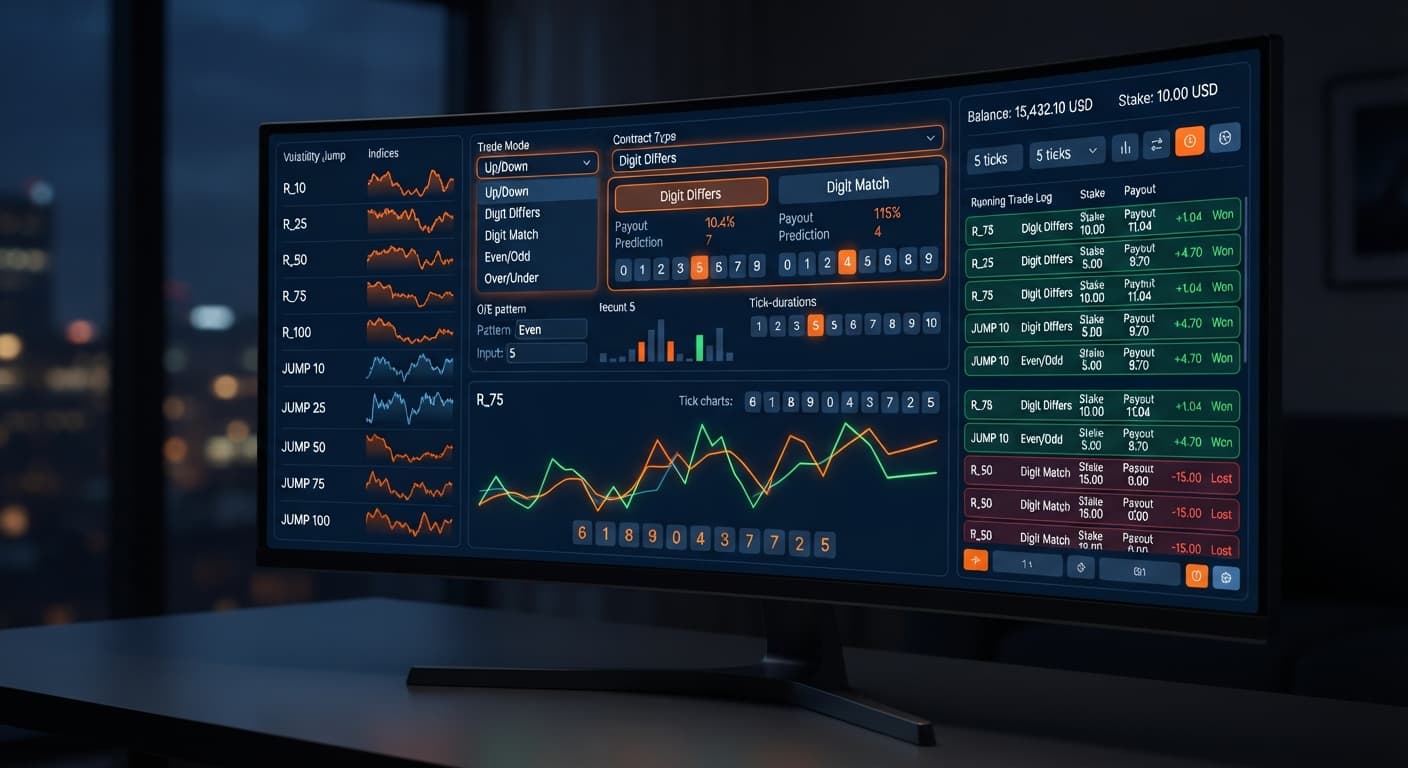
Trading digit statistics on deriv bots requires understanding payout structures and trade execution mechanics. Here is how the two contract modes compare head-to-head.
| Feature / Dimension | Digit Differs (DIGITDIFF) | Digit Match (DIGITMATCH) |
|---|---|---|
| Primary Trade Objective | Predict the last digit will NOT match a target number | Predict the last digit WILL match a target number |
| Win Probability Per Tick | ~90% (9 out of 10 digits win) | ~10% (1 out of 10 digits wins) |
| Typical Payout Rate | ~9.9% on stake | ~800% to ~850% on stake |
| Loss Impact | High (losing 1 trade wipes out ~10 past winning trades) | Low (losing 1 trade costs only the base stake) |
| Consecutive Losses Risk | Low frequency, but high dollar impact on recovery | High frequency, expected as normal operation |
| Solid Bot Availability | Native option in Trade Mode dropdown | Target reference strategy for manual or external execution |
| Execution Speed | 1 to 10 ticks via Tick Duration control | Typically 1 tick duration |
| Supported Synthetic Markets | Volatility 10 to 100, (1s) series, and Jump indices | Volatility 10 to 100, (1s) series, and Jump indices |
Let's look at what actually happens when you run a $50 account balance through both contract approaches. This is where abstract percentages become actual dollar figures on your screen.
You load Solid Trading Bot, pick Volatility 75 Index under Market Index, and set Trade Mode to Digit Differs. You enter a Start Stake ($) of $5, set Target Profit ($) to $5, and set Stop Loss ($) to $25. You choose a Tick Duration of 1 tick.
Notice the math. Four wins gave you $1.96 total. Single loss wiped out all four wins and put you $3.04 below your starting balance.
If your strategy uses martingale stake scaling on Digit Differs to recover from that single loss, your next stake jumps from $5 to roughly $51 to recover the $5 loss and secure a tiny profit. But your total balance is only $46.96. The bot cannot place the trade because your account lacks sufficient margin. You stop out immediately.
Now take that same $50 balance and run a Digit Match structure with a fixed Start Stake ($) of $1. You set Target Profit ($) to $15 and Stop Loss ($) to $25.
In this run, you lost 14 out of 16 trades—an 87.5% failure rate—yet your net balance increased by $3.00.
The lesson is simple: Digit Differs gives you frequent dopamine hits with severe tail risk. Digit Match gives you frustrating loss sequences with controlled risk per trade.
No trading strategy eliminates risk, and binary bots won't change the underlying probability engine. Deriv synthetic indices rely on random number generators where each tick is independent of the last.
+-----------------------------------------------------------------------+
|                       DIGIT DIFFERS WEAKNESS                          |
|  [Win $0.99] [Win $0.99] [Win $0.99] [Win $0.99] ---> [LOSE $10.00]   |
|  Result: 4 Wins, 1 Loss = -$6.04 Total Net Loss                       |
+-----------------------------------------------------------------------+
|                        DIGIT MATCH WEAKNESS                           |
|  [Loss $1] [Loss $1] [Loss $1] ... (18 times in a row) ---> -$18.00   |
|  Result: Long drawdowns test your emotional patience                  |
+-----------------------------------------------------------------------+
Traders get blinded by 90% win rates. Winning 18 trades out of 20 feels great, but the arithmetic works against you over time. Because a win pays roughly 10% while a loss destroys 100% of your stake, your break-even win rate is about 90.9%. If your long-term win rate slips to 89%, your balance drains.
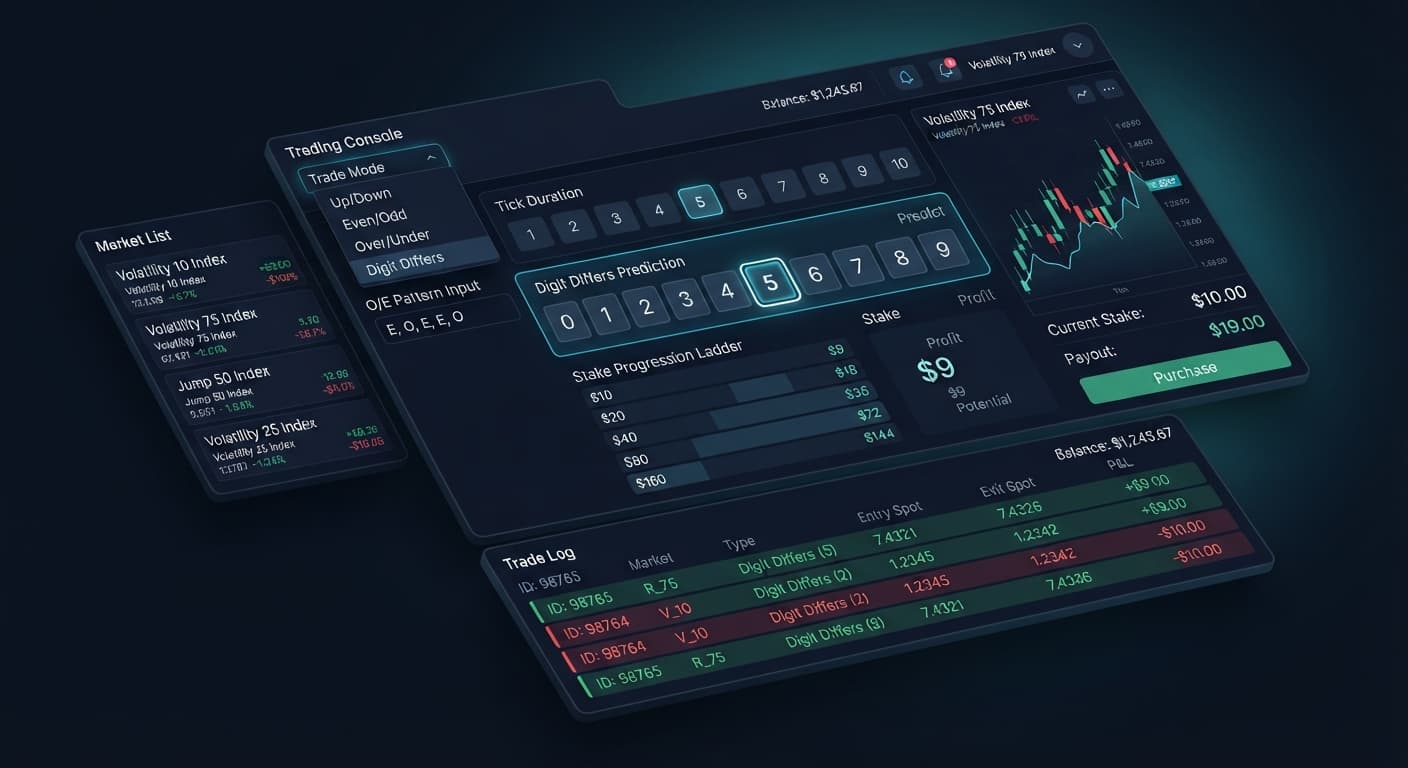
Adding martingale scaling to Digit Differs turns a small risk into account destruction. A base stake of $2 that doubles after losses turns into $4, $8, $16, $32, $64, $128, and $256 within seven trades. On a $100 account, a streak of two unexpected losses ends the session. Past digits don't bias future ticks. An odd digit on tick one does not make an even digit more likely on tick two.
The downside to Digit Match is duration and psychological fatigue. Missing 25 digits in a row is mathematically normal. If you run a $1 stake, a 25-trade losing run drops your account by $25 before you see a hit.
Traders often panic during these cold spells. They change settings mid-session, increase stakes out of frustration, or kill the bot right before a winning hit lands.
When setting up automated execution on deriv bots, you need clear steps to set risk boundaries before clicking start.
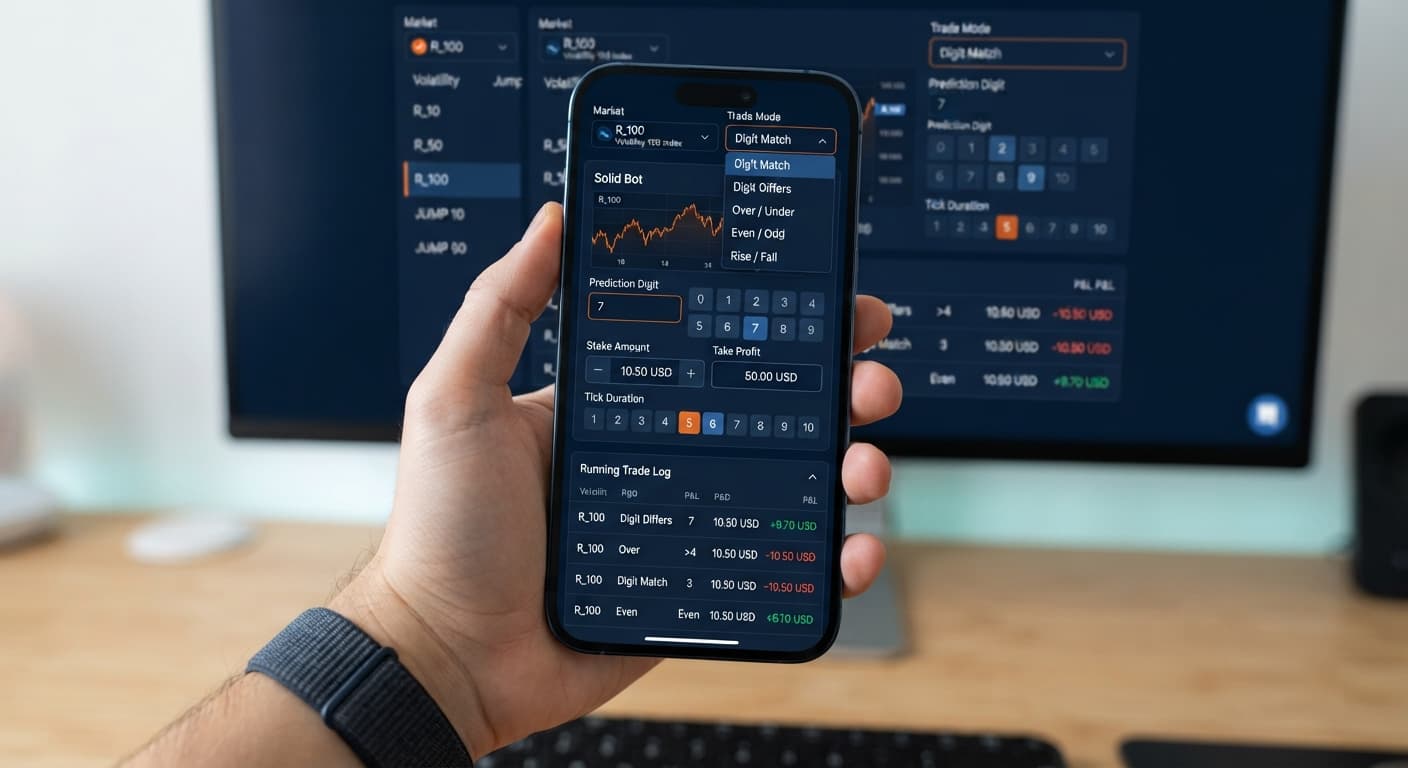
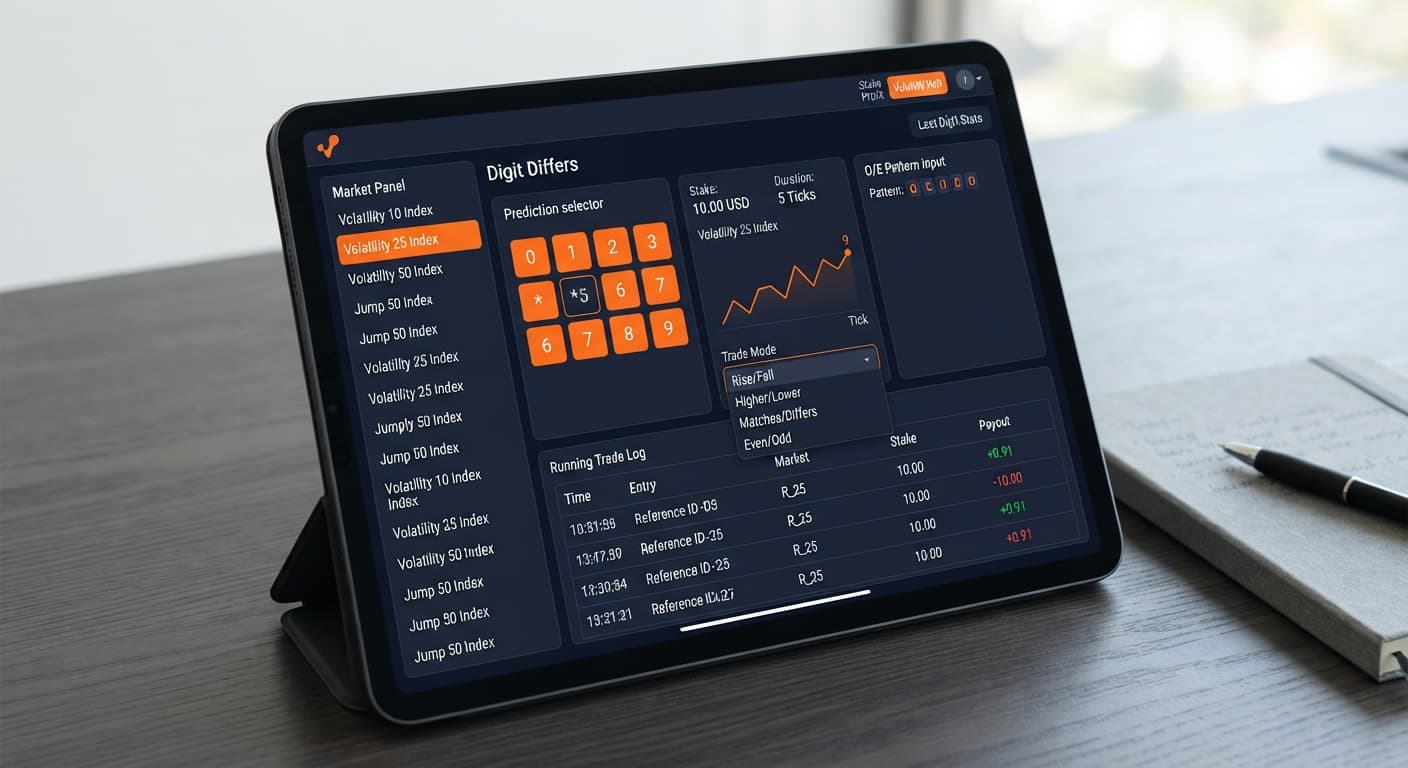
Here is how to configure Solid Trading Bot for a structured digit session:
OOO or EEE if you want the bot to filter entry conditions after a run of consecutive odd or even digits.[Solid Trading Bot UI Setup]
├── Market Index: Volatility 75 Index
├── Trade Mode: Digit Differs
├── Pattern (O=Odd, E=Even): OEE
├── Start Stake ($): $2.00
├── Tick Duration: 1 Ticks
├── Target Profit ($): $10.00
└── Stop Loss ($): $30.00
Always test these controls on a virtual account first. Verify how the bot acts during consecutive losses on demo money before running live funds.
This guide is for educational purposes and should not be taken as financial advice. Automated trading on synthetic indices carries inherent financial risk, and you can lose your entire capital balance if risk management parameters are ignored.
Test out these setups risk-free on Solid Trading Bot using a Deriv demo balance before committing real money.
If you need a trading account to get started, create a free Deriv account to receive virtual demo funds instantly.
Trading involves risk. Past performance does not guarantee future results.
Related: Configuring DualShot Risk Levels on BinaryBot.live
Related: Why Your Accumulator Bot Growth Rate Keeps Failing
Related: Step-by-Step Guide to Configuring AutoPilot for Deriv
Related: Step-by-Step Guide on How to Use Solid Trading Bot on BinaryBot.live for Automated Deriv Trading
Related: Are Deriv Bots Profitable on Volatility 100 Index? Reality Check
Related: Configuring Solid Trading Bot Settings on BinaryBot.live
Related: Sniper Bot V2 Settings: Complete Deriv Bot Setup Guide
Advanced automated digit trading bot for Deriv with 9 trading strategies including Digit Differs, Odd/Even, Over/Under, Rise/Fall and Higher/Lower.
Open Solid Trading Bot →Digit Differs has a win probability of around 90%, meaning 9 out of 10 digits win. However, a single loss wipes out about 10 past winning trades because the typical payout is only about 9.9% on your stake.
Digit Match offers high payouts ranging from 800% to 850% on a small individual stake. You can expect long losing streaks while waiting for a single correct tick hit since the win probability is only about 10%.
When you use Digit Differs, a single loss wipes out multiple previous wins, and trying to recover with martingale stake scaling requires a massive next stake. Your account quickly lacks sufficient balance to place the trade, causing you to stop out immediately.
You load Solid Trading Bot, pick your market index under Market Index, and set your Trade Mode to Digit Differs. From there, you enter your start stake, target profit, and stop loss, and choose a tick duration of 1 tick.
Guides closest to this one.
Build a solid trading bot on volatility 25 using Deriv digit differs. Follow this step-by-step setup guide for free binary bots. Start testing today.
Configure the solid trading bot on volatility 10 for automated digit trading on BinaryBot.live. Learn the step-by-step deriv bot trading strategy now.
Read this solid trading bot review for BinaryBot.live. Learn how to configure the digit differs automated trading bot safely. Try our free deriv bot today.